CAS 120-72-9
:índole
Descripción:
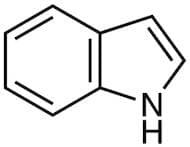
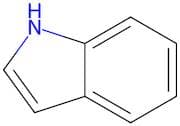
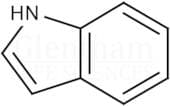
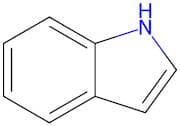
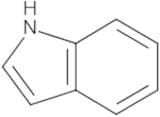
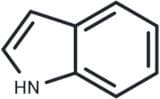
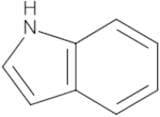
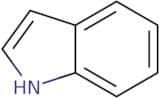
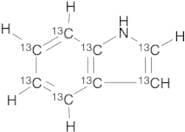
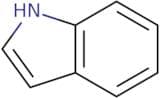
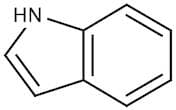
índole es un compuesto orgánico heterocíclico aromático caracterizado por una estructura bicíclica que consiste en un anillo de benceno de seis miembros fusionado con un anillo de pirrol de cinco miembros que contiene nitrógeno. Su fórmula molecular es C8H7N, y es conocido por su distintivo y agradable olor que recuerda al jazmín. índole es un sólido incoloro a amarillo pálido a temperatura ambiente, con un punto de fusión que varía según la pureza. Es soluble en disolventes orgánicos como el etanol y el éter, pero tiene una solubilidad limitada en agua. índole es un bloque de construcción clave en la síntesis de varios fármacos, agroquímicos y productos naturales, incluyendo el aminoácido triptófano, que es un precursor de la serotonina. Además, índole exhibe interesantes actividades biológicas, incluyendo propiedades antimicrobianas y anticancerígenas. Su reactividad está influenciada por el átomo de nitrógeno, lo que le permite participar en varias reacciones químicas, como la sustitución electrofílica y las reacciones de condensación. En general, índole es significativo tanto en la química sintética como en la natural, contribuyendo a una amplia gama de procesos químicos y biológicos.
Fórmula:C8H7N
InChI:InChI=1S/C8H7N/c1-2-4-8-7(3-1)5-6-9-8/h1-6,9H
Clave InChI:InChIKey=SIKJAQJRHWYJAI-UHFFFAOYSA-N
SMILES:C1=2C(NC=C1)=CC=CC2
Sinónimos:- 1-Azaindene
- 1-Benzazole
- 1H-Indole
- 2,3-Benzopyrrole
- Benzo[b]pyrrole
- Indol
- Indole, (1-Benzazole)
- Ketole
- Nsc 1964
- Indole
Ordenar por
Pureza (%)
0
100
|
0
|
50
|
90
|
95
|
100
Encontrado 15 productos.
Indole
CAS:Fórmula:C8H7NPureza:>99.0%(GC)Forma y color:White to Almost white powder to crystalPeso molecular:117.15Indole, 99%
CAS:Indole is used in the preparation of gramine, which is obtained by Mannich reaction dimethylamine and formaldehyde. It is used as a starting material for the preparation of oxindole and indole-3-carboxaldehyde. In Diels-Alder reaction, it acts as dienophile and reacts with 2-aminofuran to get strychFórmula:C8H7NPureza:99%Forma y color:Crystals or powder or crystalline powder or flakes, White to pale creamPeso molecular:117.15Indole
CAS:Acridine (10-azaanthracene) and indole (2,3-benzopyrrole)Fórmula:C8H7NForma y color:White Crystalline PowderPeso molecular:117.05785Indole
CAS:Fórmula:C8H7NPureza:(GC) ≥ 99.0%Forma y color:White to beige powder or crystalsPeso molecular:117.151H-Indole
CAS:1H-IndoleFórmula:C8H7NPureza:98%Forma y color: faint red/orange crystalline solidPeso molecular:117.14788g/molIndole
CAS:Indole: aromatic compound with a fused benzene and pyrrole structure, byproduct of tryptophan, found in feces, smells flowery at low concentrations.Fórmula:C8H7NPureza:99.86%Forma y color:Solid Solid CrystallinePeso molecular:117.15Indole
CAS:Producto controladoApplications Indole can be used in perfumes and in the synthesis of tryptophan. This compound is a contaminant of emerging concern (CECs).
Not a dangerous good if item is equal to or less than 1g/ml and there is less than 100g/ml in the packageFórmula:C8H7NForma y color:NeatPeso molecular:117.15Indole
CAS:Indole is a nitrogen-containing heterocyclic aromatic organic compound. Copper chloride in the presence of trifluoroacetic acid and indole gives rise to an indolenine derivative, which reacts with nitrogen atoms to form a copper nitride. This reaction is used as a model system for biological properties of indole. Indolenine has been shown to have bone cancer prevention and treatment effects in mice, and may also be beneficial in autoimmune diseases and metabolic disorders, due to its ability to inhibit toll-like receptor signaling pathways. The wild-type strain has shown resistance to antibiotics, which can be overcome by using mutant strains that are resistant to antibiotic treatments.Fórmula:C8H7NPureza:Min. 95 Area-%Forma y color:Off-White PowderPeso molecular:117.15 g/molIndole
CAS:Indole is a heterocyclic aromatic organic compound. It is a colorless solid that has a strong, unpleasant odor. Indole is classified as a nitrogenous base and is found in many natural products such as the amino acid tryptophan and the alkaloid caffeine. Indole can also be used as a building block for complex molecules, such as pharmaceuticals, herbicides, and pesticides. Indole is soluble in water, but insoluble in most organic solvents. It can be used to synthesize other compounds through reactions with other chemicals or by heating it with different reagents.Fórmula:C8H7NPureza:Min. 98 Area-%Peso molecular:117.15 g/molIndole crystalline extrapure AR, 99%
CAS:Fórmula:C8H7NPureza:min. 99%Forma y color:White ( turns pink on storage), Crystalline powder, Clear, ColourlessPeso molecular:117.15