CAS 120066-38-8
:factor liberador de corticotropina *fragmento 6-33
Descripción:
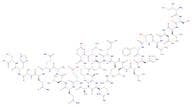
El fragmento 6-33 del factor liberador de corticotropina (CRF) es un péptido derivado de la hormona liberadora de corticotropina más grande, que desempeña un papel crucial en la respuesta del cuerpo al estrés. Este fragmento específico consiste en los aminoácidos 6 a 33 de la CRF de longitud completa y es conocido por su participación en la modulación del eje hipotálamo-hipófiso-adrenal (HPA). El número CAS 120066-38-8 identifica este péptido en bases de datos químicas. Característicamente, el fragmento CRF 6-33 exhibe actividad biológica relacionada con la respuesta al estrés, influyendo en la liberación de la hormona adrenocorticotrópica (ACTH) de la glándula pituitaria. Se sintetiza típicamente a través de la síntesis de péptidos en fase sólida y puede ser utilizado en investigaciones para estudiar trastornos relacionados con el estrés, funciones neuroendocrinas y aplicaciones terapéuticas potenciales. El péptido es generalmente soluble en soluciones acuosas y puede exhibir afinidades de unión específicas a los receptores de CRF, contribuyendo a sus efectos fisiológicos. En general, el fragmento CRF 6-33 sirve como una herramienta importante en la investigación neurobiológica y endocrinológica.
Fórmula:C141H231N41O43S
Sinónimos:- CRF (6-33) (human, rat)
- H-Ile-Ser-Leu-Asp-Leu-Thr-Phe-His-Leu-Leu-Arg-Glu-Val-Leu-Glu-Met-Ala-Arg-Ala-Glu-Gln-Leu-Ala-Gln-Gln-Ala-His-Ser-OH
- CORTICOTROPIN RELEASING FACTOR FRAGMENT 6-33, HUMAN, RAT
- CRF (6-33)
- 6-33-Corticotropin-releasing factor (human) (9CI)
- CRF (6-33) (human, rat) H-Ile-Ser-Leu-Asp-Leu-Thr-Phe-His-Leu-Leu-Arg-Glu-Val-Leu-Glu-Met-Ala-Arg-Ala-Glu-Gln-Leu-Ala-Gln-Gln-Ala-His-Ser-OH
- CORTICOTROPIN RELEASING FACTOR FRAGMENT 6-33, HUMA
- CRF(6-33)(human)
- ILE-SER-LEU-ASP-LEU-THR-PHE-HIS-LEU-LEU-ARG-GLU-VAL-LEU-GLU-MET-ALA-ARG-ALA-GLU-GLN-LEU-ALA-GLN-GLN-ALA-HIS-SER
- CORTICOTROPIN-RELEASING FACTOR (6-33) (HUMAN, RAT)
- Corticotropin Releasing Factor Fragment 6-33 human, rat >=97% (HPLC)
Ordenar por
Pureza (%)
0
100
|
0
|
50
|
90
|
95
|
100
Encontrado 4 productos.
CRF (6-33) (human, rat)
CAS:This CRF fragment may have two different beneficial effects in Alzheimer’s disease (AD). First CRF (6-33) dissociates CRF from the CRF-binding protein and may therefore be able to restore the dramatic reduction of free CRF content in AD. Second this fragment shows cognition-enhancing properties in animal models of learning and memory, without the characteristic anxiogenic effects of CRF receptor agonists, and may therefore be useful in the treatment of memory deficits seen in AD.Fórmula:C141H231N41O43SPureza:96.8%Forma y color:WhitePeso molecular:3220.7CRF(6-33)(human)
CAS:CRFBP inhibitor peptide; blocks CRF, reduces weight gain, boosts activity in obese rats.Fórmula:C141H231N41O43SPureza:98%Forma y color:SolidPeso molecular:3220.68CRF (6-33) (human, rat)
CAS:CRF (6-33) is a neuropeptide that is found in the human cerebral cortex and rat liver. It has been shown to inhibit protein synthesis and sequenced by Edmond H. Fischer, who also discovered corticotropin-releasing factor (CRF). CRF (6-33) binds to its receptor CRFR1, which activates phospholipase C and generates inositol 1,4,5-triphosphate. This leads to the release of calcium from intracellular stores and the activation of protein kinase C. The release of calcium ions into the cytosol causes an increase in intracellular levels of cAMP, which activates a series of reactions responsible for the cellular effects of CRF. CRF (6-33) has been shown to be involved in depression by controlling neurotransmitter levels.br>Fórmula:C141H231N41O43SPureza:Min. 95%Peso molecular:3,220.66 g/mol