CAS 122965-43-9
:3,7-Bis(dimetilamino)fenotiazina-5-io, cloruro, hidrato (1:1:?)
Descripción:
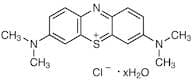
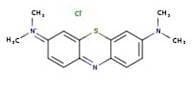
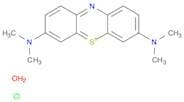
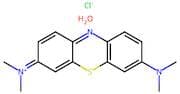
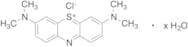
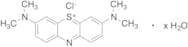
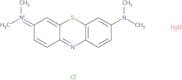
El 3,7-Bis(dimetilamino)fenotiazina-5-io, cloruro, hidratado es un compuesto químico caracterizado por su estructura compleja, que incluye un núcleo de fenotiazina sustituido con dos grupos dimetilamino en las posiciones 3 y 7. Este compuesto típicamente aparece como un sólido y es conocido por su color vibrante, a menudo asociado con su uso como colorante o en aplicaciones biológicas. La presencia del ion cloruro indica que es una sal, y la forma hidratada sugiere que contiene moléculas de agua en su estructura cristalina, lo que puede influir en su solubilidad y estabilidad. Los grupos dimetilamino contribuyen a su basicidad y potencial reactividad, lo que lo hace útil en varios contextos químicos y biológicos. Además, este compuesto puede exhibir propiedades fotofísicas interesantes, como la fluorescencia, que pueden ser explotadas en aplicaciones de imagen o detección. Sus aplicaciones y comportamiento específicos pueden variar según las condiciones y el entorno en el que se utilice.
Fórmula:C16H18N3S·Cl·xH2O
InChI:InChI=1S/C16H18N3S.ClH.H2O/c1-18(2)11-5-7-13-15(9-11)20-16-10-12(19(3)4)6-8-14(16)17-13;;/h5-10H,1-4H3;1H;1H2/q+1;;/p-1
Clave InChI:InChIKey=WQVSELLRAGBDLX-UHFFFAOYSA-M
SMILES:N(C)(C)C1=CC2=C(N=C3C(=[S+]2)C=C(N(C)C)C=C3)C=C1.[Cl-].O
Sinónimos:- 3,7-Bis(dimethylamino)phenothiazin-5-ium, chloride, hydrate (1:1:?)
- Basic Blue 9 hydrate
- N-[7-(dimethylamino)-3H-phenothiazin-3-ylidene]-N-methylmethanaminium chloride hydrate (1:1:3)
- Phenothiazin-5-ium, 3,7-bis(dimethylamino)-, chloride, hydrate
- Phenothiazin-5-ium, 3,7-bis(dimethylamino)-, chloride, hydrate (1:1:?)
Ordenar por
Pureza (%)
0
100
|
0
|
50
|
90
|
95
|
100
Encontrado 10 productos.
Methylene Blue Hydrate
CAS:Fórmula:C16H18ClN3S·xH2OPureza:>70.0%(W)Forma y color:Green to Dark green powder to crystalPeso molecular:319.85 (as Anhydrous)Methylene Blue, high purity, biological stain
CAS:Methylene blue is used as a dye in different staining procedures viz. Wright's stain and Jenner's stain. It also serves as an indicator and medicine. Further, it is used to examine RNA and DNA under the microscope or in a gel. It is widely used as a redox indicator in analytical chemistry. It actsFórmula:C16H18ClN3SForma y color:Dark green, Crystals or powder or crystalline powderPeso molecular:319.85Methylene Blue
CAS:Basic dyes and preparations based thereonFórmula:C16H18ClN3S·xH2OForma y color:Blue Dark Green CrystalsPeso molecular:319.85 g/molMethylene Blue hydrate (C.I. 52015)
CAS:Fórmula:C16H18ClN3S·xH2OPureza:≥ 98.0% (dried basis)Forma y color:Dark green crystalline powderPeso molecular:319.85 (anhy.)Methylene Blue Hydrate (>90%)
CAS:Producto controladoApplications Methylene Blue Trihydrate is a competitive inhibitor of glutathione reductase used in combination with antimalarial drugs. Dyes and metabolites.
References Gut, F. et al.: Eur. J. Pharm. Biopharm., 69, 582 (2008); Delves, M. et al.: PLoS, Med., 10, e1001169 (2012);Fórmula:C16H18ClN3SxH2OPureza:>90%Forma y color:Dark GreenPeso molecular:319.85Methylene Blue hydrate
CAS:Methylene Blue Hydrate is a dye that is used in wastewater treatment and as an analytical chemical. It has a high affinity for water, which it can bind to with great strength. Methylene Blue Hydrate is also used as a sealant in construction and as a kinetic indicator in analytical chemistry. The equilibrium constants of the Langmuir adsorption isotherm for Methylene Blue Hydrate are high, meaning that it binds tightly to water vapor. This means that Methylene Blue Hydrate will not be released into the atmosphere as quickly as other substances. Methylene Blue Hydrate has been shown to have antimicrobial properties against model organisms such as Escherichia coli and Staphylococcus aureus, making it useful for controlling microorganisms in vivo models or laboratory cultures. Methylene blue hydrate can be applied in vivo models by injecting the substance into the bloodstream or directly into the infected area, where it will act against microorganisms onFórmula:C16H18ClN3S·xH2OPureza:Min. 95%Peso molecular:319.85 g/mol