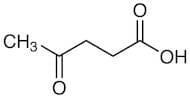
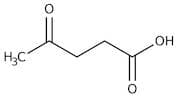
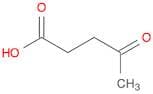
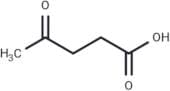
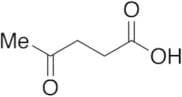
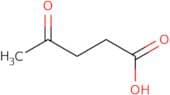
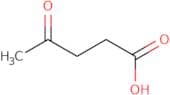
CAS 123-76-2
:Ácido levulínico
- 3-Acetylpropanoic acid
- 3-Acetylpropionic acid
- 3-Oxobutanecarboxylic acid
- 4-Ketovaleric acid
- 4-Oxopentanoic acid
- 4-Oxovaleriansaure
- 4-Oxovaleric Acid
- Acide 4-oxovalerique
- Acido 4-Oxovalerico
- Laevulinic acid
- Laevulinsaeure
- Lev-OH
- Levulic acid
- Levulinic acid
- Nsc 3716
- β-Acetylpropionic acid
- γ-Ketovaleric acid
- laevulic acid
- calcium bis(4-oxopentanoate)
- Pentanoic acid, 4-oxo-
- 4-Ketopentanoic acid
- sodium 4-oxopentanoate
- Levulinic acid,(4-Ketopentanoic acid
- 2-methyl-3-oxobutanoic acid
- Ver más sinónimos
Levulinic Acid
CAS:Fórmula:C5H8O3Pureza:>97.0%(GC)(T)Forma y color:White or Colorless to Light yellow powder to lump to clear liquidPeso molecular:116.12Levulinic acid, 98%
CAS:Mainly used as an intermediate for medicines, agricultural chemical and organic synthesis. Used as raw material of perfume, modifier and solvent of plastics. It is also employed as an additive of polymer, paints and lubricating oil. Also used as a surfactant and auxiliary for making printing ink, rFórmula:C5H8O3Pureza:98%Forma y color:Clear colorless to pale yellow, LiquidPeso molecular:116.12Levulinic acid
CAS:Levulinic acid (4-Oxovaleric acid), derived from the degradation of cellulose, is a precursor for the synthesis of biofuels, such as ethyl levulinate.Fórmula:C5H8O3Pureza:99.76%Forma y color:Liquid PelletslargecrystalsPeso molecular:116.12Levulinic Acid
CAS:Producto controladoApplications Levulinic Acid is derived from the degredation of cellulose and is a potential precursor to biofuels. Levulinic acid is also a photosensitizer for photodynamic therapy.
References Serrano-Ruiz, J.C., et al.: Catalysis., 195, 162 (2012); Liedtke, A.J. et al.: Tetrahedron., 68, 10049 (2012);Fórmula:C5H8O3Forma y color:Light Yellow MeltedPeso molecular:116.12Levulinic acid
CAS:Levulinic acid is an organic compound, which is derived from the acid hydrolysis of biomass, such as lignocellulosic materials. Its chemical structure makes it a pivotal platform chemical with potential for diverse transformations. Levulinic acid functions as a building block for various chemical synthesis processes, facilitating the production of numerous derivatives including pharmaceuticals, agrochemicals, plasticizers, and biofuels.Fórmula:C5H8O3Pureza:Min. 97.0 Area-%Peso molecular:116.12 g/molLevulinic acid
CAS:Levulinic acid is a dicarboxylic acid that is resistant to the formation of the levulinate ester. In vitro, it has been shown to have a synergistic effect with other antibiotics such as erythromycin and cefazolin against bacteria in experimental models. The mechanism of this synergistic effect is not known, but may be due to inhibition of bacterial cell wall synthesis. Levulinic acid can also be used as an injection solution or magnesium salt for surface methodology experiments. The rate of reaction with magnesium is slow, and the reactivity is similar to that of levulinate. Kinetic studies have shown that the rate-determining step in the reaction between levulinic acid and magnesium chloride is the binding of MgCl2 to LHA (levulinic acid). This binding also reacts slowly with water and formaldehyde.
Fórmula:C5H8O3Pureza:Min. 95%Forma y color:PowderPeso molecular:116.12 g/mol4-Oxopentanoic acid
CAS:Fórmula:C5H8O3Pureza:97%Forma y color:Solid, Low Melting SolidPeso molecular:116.116Levulinic Acid
CAS:Carboxylic acids with aldehyde or ketone function but without other oxygen function, their anhydrides, halides, peroxides, peroxyacids andtheir derivFórmula:C5H8O3Peso molecular:116.04734