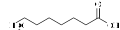
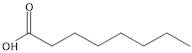
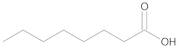
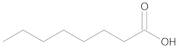
CAS 124-07-2
:Ácido octanoico
Descripción:
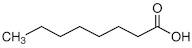
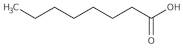
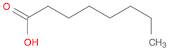
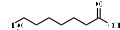
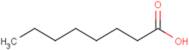
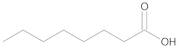
Ácido octanoico, también conocido como ácido caprílico, es un ácido graso saturado con la fórmula molecular C8H16O2. Se caracteriza por su cadena de ocho carbonos, que contribuye a su naturaleza hidrofóbica. Ácido octanoico es un líquido oleoso e incoloro a temperatura ambiente y tiene un olor distintivo y rancio. Es soluble en disolventes orgánicos, pero solo ligeramente soluble en agua debido a sus propiedades hidrofóbicas. Este ácido graso se encuentra comúnmente en el aceite de coco y el aceite de palmiste y se utiliza en diversas aplicaciones, incluyendo saborización de alimentos, cosméticos y productos farmacéuticos. Ácido octanoico también es conocido por sus propiedades antimicrobianas y a veces se utiliza en el tratamiento de ciertos trastornos gastrointestinales. Además, juega un papel en la producción de ésteres para su uso en fragancias y como tensioactivo en varios procesos industriales. Su número CAS, 124-07-2, es un identificador único que ayuda en la clasificación y regulación de esta sustancia química.
Fórmula:C8H16O2
InChI:InChI=1S/C8H16O2/c1-2-3-4-5-6-7-8(9)10/h2-7H2,1H3,(H,9,10)
Clave InChI:InChIKey=WWZKQHOCKIZLMA-UHFFFAOYSA-N
SMILES:C(CCCCC)CC(O)=O
Sinónimos:- 1-Heptanecarboxylic acid
- Acide octanoique
- Acido Octanoico
- Caprylic
- Caprylic Acid Free Acid
- Caprylic acid
- Caprylic-Acid, Natural (C8)
- Caprylsaeure
- Capylic Acid
- Cg 100
- Cg 100 (fatty acid)
- Edenor 8-99MY
- Edenor C 8-98-100
- Edenor C 8-99MY
- Emery 657
- Kortacid 0899
- Lunac 8-95
- Lunac 8-98
- Mcfa 8S
- N-Octanoic acid
- Naa 82
- Neo-Fat 8
- Neo-Fat 8S
- Nsc 5024
- Octanoic Acid (1.00193)
- Octanoic Acid (C8)
- Octansaure
- Octylic acid
- Prifac 2901
- Tin(2+) Dioctanoate
- n-CAPRYLIC ACID
- n-Octoic acid
- n-Octylic acid
- N-capylic acid
- Octanoic acid
- acidecaprylique
- 1-heptanecarboxylicacid
- C8
- OCTIC ACID
- RARECHEM AL BO 0185
- OCTOIC ACID
- C8 ACID
- FEMA 2799
- CARBOXYLIC ACID C8
- 1-octanoic acid
- acideoctanoique
- Ver más sinónimos
Ordenar por
Pureza (%)
0
100
|
0
|
50
|
90
|
95
|
100
n-Octanoic Acid
CAS:Fórmula:C8H16O2Pureza:>98.0%(GC)(T)Forma y color:White or Colorless to Light yellow powder to lump to clear liquidPeso molecular:144.21Octanoic acid, 98+%
CAS:Octanoic acid is used in the production of esters, which finds application in perfumery and also dyes manufacture. It is used as a food contact surface sanitizer in commercial food handling, as a dietary supplement and as disinfectant in health care facilities, recreational facilities, livestock preFórmula:C8H16O2Pureza:98+%Forma y color:Clear colorless to pale yellow, LiquidPeso molecular:144.21Caprylic Acid
CAS:Saturated acyclic monocarboxylic acids and their anhydrides, halides, peroxides etc, nesoiFórmula:C8H16O2Forma y color:Colorless Clear Pale Yellow LiquidPeso molecular:144.11503Ref: IN-DA000LCW
25g20,00€100g24,00€500g28,00€1000g34,00€1kg38,00€10kg167,00€25kg306,00€50kg621,00€100kg773,00€Octanoic acid
CAS:Fórmula:CH3(CH2)6CO2HPureza:≥ 98.0%Forma y color:Colourless to light-yellow liquidPeso molecular:144.21Octanoic-8,8,8-d3 Acid
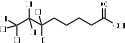
CAS:Fórmula:CD3(CH2)6COOHPureza:99 atom % DForma y color:Colorless LiquidPeso molecular:147.13386Octanoic-7,7,8,8,8-d5 Acid(OctanoicAcid-c)
CAS:Fórmula:CD3CD2(CH2)5COOHPureza:99 atom % DPeso molecular:149.14641Octanoic-2,2-d2 Acid
CAS:Fórmula:CH3(CH2)5CD2COOHPureza:98 atom % DForma y color:Colorless LiquidPeso molecular:146.12758Octanoic acid
CAS:Octanoic acidFórmula:C8H16O2Pureza:95%Forma y color:Liquid-ViscousPeso molecular:144.21143Octanoic acid
CAS:Octanoic acid (Caprylic acid) is found naturally in coconuts and breast milk. Caprylic acid is used in the production of esters used in perfumery.Fórmula:C8H16O2Pureza:97.43% - 99.90%Forma y color:SolidPeso molecular:144.21Octanoic Acid
CAS:Applications Octanoic Acid, is found naturally in the milk of various mammals. Its esters can be used in perfumery and also in the manufacture of dyes. It is also an antimicrobial pesticide used as a food contact surface sanitizer. Caprylic acid is also used in the treatment of some bacterial infections.
Not a dangerous good if item is equal to or less than 1g/ml and there is less than 100g/ml in the package
References Lide, D. R., et al.: CRC Handbook chem. Phys., 70th Ed. (1990); Beare-Rogers, J., et al.: Pue Appl. Chem., 73 (4), 685 (2001);Fórmula:C8H16O2Forma y color:NeatPeso molecular:144.21