CAS 12676-15-2
:Angiotensina IV
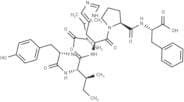
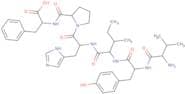
- (2S)-2-[[(2S)-1-[(2S)-2-[[(2S,3S)-2-[[(2S)-2-[[(2S)-2-amino-3-methylbutanoyl]amino]-3-(4-hydroxyphenyl)propanoyl]amino]-3-methylpentanoyl]amino]-3-(3H-imidazol-4-yl)propanoyl]pyrrolidine-2-carbonyl]amino]-3-phenylpropanoic acid
- angiotensin III, 1-desarginine-
- Ang IV, Angiotensin II (3-8)
- Angiotensin IV trifluoroacetate salt
Angiotensin II (3-8), human
CAS:Angiotensin II (3-8), human is a less effective agonist at the angiotensin AT1 receptor.Forma y color:SolidAngiotensin IV Trifluoroacetate
CAS:Angiotensin-IV is primarily produced from angiotensin-III by the removal of an arginine residue from the N-terminal by membrane alanyl aminopeptidase N (AP-N). Ang-IV can however also be formed by the action of aminopeptidases on Ang-I directly.Ang-IV has been shown to enhance cognitive functions, although how it does this in still unclear. It has been suggested that Ang-IV is able to inhibit the insulin-regulated aminopeptidase (IRAP) receptor in the brain (originally defined as the AT(4) receptor). IRAP is a single-spanning transmembrane zinc-metallopeptidase that belongs to the M1 family of aminopeptidases and its substrates include vasopressin, somatostatin, and cholecystokinin. The half-life of these compounds are prolonged when IRAP is inhibited by Ang-IV, and this may result in the enhanced cognitive abilities seen with Ang-IV treatment. c-Met, a tyrosine kinase receptor that binds hepatocyte growth factor (HGF) has also been proposed as an Ang IV targets. c-Met is associated with memory and learning consolidation.
Peso molecular:774.4 g/molAngiotensin IV trifluoroacetate
CAS:Angiotensin IV trifluoroacetate is an active analogue of angiotensin. It has been shown to have a high affinity for AT1 receptors and is able to enhance the uptake of angiotensin in proximal tubules, which may be due to its ability to bind DNA. Angiotensin IV trifluoroacetate has also been shown to have beneficial effects on skin cells, such as the reduction of skin inflammation and alleviation of pain. Angiotensin IV trifluoroacetate has shown anti-inflammatory activities, which may be due to its ability to reduce pro-inflammatory cytokines such as IL-6 and TNF-α. This drug also binds to the CD4 receptor, thereby inhibiting inflammatory responses in autoimmune diseases.Mass spectrometry of peptides and proteins using digestion by a grape cysteine protease at pH 3Z Perutka, M Ã Â ebela - Journal of mass spectrometry, 2020 - Wiley Online Libraryhttps://analyticalsciencejournals.onlinelibrary.wiley.com/doi/abs/10.1002/jms.4444Integrating computational modeling and experimental assay to discover new potent ACE-inhibitory peptidesY Ren, Q Wang, S Chen, H Cao - Molecular Informatics, 2014 - Wiley Online Libraryhttps://onlinelibrary.wiley.com/doi/abs/10.1002/minf.201300131Absorption of casein antihypertensive peptides through an in vitro model of intestinal epitheliumM del Mar Contreras , AI Sancho , I Recio, C Mills - Food Digestion, 2012 - Springerhttps://link.springer.com/article/10.1007/s13228-012-0020-2Enhanced recombinant expression and purification of human IRAP for biochemical and crystallography studiesL Sui , HC Guo - Biochemistry and Biophysics Reports, 2021 - Elsevierhttps://www.sciencedirect.com/science/article/pii/S2405580821001369The specific isolation of C-terminal peptides of proteins through a transamination reaction and its advantage for introducing functional groups into the peptideK Sonomura, H Kuyama , E Matsuo - Journal Devoted to , 2009 - Wiley Online Libraryhttps://analyticalsciencejournals.onlinelibrary.wiley.com/doi/abs/10.1002/rcm.3920Fragmentation mechanisms of oxidized peptides elucidated by SID, RRKM modeling, and molecular dynamicsJM Spraggins , JA Lloyd, MV Johnston , J Laskin - Journal of the American , 2009 - Springerhttps://link.springer.com/article/10.1016/j.jasms.2009.04.012Gold ion-angiotensin peptide interaction by mass spectrometryJ Lee, LP Jayathilaka, S Gupta - Journal of the , 2012 - ACS Publicationshttps://pubs.acs.org/doi/abs/10.1007/s13361-011-0328-0Structure-activity study of LVV-hemorphin-7: angiotensin AT4 receptor ligand and inhibitor of insulin-regulated aminopeptidaseJ Lee , T Mustafa, SG McDowall - of Pharmacology and , 2003 - ASPEThttps://jpet.aspetjournals.org/content/305/1/205.shortA mechanistic investigation of the enhanced cleavage at histidine in the gas-phase dissociation of protonated peptidesG Tsaprailis, H Nair, W Zhong , K Kuppannan - Analytical , 2004 - ACS Publicationshttps://pubs.acs.org/doi/abs/10.1021/ac034971jStudy of secondary specificity of enteropeptidase in comparison with trypsinAG Mikhailova, VV Likhareva, BV Vaskovsky - Biochemistry , 2004 - Springerhttps://link.springer.com/article/10.1023/B:BIRY.0000040224.47278.3bFórmula:C40H54N8O8•(C2HF3O2)xPureza:Min. 95%Peso molecular:774.9 g/mol