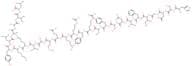
CAS 127317-03-7
:polipéptido activador de la adenilato ciclasa pituitaria
Descripción:
El polipéptido activador de la adenilato ciclasa de la hipófisis (PACAP) es un neuropeptido que desempeña un papel crucial en varios procesos fisiológicos, incluyendo la neuroprotección, la neurotransmisión y la secreción hormonal. Se caracteriza por su capacidad para activar la adenilato ciclasa, lo que lleva a niveles aumentados de AMP cíclico (cAMP) en las células objetivo. PACAP es conocido por sus diversas funciones biológicas, incluyendo la modulación de los ritmos circadianos, la regulación de las respuestas al estrés y la participación en funciones reproductivas. El péptido exhibe alta afinidad por receptores específicos, a saber, los receptores de PACAP (PAC1, VPAC1 y VPAC2), que median sus efectos en diferentes tejidos. Además, PACAP está implicado en diversas condiciones patofisiológicas, incluyendo enfermedades neurodegenerativas y trastornos metabólicos. Su estructura consiste en una secuencia de aminoácidos que contribuyen a su estabilidad y actividad, y a menudo se estudia por sus posibles aplicaciones terapéuticas en neurología y endocrinología. En general, PACAP es una molécula significativa tanto en la investigación básica como clínica, destacando su importancia en la comprensión de sistemas biológicos complejos.
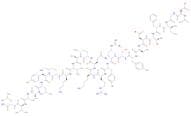
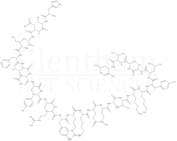
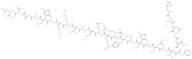
Fórmula:C142H224N40O39S
Sinónimos:- Pituitary Adenylate Cyclase Activating Polypeptide (1-27) amide (human, ovine, rat)
- H-His-Ser-Asp-Gly-Ile-Phe-Thr-Asp-Ser-Tyr-Ser-Arg-Tyr-Arg-Lys-Gln-Met-Ala-Val-Lys-Lys-Tyr-Leu-Ala-Ala-Val-Leu-NH2
- PACAP 27 Amide, Ovine
Ordenar por
Pureza (%)
0
100
|
0
|
50
|
90
|
95
|
100
Encontrado 9 productos.
PACAP (1-27), Human, Ovine, Rat
CAS:For cellular and molecular biology applications
Fórmula:C142H224N40O39SPeso molecular:3147.64PACAP-27 (human, mouse, ovine, porcine, rat)
CAS:PACAP-38 and its N-terminal fragment PACAP-27 are neuropeptides originally isolated from ovine hypothalamus, but also found in humans and rats. Both PACAP-27, which shows considerable homology with vasoactive intestinal polypeptide (VIP), and PACAP-38 stimulate adenylate cyclase much more potently than VIP. Specific PACAP receptors have been identified in different tissues and cell lines.Kojro et al. observed that the PAC1 agonists PACAP-27 and PACAP-38 strongly increased the activity of α-secretase, thus promoting the non-amyloidogenic processing of amyloid precursor protein.Fórmula:C142H224N40O39SPureza:≥ 97%Forma y color:WhitePeso molecular:3147.65H-HIS-SER-ASP-GLY-ILE-PHE-THR-ASP-SER-TYR-SER-ARG-TYR-ARG-LYS-GLN-MET-ALA-VAL-LYS-LYS-TYR-LEU-ALA-ALA-VAL-LEU-NH2
CAS:Fórmula:C142H224N40O39SPureza:95%Peso molecular:3147.6076Pituitary adenylate cyclase activating polypeptide-27 ovine
CAS:Fórmula:C142H224N40O39SPeso molecular:3147.64PACAP (1-27), human, ovine, rat
CAS:PACAP (1-27) (the N-terminal fragment of PACAP-38) is a novel neuropeptides originally isolated from bovine hypothalamus, also found in humans and rats.Fórmula:C142H224N40O39SPureza:98%Forma y color:SolidPeso molecular:3147.66PACAP-27 (human, mouse, ovine, porcine, rat)
CAS:PACAP 1-27 (Pituitary adenylate cyclase-activating polypeptide 27) is a potent stimulator of adenylyl cyclase and increases cAMP levels.Fórmula:C142H224N40O39SPeso molecular:3,147.65 g/molPACAP-27 (human, mouse, ovine, porcine, rat)
CAS:Custom research peptide; min purity 95%.
Fórmula:C142H224N40O39SPureza:Min. 95%Peso molecular:3,147.68 g/molPACAP27 (Human, 1-27 Amide)
CAS:PACAP27 is a peptide that is used as a research tool. PACAP27 binds to the receptor for pituitary adenylate cyclase-activating polypeptide (PACAP). The binding of PACAP27 to the receptor leads to activation of adenylyl cyclase, which increases intracellular levels of cAMP. This increase in cAMP may lead to cellular responses such as increased ion channel activity and increased protein synthesis.Fórmula:C142H224N40O39SPureza:Min. 95%Peso molecular:3,147.6 g/molPACAP-27 (human, mouse, ovine, porcine, rat) trifluoroacetate salt
CAS:Trifluoroacetate saltFórmula:C142H224N40O39SPureza:Min. 95%Peso molecular:3,147.61 g/mol