CAS 13073-35-3
:L-Homocisteína, S-etil-
Descripción:
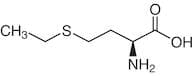
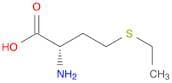
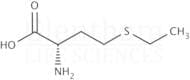
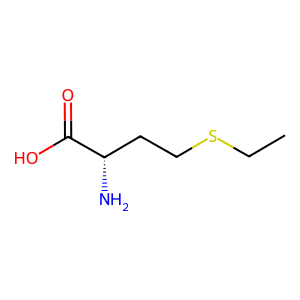
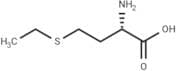
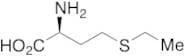
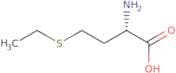
L-Homocisteína, S-etil- es un derivado de aminoácido que contiene azufre y juega un papel en varios procesos bioquímicos, particularmente en el metabolismo de la homocisteína, un aminoácido importante en el cuerpo. Este compuesto se caracteriza por la presencia de un grupo etilo unido al átomo de azufre de la homocisteína, lo que puede influir en su reactividad y actividad biológica. L-Homocisteína, S-etil- es típicamente un sólido blanco a blanco sucio y es soluble en agua, lo que lo hace accesible para diversas aplicaciones en investigación bioquímica y contextos terapéuticos potenciales. Su estructura incluye un grupo amino, un grupo carboxilo y un grupo tiol, que son características comunes de los aminoácidos. El compuesto es de interés en estudios relacionados con la salud cardiovascular, ya que niveles elevados de homocisteína están asociados con un mayor riesgo de enfermedades cardiovasculares. Además, puede servir como precursor en la síntesis de otros compuestos biológicamente relevantes. Al igual que muchos derivados de aminoácidos, su estabilidad y reactividad pueden verse influenciadas por factores ambientales como el pH y la temperatura.
Fórmula:C6H13NO2S
InChI:InChI=1/C6H13NO2S/c1-2-10-4-3-5(7)6(8)9/h5H,2-4,7H2,1H3,(H,8,9)/t5-/m0/s1
Clave InChI:InChIKey=GGLZPLKKBSSKCX-YFKPBYRVSA-N
SMILES:[C@H](CCSCC)(C(O)=O)N
Sinónimos:- (2S)-2-Amino-4-(ethylsulfanyl)butanoic acid
- (2S)-2-Azaniumyl-4-ethylsulfanylbutanoate
- <span class="text-smallcaps">L</span>-Ethionine
- <span class="text-smallcaps">L</span>-Homocysteine, S-ethyl-
- Butanoic acid, 2-amino-4-(ethylthio)-, (S)-
- Butyric acid, 2-amino-4-(ethylthio)-, <span class="text-smallcaps">L</span>-
- Butyric acid, 2-amino-4-(ethylthio)-, L-
- ETH
- Ethionine
- L-Ethionine
- Nsc 82393
- S-Ethyl-<span class="text-smallcaps">L</span>-homocysteine
- S-Ethyl-L-homocystein
- S-Ethyl-L-homocysteine
- S-Ethylhomocysteine
- S-etil-L-homocisteina
- L-Homocysteine, S-ethyl-
- s-ethyl-homocystein
- alpha-amino-gamma-(ethylmercapto)butyricacid
- L-ETHIONINE 99%
- (S)-2-Amino-4-(ethylthio)butyric acid
- H-ETH-OH
- homocysteines-ethylether
- L-2-AMINO-4-(ETHYLTHIO)BUTYRIC ACID
- 2-amino-4-(ethylthio)-butanoicaci
- [S,(+)]-2-Amino-4-(ethylthio)butyric acid
- L-ETHIONINE 98+%
- Ver más sinónimos
Ordenar por
Pureza (%)
0
100
|
0
|
50
|
90
|
95
|
100
Encontrado 9 productos.
L-Ethionine
CAS:Fórmula:C6H13NO2SPureza:>98.0%(T)Forma y color:White to Almost white powder to crystalPeso molecular:163.24(S)-2-Amino-4-(Ethylthio)Butanoic Acid
CAS:(S)-2-Amino-4-(Ethylthio)Butanoic AcidPureza:98%Peso molecular:163.24g/molEthionine
CAS:Ethionine (NSC-82393) is an antimetabolite and methionine antagonist. It also produces liver neoplasms.Fórmula:C6H13NO2SPureza:99.28% - ≥95%Forma y color:Crystals White SolidPeso molecular:163.24L-Ethionine
CAS:Producto controladoApplications Ethionine-induced inhibition of protein synthesis and lowering of ATP level in the liver.
References Rotig, A., et al.: Lancet, 356, 391 (2000), Forsgren, M., et al.: Biochem. J., 382, 519 (2004), Johnson, A., et al.: J. Biol. Chem., 280, 31397 (2005), Horvath, R., et al.: Neurology, 66, 253 (2006), Mollet, M., et al.: J. Clin. Invest., 117, 765 (2007),Fórmula:C6H13NO2SForma y color:NeatPeso molecular:163.24L-Ethionine
CAS:L-Ethionine is an amino acid that can be synthesized by the body through the transsulfuration pathway. It has been shown to inhibit the growth of Aeromonas hydrophilia, a bacterium that is resistant to many antibiotics. L-Ethionine has also been shown to have effects on DNA replication and repair, protein synthesis, cell lysis, and energy metabolism in vitro. In vivo studies have demonstrated its efficacy against Methicillin-resistant Staphylococcus aureus (MRSA). L-Ethionine may be used as a potential therapeutic agent for MRSA infections.Fórmula:C6H13NO2SPureza:Min. 95%Forma y color:White PowderPeso molecular:163.24 g/mol