CAS 1314-32-5
:Óxido de talio (Tl2O3)
Descripción:
Óxido de talio (Tl2O3) es un compuesto inorgánico caracterizado por su formación a partir de talio y oxígeno. Típicamente aparece como un sólido amarillento a marrón y es conocido por su alto punto de fusión. El óxido de talio es un semiconductor y exhibe propiedades eléctricas interesantes, lo que lo hace relevante en diversas aplicaciones, incluyendo electrónica y óptica. El compuesto se encuentra principalmente en dos estados de oxidación, siendo Tl2O3 el que representa al talio en el estado de oxidación +3. Es relativamente estable en aire, pero puede reaccionar con ácidos para formar sales de talio. El óxido de talio también es notable por su toxicidad, lo que requiere un manejo y disposición cuidadosos debido a los posibles riesgos para la salud asociados con la exposición al talio. En términos de solubilidad, es poco soluble en agua, pero puede disolverse en ácidos fuertes. Sus propiedades únicas y aplicaciones potenciales en ciencia de materiales y electrónica continúan siendo objeto de investigación, aunque las precauciones de seguridad son primordiales debido a su naturaleza tóxica.
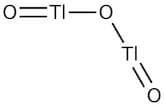
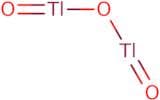
Fórmula:O3Tl2
InChI:InChI=1/3O.2Tl/rO3Tl2/c1-4-3-5-2
Sinónimos:- Dithallium Trioxide
- Dithalliumtrioxid
- Thallic oxide
- Thallium oxide
- Thallium oxide (2:3)
- Thallium oxide (Tl<sub>2</sub>O<sub>3</sub>)
- Thallium sesquioxide
- Thallium trioxide
- Thallium(3+) oxide
- Thallium(III) oxide
- Trioxido De Ditalio
- Trioxyde de dithallium
- Thalliumoxide
- Thallium oxide (Tl2O3)
- Thallium (III) oxide (99.5%-Tl)
- Thalliumoxideblackpowder
- oxo-oxothallanyloxy-thallane
- Ver más sinónimos
Ordenar por
Pureza (%)
0
100
|
0
|
50
|
90
|
95
|
100
Encontrado 5 productos.
Thallium(III) oxide, 96%
CAS:Thallium(III) oxide is used in organic synthesis and as an analytical reagent This Thermo Scientific Chemicals brand product was originally part of the Alfa Aesar product portfolio. Some documentation and label information may refer to the legacy brand. The original Alfa Aesar product / item code oFórmula:O3Tl2Pureza:96%Forma y color:Brown, Crystals or powder or crystalline powderPeso molecular:456.76Thallium(III) oxide (99.5%-Tl)
CAS:Thallium(III) oxide (99.5%-Tl)
Fórmula:Tl2O3Pureza:(99.5%-Tl)Forma y color:black pwdr.Peso molecular:456.74Thallium(III) oxide (99.99%-Tl) PURATREM
CAS:Thallium(III) oxide (99.99%-Tl) PURATREM
Fórmula:Tl2O3Pureza:(99.99%-Tl)Forma y color:black pwdr.Peso molecular:456.74Thallium (III) oxide
CAS:Thallium (III) oxide is a white powder that is insoluble in water and hydrochloric acid, soluble in nitric acid, and melts at 200 degrees Celsius. It has a density of 3.2 g/cm3 and thermal expansion coefficient of 5.5x10⁻⁶ K-1. Thallium (III) oxide has an irreversible oxidation reaction with hydrochloric acid to form thallous chloride and hydrogen gas. It also undergoes strong absorption of ultraviolet light at wavelengths below 300 nm, which makes it useful for the detection of hydrocarbons in petroleum products. Thallium (III) oxide can be used as a catalyst for acylation reactions and exhibits hydrogen bonding interactions with organic molecules.Fórmula:Tl2O3Pureza:Min. 95%Forma y color:Brown Clear LiquidPeso molecular:456.76 g/molThallium (III) oxide - 99.9%
CAS:Thallium oxide is a white solid that is used in the production of semiconductors, glass, and ceramics. The fluorescence spectrometry technique can be used to identify thallium compounds with high accuracy and sensitivity. Thallium oxide also has an acylation reaction with fatty acids. Thallium oxide can be easily oxidized by air to form a stable oxide, which has been shown to have a thermal expansion coefficient similar to zirconia. This chemical also has properties that are very similar to those of iron oxides, such as irreversible oxidation and hydrogen bonding interactions.
Fórmula:O3Tl2Pureza:Min. 95%Peso molecular:456.76 g/molRef: 3D-FT138061
Producto descatalogado