CAS 1321-74-0
:Divinilbenceno
Descripción:
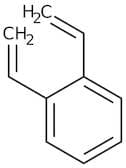
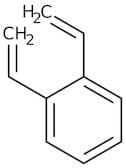
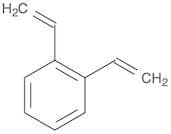
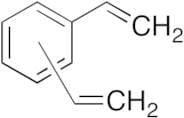
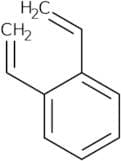
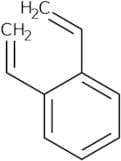
Divinilbenceno (DVB) es un compuesto orgánico caracterizado por su estructura, que contiene dos grupos vinilo unidos a un anillo de benceno. Es un líquido incoloro a amarillo pálido con un olor aromático distintivo. DVB es conocido por su alta reactividad debido a la presencia de los grupos vinilo, lo que lo convierte en un monómero valioso en la producción de polímeros y resinas reticuladas. Se utiliza comúnmente en la síntesis de resinas de intercambio iónico, así como en la fabricación de varios plásticos y recubrimientos. El compuesto es soluble en disolventes orgánicos pero tiene una solubilidad limitada en agua. DVB puede someterse a polimerización, lo que lleva a la formación de estructuras reticuladas que mejoran las propiedades mecánicas y térmicas de los materiales resultantes. Las consideraciones de seguridad son importantes al manipular DVB, ya que puede ser un irritante para la piel y los ojos, y se deben tomar las precauciones adecuadas para minimizar la exposición. En general, Divinilbenceno es un compuesto versátil con aplicaciones significativas en la industria química.
Fórmula:C10H10
InChI:InChI=1/2C10H10/c1-3-9-5-7-10(4-2)8-6-9;1-3-9-6-5-7-10(4-2)8-9/h2*3-8H,1-2H2
SMILES:C=Cc1ccc(C=C)cc1.C=Cc1cccc(C=C)c1
Sinónimos:- Benzene, Divinyl
- Benzene, diethenyl-
- Diethenylbenzene
- Divinilbenceno
- Divinilbenceno, Puro
- Divinilbenzene
- Divinylbenzen
- Divinylbenzene
- Divinylbenzene Mixed Isomers
- Divinylbenzene, Mixture Of Isomers
- Divinylbenzenetechmixedisomers
- Divinylbenzol
- Dvb 810
- Dvb 96
- Dvb 960
- Dvb Hp
- Dvb-H
- Dvr 960
- Ethylvinyl Benzene
- Vinilestireno
- Vinilstirene
- Vinyl styrène
- Vinyl-Styrol
- Vinylethylbenzene
- Vinylstyren
- Vinylstyrene
- ジビニルベンゼン
- Ver más sinónimos
Ordenar por
Pureza (%)
0
100
|
0
|
50
|
90
|
95
|
100
Encontrado 10 productos.
Divinylbenzene (m- and p- mixture) (contains Ethylvinylbenzene, Diethylbenzene) (stabilized with TBC)
CAS:Fórmula:C10H10Pureza:>50.0%(GC)Forma y color:Colorless to Light orange to Yellow clear liquidPeso molecular:130.19Divinylbenzene, 80%, mixture of isomers, stab. with 1000ppm 4-tert-butylcatechol
CAS:Divinylbenzene is used as a reactive monomer in polyester resins and for the synthesis of highly crosslinked macroporous styrene as well as a crosslinking agent. It acts as an intermediate in the production of ion exchange resin. Further, it is used in making rubber, petroleum production and polymerFórmula:C10H10Pureza:80%Forma y color:Colorless to yellow, LiquidPeso molecular:130.19Divinylbenzene, 55%, mixture of isomers, stab. with 1000ppm 4-tert-butylcatechol
CAS:Crosslinking monomerFórmula:C10H10Forma y color:LiquidPeso molecular:130.19Divinylbenzene (ortho-, meta-, or para- substituted) (~80%)
CAS:Producto controladoApplications Divinylbenzene;m-(or p-)Divinylbenzene (cas# 1321-74-0) is a useful research chemical.
Fórmula:C10H10Pureza:~80%Forma y color:ColourlessPeso molecular:130.19Divinylbenzene (m- and p- mixture) (contains Ethylvinylbenzene, Diethylbenzene) - 80%
CAS:Divinylbenzene is a glycol ester that undergoes a palladium-catalyzed coupling reaction with an alkyne to produce a model system. The resulting polymer has high values of optical sensor, kinetic data, and thermal expansion. Divinylbenzene's chemical stability and particle size make it an appropriate sample preparation for various types of analytical techniques such as optical sensor, which can measure the concentration of divinylbenzene in polymers. Divinylbenzene contains nitrogen atoms that can react with fatty acids to form liver lesions in rats.Fórmula:C10H10Pureza:Min. 80 Area-%Forma y color:Clear LiquidPeso molecular:130.19 g/molDivinylbenzene (m- and p- mixture) (contains Ethylvinylbenzene, Diethylbenzene) - 55%
CAS:Divinylbenzene is a glycol ether that is used as a solvent and an intermediate in the production of polyvinyl chloride. It has been shown to be harmful to the liver in animal studies, causing lesions. It also causes an increase in the levels of water vapor in the air and high values for thermal expansion. Divinylbenzene undergoes a reaction with phosphorus pentoxide, yielding polyvinyl chloride and hydrogen gas. The mechanism of this reaction is catalyzed by palladium.Fórmula:C10H10Pureza:Min. 55 Area-%Peso molecular:130.19 g/mol