CAS 133-13-1
:1,3-Dietil 2-etilpropanodioato
Descripción:
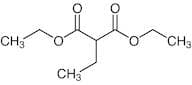
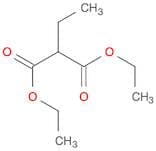
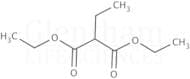
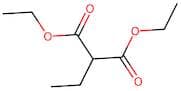
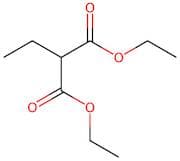
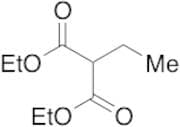
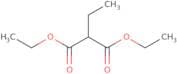
1,3-Dietil 2-etilpropanodioato, con el número CAS 133-13-1, es un compuesto orgánico que pertenece a la clase de diésteres. Presenta una estructura central de propanodioato con grupos etilo unidos a las posiciones 1 y 3, así como un grupo etilo adicional en la posición 2. Este compuesto es típicamente un líquido incoloro a amarillo pálido con un olor afrutado, indicativo de su naturaleza de éster. Es soluble en disolventes orgánicos, pero tiene una solubilidad limitada en agua debido a sus cadenas alquílicas hidrofóbicas. El compuesto se utiliza a menudo en síntesis orgánica y como intermediario en la producción de varios productos químicos. Su reactividad se caracteriza por la presencia de grupos funcionales de éster, lo que lo hace susceptible a reacciones de hidrólisis y transesterificación. Los datos de seguridad indican que, al igual que muchos ésteres, debe manejarse con cuidado, ya que puede causar irritación al contacto con la piel o los ojos. Se recomienda un almacenamiento adecuado en un lugar fresco y seco, alejado de agentes oxidantes fuertes, para mantener su estabilidad.
Fórmula:C9H16O4
InChI:InChI=1/C9H16O4/c1-4-7(8(10)12-5-2)9(11)13-6-3/h7H,4-6H2,1-3H3
Clave InChI:InChIKey=VQAZCUCWHIIFGE-UHFFFAOYSA-N
SMILES:C(C(OCC)=O)(C(OCC)=O)CC
Sinónimos:- 1,3-Diethyl 2-ethylpropanedioate
- 2-Ethylmalonic acid diethyl ester
- Diethyl 2-ethylmalonate
- Diethyl Ethylpropanedioate
- Diethyl α-ethylmalonate
- Ethylmalonic acid diethyl ester
- Ethylpropanedioic acid diethyl ester
- Malonic acid, ethyl-, diethyl ester
- NSC 8706
- Propanedioic acid, 2-ethyl-, 1,3-diethyl ester
- Propanedioic acid, ethyl-, diethyl ester
- Diethyl ethylmalonate
- ethyl-propanedioicacidiethylester
- Diethylethylmalonat
- ethyl-propanedioicaciddiethylester
- Ethylmalonicacid,diethylest
- 2-ethyl-malonicaciddiethylester
- Ethylmalonicester
- Diethyl 2-ethylpropanedioate
- 2-Ethylpropanedioic acid diethyl ester
- DIETHYL ETHYLAMAONATE
- DEEM
- Ver más sinónimos
Ordenar por
Pureza (%)
0
100
|
0
|
50
|
90
|
95
|
100
Encontrado 8 productos.
Diethyl Ethylmalonate
CAS:Fórmula:C9H16O4Pureza:>98.0%(GC)Forma y color:Colorless to Almost colorless clear liquidPeso molecular:188.22Propanedioic acid, 2-ethyl-, 1,3-diethyl ester
CAS:Fórmula:C9H16O4Pureza:98%Forma y color:LiquidPeso molecular:188.2209Diethyl ethylmalonate
CAS:Fórmula:C9H16O4Pureza:(GC) ≥ 99.0%Forma y color:Clear, colourless liquidPeso molecular:188.221,3-Diethyl 2-ethylpropanedioate
CAS:1,3-Diethyl 2-ethylpropanedioate
Pureza:95%Peso molecular:188.22g/molRef: 54-OR79849
25gA consultar25lA consultar100gA consultar2.5lA consultar25mlA consultar100mlA consultar500mlA consultarDiethyl Ethylmalonate
CAS:Producto controladoApplications Diethyl Ethylmalonate is used in the synthesis of HIV-1 reverse transcriptase inhibitors. Also used in the preparation of Peloruside A, a novel antimitotic agent used as a potential anti-cancer agent.
References Wu, H. et al.: Bioorg. Med. Chem., 21, 6477 (2013); Hood, L. et al.: Cancer Res., 62, 3356 (2002);Fórmula:C9H16O4Forma y color:NeatPeso molecular:188.22Diethyl Ethylmalonate
CAS:Diethyl ethylmalonate is a chemical compound that belongs to the group of polycarboxylic acids. It is primarily used as a solvent for coatings and adhesives, as well as a catalyst in the Friedel-Crafts reaction. Diethyl ethylmalonate has been shown to undergo a number of reactions, often in the presence of chlorine or another halogen atom. This compound reacts with malonic acid to form diethyl succinate, which can be hydrolyzed by water to form carbon dioxide and ethanol. Diethyl ethylmalonate also binds to receptors on cells, which may be related to its viscosity. The reactivity of this compound can be controlled by varying the particle size.Fórmula:C9H16O4Pureza:Min. 95%Peso molecular:188.22 g/mol