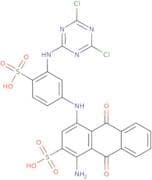
CAS 13324-20-4
:Azul Reactivo 4
Descripción:
Azul Reactivo 4 es un colorante sintético que pertenece a la clase de colorantes reactivos, utilizado principalmente para teñir fibras de celulosa, como el algodón. Se caracteriza por su brillante color azul y alta afinidad por las telas, lo que permite una fuerte unión a través de enlaces covalentes con las moléculas de fibra. Este colorante contiene grupos reactivos que facilitan su adhesión al sustrato, lo que lo hace adecuado para diversas aplicaciones textiles. Azul Reactivo 4 es conocido por sus excelentes propiedades de resistencia a la luz y a los lavados, que contribuyen a la durabilidad de los materiales teñidos. Sin embargo, al igual que muchos colorantes sintéticos, puede plantear preocupaciones ambientales debido a su potencial toxicidad y la necesidad de un manejo cuidadoso durante la aplicación y eliminación. El colorante es soluble en agua, lo que mejora su usabilidad en los procesos de teñido. Además, es importante tener en cuenta que se deben tomar medidas de seguridad al trabajar con este compuesto, ya que puede causar irritación en la piel o reacciones alérgicas en algunas personas. En general, Azul Reactivo 4 es un colorante ampliamente utilizado en la industria textil, valorado por su color vibrante y sus efectivas propiedades de teñido.
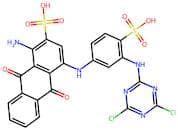
Fórmula:C23H14Cl2N6O8S2
InChI:InChI=1S/C23H14Cl2N6O8S2/c24-21-29-22(25)31-23(30-21)28-12-7-9(5-6-14(12)40(34,35)36)27-13-8-15(41(37,38)39)18(26)17-16(13)19(32)10-3-1-2-4-11(10)20(17)33/h1-8,27H,26H2,(H,34,35,36)(H,37,38,39)(H,28,29,30,31)
Clave InChI:InChIKey=RTLULCVBFCRQKI-UHFFFAOYSA-N
SMILES:N(C1=C2C(C(=O)C=3C(C2=O)=CC=CC3)=C(N)C(S(=O)(=O)O)=C1)C4=CC(NC=5N=C(Cl)N=C(Cl)N5)=C(S(=O)(=O)O)C=C4
Sinónimos:- 1-Amino-4-(2-(4,6-Dichloro-S-Triazin-2-Yl)Amino)Phenylamino)9,10-Dihydro-9,10-Dioxoanthracene-2,4-Disulphonic Acid
- 1-Amino-4-({3-[(4,6-Dichloro-1,3,5-Triazin-2-Yl)Amino]-4-Sulfophenyl}Amino)-9,10-Dioxo-9,10-Dihydroanthracene-2-Sulfonic Acid
- 1-Amino-4-[[3-[(4,6-dichloro-1,3,5-triazin-2-yl)amino]-4-sulfophenyl]amino]-9,10-dihydro-9,10-dioxo-2-anthracenesulfonic acid
- 2-Anthracenesulfonic acid, 1-amino-4-[3-[(4,6-dichloro-s-triazin-2-yl)amino]-4-sulfoanilino]-9,10-dihydro-9,10-dioxo-
- 2-Anthracenesulfonic acid, 1-amino-4-[[3-[(4,6-dichloro-1,3,5-triazin-2-yl)amino]-4-sulfophenyl]amino]-9,10-dihydro-9,10-dioxo-
- 2-Anthraquinonesulfonic acid, 1-amino-4-[3-[(4,6-dichloro-s-triazin-2-yl)amino]-4-sulfoanilino]-
- Brilliant blue X-BR 140
- Helaktyn Blue FR
- Helaktyn Pure Blue F-R
- Intracron Blue C-R
- Mikacion Brilliant Blue RS
- NSC 364368
- Orbaktiv Brilliant Blue M-R
- Ostazin Blue S-R
- Ostazin Brilliant Blue S-R
- Procion Blue 11X-R
- Procion Blue MR
- Procion Brilliant Blue MR
- Procion Brilliant Blue MX-R
- Procion Brilliant Blue RS
- Procion blue MX-R
- Procion blue MX-R?Reactive Blue 4
- Reactive Blue 4
- Reactive Blue MR
- Reactive Blue MXR
- Reactive Blue No. 4
- Reactive Blue X-BR
- Reactive Brill. Blue X-BR
- Reactive Brilliant Blue X-BR
- Reactive Brilliant Blue X-BR 140%
- Sigma Reactive Blue 4
- Ver más sinónimos
Ordenar por
Pureza (%)
0
100
|
0
|
50
|
90
|
95
|
100
Encontrado 8 productos.
Reactive Blue 4, dye content min. 35%
CAS:This Thermo Scientific Chemicals brand product was originally part of the Alfa Aesar product portfolio. Some documentation and label information may refer to the legacy brand. The original Alfa Aesar product / item code or SKU reference has not changed as a part of the brand transition to Thermo SciFórmula:C23H14Cl2N6O8S2Forma y color:Grey to blue to dark blue, PowderPeso molecular:637.44Reactive Blue 4
CAS:Reactive Blue 4: An anthraquinone dye; phytotoxic, cytotoxic, genotoxic. Used as a colorimetric sensor for various analytes in water.Fórmula:C23H14Cl2N6O8S2Pureza:99.701%Forma y color:SolidPeso molecular:637.43Reactive Blue 4
CAS:Reactive Blue 4 is a reactive dye that is used in the treatment of wastewater. It has been shown to be effective against microbial and fungal infections. Reactive Blue 4 binds to the cell membrane, preventing the transport of ions and other essential components into the cell, leading to its death. The binding mechanism is thought to involve steric interactions and hydrogen bonding. This dye also inhibits enzymes such as benzalkonium chloride and sodium carbonate, which are involved in bacterial processes such as photosynthesis or respiration.
Fórmula:C23H14Cl2N6O8S2Pureza:Min. 95%Forma y color:PowderPeso molecular:637.43 g/mol