CAS 134381-21-8
:Epoxomicina
Descripción:
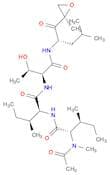
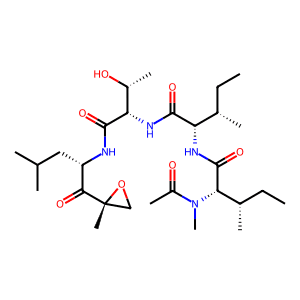
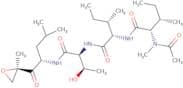
Epoxomicina es un potente e inhibidor selectivo del proteasoma, conocido principalmente por su papel en la investigación relacionada con el cáncer y las enfermedades neurodegenerativas. Es un producto natural derivado de la fermentación de la bacteria *Streptomyces*. El compuesto presenta un grupo funcional epóxido único, que contribuye a su mecanismo de acción al unirse covalentemente al sitio activo del proteasoma, inhibiendo así su función. Esta inhibición conduce a la acumulación de proteínas reguladoras y apoptosis en células cancerosas, lo que lo convierte en una herramienta valiosa en la investigación del cáncer. Epoxomicina también se ha estudiado por sus posibles efectos neuroprotectores, ya que puede influir en la degradación de proteínas mal plegadas asociadas con trastornos neurodegenerativos. En términos de propiedades físicas, Epoxomicina se caracteriza típicamente por su estado sólido a temperatura ambiente y es soluble en disolventes orgánicos. Su uso en entornos de laboratorio requiere un manejo cuidadoso debido a su actividad biológica y potencial toxicidad. En general, Epoxomicina sirve como un compuesto importante en el estudio de la función del proteasoma y sus implicaciones en varias enfermedades.
Fórmula:C28H50N4O7
InChI:InChI=1/C28H50N4O7/c1-11-16(5)21(30-27(38)23(17(6)12-2)32(10)19(8)34)25(36)31-26(37)22(18(7)33)29-20(13-15(3)4)24(35)28(9)14-39-28/h15-18,20-23,29,33H,11-14H2,1-10H3,(H,30,38)(H,31,36,37)/t16-,17-,18+,20?,21-,22-,23-,28+/m0/s1
Clave InChI:InChIKey=DOGIDQKFVLKMLQ-JTHVHQAWSA-N
SMILES:C([C@@H](NC([C@@H](NC([C@@H](NC([C@@H](N(C(C)=O)C)[C@H](CC)C)=O)[C@H](CC)C)=O)[C@@H](C)O)=O)CC(C)C)(=O)[C@@]1(C)CO1
Sinónimos:- (2R)-2-[Acetyl-(N-Methyl-L-Isoleucyl)-L-Isoleucyl-L-Threonyl-L-Leucyl]-2-Methyloxirane
- <span class="text-smallcaps">L</smallcap>-Threoninamide, N-acetyl-N-methyl-<smallcap>L</smallcap>-isoleucyl-<smallcap>L</span>-isoleucyl-N-[(1S)-3-methyl-1-[[(2R)-2-methyl-2-oxiranyl]carbonyl]butyl]-
- <span class="text-smallcaps">L</smallcap>-Threoninamide, N-acetyl-N-methyl-<smallcap>L</smallcap>-isoleucyl-<smallcap>L</span>-isoleucyl-N-[(1S)-3-methyl-1-[[(2R)-2-methyloxiranyl]carbonyl]butyl]-
- Bu-4061T
- Epoxomicin, Synthetic
- N-Acetyl-N-Methyl-L-Isoleucyl-L-Isoleucyl-N-[(1S)-3-Methyl-1-[[(2R)-2-Methyloxiranyl]Carbonyl]Butyl]-L-Threoninamide
- N-Acetyl-N-methyl-<span class="text-smallcaps">L</smallcap>-isoleucyl-<smallcap>L</smallcap>-isoleucyl-N-[(1S)-3-methyl-1-[[(2R)-2-methyl-2-oxiranyl]carbonyl]butyl]-<smallcap>L</span>-threoninamide
- N-acetyl-N-methyl-L-isoleucyl-L-isoleucyl-L-threonyl-N-{2-[(2R)-2-methyloxiran-2-yl]-2-oxoethyl}-L-leucinamide
- N-acetyl-N-methyl-L-isoleucyl-N-{(2S,3R)-3-hydroxy-2-[(3-methyl-1-{[(2R)-2-methyloxiran-2-yl]carbonyl}butyl)amino]butanoyl}-L-isoleucinamide
- N-Acetyl-N-methyl-L-isoleucyl-L-isoleucyl-N-[(1S)-3-methyl-1-[[(2R)-2-methyl-2-oxiranyl]carbonyl]butyl]-L-threoninamide
- L-Threoninamide, N-acetyl-N-methyl-L-isoleucyl-L-isoleucyl-N-[(1S)-3-methyl-1-[[(2R)-2-methyloxiranyl]carbonyl]butyl]-
- L-Threoninamide, N-acetyl-N-methyl-L-isoleucyl-L-isoleucyl-N-[(1S)-3-methyl-1-[[(2R)-2-methyl-2-oxiranyl]carbonyl]butyl]-
- Epoxomicin
- Epoxomicin(BU-4061T)
- Aids010837
- CS-1626
- Aids-010837
- Epoxomicin, 97%, a selective proteasome inhibitor
- BU-4061T,Aids010837
- (2S,3S)-2-[[(2S,3S)-2-[acetyl(Methyl)aMino]-3-Methylpentanoyl]aMino]-N-[(2S,3R)-3-hydroxy-2-[[(2S)-4-Methyl-1-[(2R)-2-Methyloxiran-2-yl]-1-oxopentan-2-yl]aMino]butanoyl]-3-MethylpentanaMide
- EPOXOMICIN;BU4061T;BU-4061T
- 134381-21-8 supplier in China
- Ver más sinónimos
Ordenar por
Pureza (%)
0
100
|
0
|
50
|
90
|
95
|
100
Encontrado 6 productos.
Epoxomicin
CAS:Fórmula:C28H50N4O7Pureza:≥ 98.0%Forma y color:White to off-white or light-yellow solidPeso molecular:554.7Epoxomicin
CAS:Epoxomicin, a selective proteasome inhibitor, chiefly blocks CH-L activity, mildly affecting T-L and PGPH at lower rates.Fórmula:C28H50N4O7Pureza:98.65% - 98.86%Forma y color:White To Off-White SolidPeso molecular:554.72Ref: TM-T6830
1mg125,00€5mg311,00€1mL*10mM (DMSO)375,00€10mg502,00€25mg817,00€50mg1.130,00€100mg1.501,00€500mg3.022,00€Epoxomicin
CAS:Epoxomicin is an activator that binds to the ligand-binding site of a receptor. It has been used as a research tool in cell biology, pharmacology, and immunology. Epoxomicin has been shown to inhibit ion channels by binding to them and blocking their activity. This property makes epoxomicin a good candidate for the treatment of epilepsy. Epoxomicin also inhibits protein synthesis through inhibition of ribosomal S6 kinase, which is involved in signal transduction pathways.
Fórmula:C28H50N4O7Pureza:Min. 95%Peso molecular:554.72 g/molEpoxomicin
CAS:Epoxomicin is a macrolide antibiotic that inhibits the production of inflammatory mediators by suppressing the activity of protein kinase C. Epoxomicin has been shown to have anti-inflammatory properties in low doses. This drug also inhibits the proteasome, an enzyme that breaks down proteins into amino acids or small peptides, and is used as an inhibitor of cancer cell proliferation. Epoxomicin binds to the 20S proteasome at a site that is distinct from that for other proteasome inhibitors such as lactacystin and bortezomib, which are used for cancer treatment. The binding site for epoxomicin is adjacent to the ATP-binding site and may be due to its inhibitory effect on ATP hydrolysis.Fórmula:C28H50N4O7Pureza:Min. 95%Forma y color:PowderPeso molecular:554.72 g/mol