CAS 13450-77-6
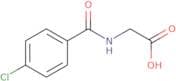
:N-(4-clorobenzoil)glicina
Descripción:
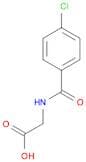
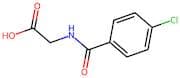
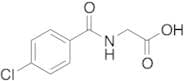
N-(4-clorobenzoil)glicina, con el número CAS 13450-77-6, es un compuesto orgánico que presenta un moiety de glicina sustituido con un grupo 4-clorobenzoyl. Este compuesto típicamente aparece como un sólido cristalino blanco a blanco sucio. Se caracteriza por sus grupos funcionales, que incluyen una amina (de la glicina) y un carbonilo (del grupo benzoyl), lo que contribuye a su potencial reactividad y solubilidad en varios disolventes. La presencia del átomo de cloro en el anillo benzoyl puede influir en sus propiedades electrónicas y actividad biológica. N-(4-clorobenzoil)glicina puede exhibir aplicaciones en farmacéuticos, particularmente en el desarrollo de medicamentos o como intermediarios en la síntesis orgánica. Sus propiedades, como el punto de fusión, solubilidad y estabilidad, pueden variar según las condiciones ambientales y la presencia de otras sustancias. Al igual que con muchos compuestos químicos, se deben consultar las hojas de datos de seguridad para obtener información sobre manejo y toxicidad, así como para cualquier consideración regulatoria específica.
Fórmula:C9H8ClNO3
InChI:InChI=1S/C9H8ClNO3/c10-7-3-1-6(2-4-7)9(14)11-5-8(12)13/h1-4H,5H2,(H,11,14)(H,12,13)
Clave InChI:InChIKey=COYZIYOEXGRBHQ-UHFFFAOYSA-N
SMILES:C(NCC(O)=O)(=O)C1=CC=C(Cl)C=C1
Sinónimos:- 2-(4-Chlorobenzamido)acetic acid
- 2-(4-Chlorobenzamido)aceticacid
- 2-[(4-Chlorophenyl)formamido]acetic acid
- 4-Chlorobenzoylglycine
- 4-Chlorohippuric acid
- 4-Chlorohippuricacid
- Glycine, N-(4-chlorobenzoyl)-
- Hippuric acid, p-chloro-
- N-(4-Chlorobenzoyl)-Glycin
- N-(4-Chlorobenzoyl)Glycine
- N-(P-Chlorobenzoyl)Glycine
- Otava-Bb Bb7210742318
- P-Chloro-Hippuricaci
- P-Chlorobenzoylglycine
- Ro 11-1903
- p-Chlorohippuric acid
- Ver más sinónimos
Ordenar por
Pureza (%)
0
100
|
0
|
50
|
90
|
95
|
100
Encontrado 8 productos.
2-(4-Chlorobenzamido)acetic acid
CAS:Fórmula:C9H8ClNO3Pureza:95%Forma y color:SolidPeso molecular:213.61772-(4-Chlorobenzamido)acetic acid
CAS:2-(4-Chlorobenzamido)acetic acidPureza:97%Peso molecular:213.62g/mol4-Chlorohippuric Acid
CAS:Producto controladoApplications 4-Chlorohippuric Acid is a derivative of Hippuric Acid (H356700) and is the major metabolite in human urine.
References Köppel, C., et al.: Arzneimittel-Forsch., 36, 1116 (1986); Oelschläger, H., et al.: Die Pharmazie, 53, 620 (1998)Fórmula:C9H8ClNO3Forma y color:White To Off-WhitePeso molecular:213.62(4-Chloro-benzoylamino)-acetic acid
CAS:Fórmula:C9H8ClNO3Pureza:98%Forma y color:SolidPeso molecular:213.624-Chlorohippuric Acid-d4
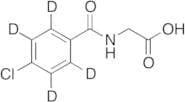
CAS:Producto controladoApplications 4-Chlorohippuric Acid-d4 is the isotope labelled analog of 4-Chlorohippuric Acid (C367420); a derivative of Hippuric Acid (H356700) and the major metabolite in human urine.
References Köppel, C., et al.: Arzneimittel-Forsch., 36, 1116 (1986); Oelschläger, H., et al.: Die Pharmazie, 53, 620 (1998)Fórmula:C9H4D4ClNO3Forma y color:NeatPeso molecular:217.644-Chlorohippuric acid
CAS:4-Chlorohippuric acid is an active analogue of hippuric acid and is metabolized by cytochrome P450. It has a high chemical stability, which makes it a useful substrate for kinetic studies. The metabolism of 4-chlorohippuric acid to the corresponding sulfoxide (4-chloro-3'-sulfoxyhippurate) was found to be dependent on the concentration of rat liver microsomes in vitro and plasma concentrations in vivo. 4-Chlorohippuric acid is excreted mainly as hippuric acid in urine samples from humans and animals. Hippuric acid may also be formed by denaturation of 4-chlorohippurate or by hydrolysis of the amide bond between the two chloro groups.Fórmula:C9H8ClNO3Pureza:Min. 95%Peso molecular:213.62 g/mol