CAS 13460-96-3
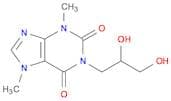
:1-(2,3-Dihidroxipropil)-3,7-dihidro-3,7-dimetil-1H-purina-2,6-diona
Descripción:
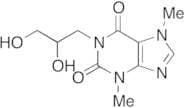
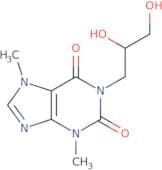
1-(2,3-Dihidroxipropil)-3,7-dihidro-3,7-dimetil-1H-purina-2,6-diona, comúnmente conocido como teobromina, es un compuesto de metilxantina con propiedades farmacológicas notables. Es un polvo cristalino blanco a blanco sucio que es soluble en agua y presenta un sabor ligeramente amargo. La sustancia se encuentra principalmente en los granos de cacao y es un componente clave del chocolate. La teobromina actúa como un estimulante, similar a la cafeína, pero con efectos más suaves en el sistema nervioso central. Se conoce por sus propiedades vasodilatadoras, que pueden llevar a un aumento del flujo sanguíneo y a una reducción de la presión arterial. Además, la teobromina tiene efectos diuréticos y puede promover la relajación de los músculos lisos, particularmente en las vías respiratorias. Su estructura molecular presenta una base de purina con sustituyentes hidroxilo y metilo, lo que contribuye a su actividad biológica. La teobromina también se estudia por sus posibles beneficios para la salud, incluyendo propiedades antioxidantes y efectos en la mejora del estado de ánimo. Sin embargo, puede ser tóxica para ciertos animales, como los perros, debido a su incapacidad para metabolizarla de manera efectiva.
Fórmula:C10H14N4O4
InChI:InChI=1S/C10H14N4O4/c1-12-5-11-8-7(12)9(17)14(3-6(16)4-15)10(18)13(8)2/h5-6,15-16H,3-4H2,1-2H3
Clave InChI:InChIKey=RRBSZTYIWIHPST-UHFFFAOYSA-N
SMILES:O=C1C2=C(N(C)C(=O)N1CC(CO)O)N=CN2C
Sinónimos:- 1-(2,3-Dihydroxy-propyl)-3,7-dimethyl-3,7-dihydro-purine-2,6-dione
- 1-(2,3-Dihydroxypropyl)-3,7-dimethylpurine-2,6-dione
- 1-(2,3-Dihydroxypropyl)-3,7-dimethylxanthine
- 1-(2,3-Dihydroxypropyl)theobromine
- 1-(2,3-Dihydroxypropyl-3,7-dimethyl-2,6(1H,3H)-purindion
- 1-(2,3-Dihydroxypropyl-3,7-dimethyl-2,6(1H,3H)-purindion [IUPAC]
- 1-(2,3-Dwuhydroksypropylo)-teobrominy
- 1-(2,3-Dwuhydroksypropylo)-teobrominy [Polish]
- 1-(2,3-dihydroxypropyl)-3,7-dimethyl-3,7-dihydro-1H-purine-2,6-dione
- 1-(beta,gamma-Dioxypropyl)-theobromin
- 1-(beta,gamma-Dioxypropyl)-theobromin [German]
- 1-Dihydroxypropyltheobromine
- 1H-Purine-2,6-dione, 1-(2,3-dihydroxypropyl)-3,7-dihydro-3,7-dimethyl-
- 1H-Purine-2,6-dione, 1-(2,3-dihydroxypropyl)-3,7-dihydro-3,7-dimethyl- (9CI)
- 1H-Purine-2,6-dione, 3,7-dihydro-1-(2,3-dihydroxypropyl)-
- Brn 0284032
- Isobromin
- Nsc 515487
- Theobromine, 1-(2,3-dihydroxypropyl)-
- Theocardin
- Theocardine
- 4-26-00-02370 (Beilstein Handbook Reference)
- 1-(2,3-Dihydroxypropyl)-3,7-dihydro-3,7-dimethyl-1H-purine-2,6-dione
- Ver más sinónimos
Ordenar por
Pureza (%)
0
100
|
0
|
50
|
90
|
95
|
100
Encontrado 3 productos.
1-(2,3-dihydroxypropyl)-3,7-dihydro-3,7-dimethyl-1H-purine-2,6-dione
CAS:Fórmula:C10H14N4O4Pureza:98%Forma y color:SolidPeso molecular:254.24261-(2,3-Dihydroxypropyl)-3,7-dihydro-3,7-dimethyl-1H-purine-2,6-dione
CAS:Producto controlado1-(2,3-Dihydroxypropyl)-3,7-dihydro-3,7-dimethyl-1H-purine-2,6-dione (theophylline) is a bronchodilator and anti-inflammatory agent. It is used to treat asthma and other respiratory conditions. Theophylline is structurally similar to caffeine and theobromine and has been shown to have a similar effect on the heart and blood vessels as these stimulants. It also stimulates the central nervous system in a manner similar to that of theobromine. Theophylline has shown some benefit in congestive heart failure patients but has not been proven effective for treating high blood pressure or fibrillation.Fórmula:C10H14N4O4Pureza:Min. 95%Peso molecular:254.24 g/mol