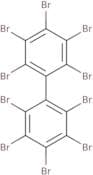
CAS 13654-09-6
:decabromo-1,1'-bifenilo
Descripción:
decabromo-1,1'-bifenilo, con el número CAS 13654-09-6, es un retardante de llama bromado que pertenece a la clase de éteres de difenilo polibromados. Se caracteriza por su alto contenido de bromo, que mejora su efectividad como retardante de llama al inhibir la combustión. Este compuesto es típicamente un sólido blanco a blanco sucio a temperatura ambiente e insoluble en agua, pero puede disolverse en disolventes orgánicos. Su estabilidad térmica es significativa, lo que le permite resistir altas temperaturas sin descomponerse. decabromo-1,1'-bifenilo se utiliza principalmente en diversas aplicaciones, incluidos textiles, plásticos y electrónica, para reducir la inflamabilidad. Sin embargo, las preocupaciones sobre su persistencia ambiental y su posible toxicidad han llevado a un mayor escrutinio y regulación. Se sabe que se bioacumula en organismos vivos, lo que plantea problemas relacionados con su impacto ecológico a largo plazo. Como resultado, se están explorando alternativas a decabromo-1,1'-bifenilo en la industria para mitigar estos riesgos ambientales y para la salud.
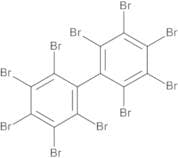
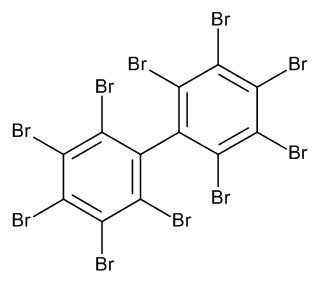
Fórmula:C12Br10
InChI:InChI=1/C12Br10/c13-3-1(4(14)8(18)11(21)7(3)17)2-5(15)9(19)12(22)10(20)6(2)16
Clave InChI:InChIKey=AQPHBYQUCKHJLT-UHFFFAOYSA-N
SMILES:BrC1=C(C(Br)=C(Br)C(Br)=C1Br)C2=C(Br)C(Br)=C(Br)C(Br)=C2Br
Sinónimos:- 1,1'-Biphenyl, 2,2',3,3',4,4',5,5',6,6'-decabromo-
- 1,1′-Biphenyl, 2,2′,3,3′,4,4′,5,5′,6,6′-decabromo-
- 2,2',3,3',4,4',5,5',6,6'-Decabromobiphenyl
- 2,2′,3,3′,4,4′,5,5′,6,6′-Decabromo-1,1′-biphenyl
- 2,2′,3,3′,4,4′,5,5′,6,6′-Decabromobiphenyl
- Adine 0102
- Bb 209
- Berkflam B 10
- Biphenyl, decabromo-
- Decabromobiphenyl
- Decabromodiphenyl
- Flammex B 10
- Hsdb 7349
- Pbb 209
- Perbromobiphenyl
- Polybrominated biphenyls
- Rbf 102
- Decabromo-1,1'-biphenyl
- Decabromobiphenyl,35 μL/mL in Isooctane
- flammexb10
- adine0102
- DECA-BB
- DECABROMOBIPHENYLS
- decabromo-bipheny
- DECABROMOBIPHENYL (35 UG/ML IN ISOOCTANE)
- PBB NO 209
- Nicotinic Acid Impurity 58
- DECABB (PBB-209)
- 2,2’,3,3’,4,4’,5,5’,6,6’-decabromo-1’-biphenyl
- 11'-Biphenyl22'33'44'55'66'-decabromo-
- Perbromo-1,1'-biphenyl
- PBB-No. 209 25
- PBB No. 209 10 μg/mL in Cyclohexane
- 1,1’-biphenyl,2,2’,3,3’,,4’,5,5’,6,6’-decabromo-(decabromobiphenyl)
- 1’-Biphenyl,2,2’,3,3’,4,4’,5,5’,6,6’-decabromo-1
- Decarbromobiphenyl
- 237-137-2
- 2,2 ', 3,3', 4,4 ', 5,5', 6,6 '- Decabromobiphenyl (BB-209)
- 1,1’-(biphenyl,2,2’,3,3’,,4’,5,5’,6,6’-decabromo-
- PBB-No. 209 50 μg/mL in Isooctane
- Ver más sinónimos
Ordenar por
Pureza (%)
0
100
|
0
|
50
|
90
|
95
|
100
Encontrado 7 productos.
PBB Mix 5 10 µg/mL in Cyclohexane
CAS:Producto controlado- 115245-07-3
- 115245-08-4
- 13029-09-9
- 13654-09-6
- 16400-50-3
- 2052-07-5
- 2113-57-7
- 53592-10-2
- 57422-77-2
- 59080-32-9
- 59080-33-0
- 59080-34-1
- 59080-35-2
- 59080-36-3
- 59080-37-4
- 59080-39-6
- 59080-40-9
- 59261-08-4
- 60044-24-8
- 60044-25-9
- 67888-96-4
- 92-66-0
- 92-86-4
Fórmula:C12H4Br6Forma y color:MixturePeso molecular:627.58PBB No. 209 10 µg/mL in Cyclohexane
CAS:Producto controladoFórmula:C12Br10Forma y color:Single SolutionPeso molecular:943.17PBB-No. 209 50 µg/mL in Isooctane
CAS:Producto controladoFórmula:C12Br10Forma y color:Single SolutionPeso molecular:943.17Decabromobiphenyl
CAS:Producto controladoApplications Decabromobiphenyl is a flame retardant and a standard for environmental testing and research.
Not a dangerous good if item is equal to or less than 1g/ml and there is less than 100g/ml in the package
References EPA. Method 1668, (EPA 821-R-00-002) (1999); Zeng, L., et al.: Environ. Sci. Technol. 48, 12586 (2014)Fórmula:C12Br10Forma y color:ColourlessPeso molecular:943.17Decabromobiphenyl
CAS:Producto controladoDecabromobiphenyl is a brominated flame retardant that has been detected in human serum, fish, and sediments. It is used as an analytical method for the determination of polybrominated diphenyl ethers (PBDEs) in environmental samples. Decabromobiphenyl binds to the receptor site for thyroid hormone, which may cause significant cytotoxicity and is associated with a number of health effects. Decabromobiphenyl can be eliminated from the body by treatment with metal hydroxides or fatty acids, although this process may not be complete. Decabromobiphenyl can also bind to cationic polymers such as polystyrene sulfonate and polyethyleneimine, which make it difficult to remove from contaminated water.Fórmula:C12Br10Pureza:Min. 95%Peso molecular:943.17 g/mol