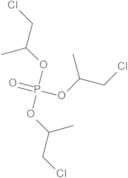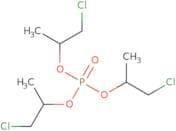
CAS 13674-84-5
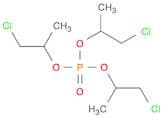
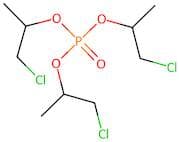
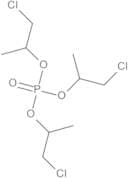
:Tris(2-cloroisopropil) fosfato
Descripción:
Tris(2-cloroisopropil) fosfato, comúnmente conocido como TCPP, es un compuesto organofosforado caracterizado por su uso como retardante de llama y plastificante en diversas aplicaciones, incluyendo textiles, plásticos y recubrimientos. Es un líquido incoloro a amarillo pálido con un punto de ebullición relativamente alto y baja volatilidad, lo que contribuye a su efectividad en la resistencia al fuego. TCPP es conocido por su capacidad para mejorar la estabilidad térmica de los materiales mientras proporciona un grado de flexibilidad. La presencia de átomos de cloro en su estructura otorga propiedades adicionales de retardante de llama, lo que lo hace particularmente útil en aplicaciones donde la seguridad contra incendios es una preocupación. Sin embargo, al igual que muchos organofosforados, TCPP ha suscitado preocupaciones ambientales y de salud debido a su potencial toxicidad y persistencia en el medio ambiente. Es importante manejar esta sustancia con cuidado, siguiendo las pautas de seguridad adecuadas para minimizar la exposición. En general, TCPP desempeña un papel significativo en la ciencia de materiales, particularmente en la mejora de la seguridad y el rendimiento de varios productos.
Fórmula:C9H18Cl3O4P
InChI:InChI=1S/C9H18Cl3O4P/c1-7(4-10)14-17(13,15-8(2)5-11)16-9(3)6-12/h7-9H,4-6H2,1-3H3
Clave InChI:InChIKey=KVMPUXDNESXNOH-UHFFFAOYSA-N
SMILES:P(OC(CCl)C)(OC(CCl)C)(OC(CCl)C)=O
Sinónimos:- 1,3-Dichloro-2-propanol phosphate
- 1-Chloro-2-Propanophosphate(3:1)
- 1-Chloro-2-propanolphosphate(3:1)
- 2-Propanol, 1-chloro-, 2,2′,2′′-phosphate
- 2-Propanol, 1-chloro-, phosphate (3:1)
- Amgard TMCP
- Antiblaze 80
- Antiblaze AB 80
- Antiblaze TMCP
- Bs 5852
- Daltoguard F
- Fyrol PCF
- Hostaflam OP 820
- Levagard PP
- Levagard PP 2
- Levagard PP-Z
- Levagard TCPP
- Pc 1389
- Phireguard TCPP
- Phosphoric acid tris(2-chloro-1-methylethyl) ester
- ProFlame PC 1389
- Puma 4010
- Tcpp
- Tmpcc
- Tolgard TMCP
- Tri(2-chloroisopropyl) phosphate
- Tri(chloropropyl) phosphate
- Tris(1-chloro-2-isopropyl)phosphate
- Tris(1-chloropropan-2-yl) phosphate
- Tris(1-chloropropyl)phosphate
- Tris(1-methyl-2-chloroethyl) phosphate
- Tris(2-chloro-1-methyl-ethyl) phosphate
- Tris(2-chloro-1-methylethyl) phosphate
- Tris(2-chloroisopropyl) phosphate
- Tris(2-chloropropyl) phosphate
- Tris(chloroISOPROPYL)phosphate
- Tris(chloropropyl)phosphate
- Tris(clorisopropyl)phosphate
- Tris(monochloropropyl) phosphate
- Tris(β-chloroisopropyl) phosphate
- Wsfr-Tcpp
- Yoke TCPP
- Tris(1-chloro-2-propyl)phosphate
- Tris(1-chloro-2-propyl) phosphate
- Ver más sinónimos
Ordenar por
Pureza (%)
0
100
|
0
|
50
|
90
|
95
|
100
Encontrado 7 productos.
Tris(1-chloropropan-2-yl) phosphate
CAS:Fórmula:C9H18Cl3O4PPureza:85.0%Forma y color:LiquidPeso molecular:327.56Tris(2-chloroisopropyl) phosphate
CAS:Fórmula:C9H18Cl3O4PPureza:98%Forma y color:LiquidPeso molecular:327.5696Tris(2-Chloro-1-Methylethyl) Phosphate
CAS:Tris(2-Chloro-1-Methylethyl) PhosphatePureza:P:9.5%Peso molecular:327.57g/molTris(2-chloroisopropyl) phosphate
CAS:Fórmula:C9H18Cl3O4PForma y color:ColourlessPeso molecular:327.57Tris(1-chloro-2-propyl) Phosphate
CAS:Producto controladoStability Moisture Sensitive
Applications Tris(1-chloro-2-propyl) Phosphate is a flame retardant of low hydrolytic stability, used in polyurethane (PU) rigid and flexible foam, PVC, EVA, phenolics and epoxy resin.
References Grump, D., et al.: Toxicol. Sci., 126, 140 (2012); Paciorek, S.J., et al.: J. Porous. Mater., 19, 161 (2012);Fórmula:C9H18Cl3O4PForma y color:ColourlessPeso molecular:327.57Tris(1-chloro-2-propyl) phosphate - mixture of isomers
CAS:Tris(1-chloro-2-propyl) phosphate is a synthetic compound that belongs to the class of diphenyl ethers. It is used as an intermediate in the production of other chemicals, such as plastics and pesticides. Tris(1-chloro-2-propyl) phosphate has been shown to be toxic to cells by inhibiting mitochondrial membrane potential and interfering with cellular metabolism. This chemical can cause severe health effects, such as liver damage and death, at high doses. Tris(1-chloro-2-propyl) phosphate can also be detected in human serum and urine samples with high sensitivity.Fórmula:C9H18Cl3O4PPureza:Min. 95%Peso molecular:327.57 g/mol