CAS 13965-03-2
:Diclorobis(trifenilfosfina)paladio
Descripción:
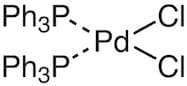
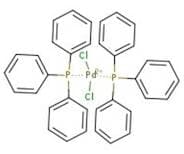
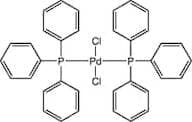
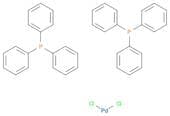
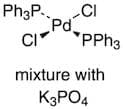
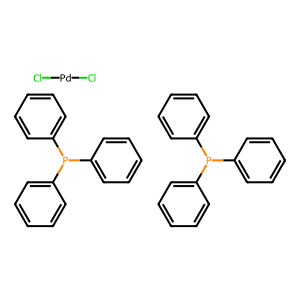
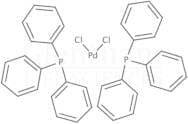
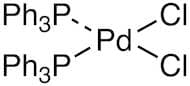
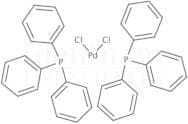
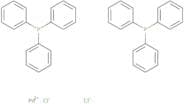
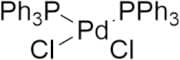
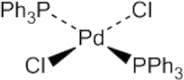
Diclorobis(trifenilfosfina)paladio, comúnmente conocido como Pd(PPh₃)₂Cl₂, es un complejo de coordinación de paladio que presenta dos ligandos de triphenilfosfina y dos iones de cloruro. Este compuesto se caracteriza por su geometría cuadrada plana, típica de muchos complejos metálicos d⁸, lo que contribuye a su estabilidad y reactividad. A menudo se utiliza como catalizador en diversas reacciones orgánicas, particularmente en reacciones de acilo cruzado como las reacciones de Suzuki y Heck, debido a su capacidad para facilitar la formación de enlaces carbono-carbono. La presencia de los ligandos de triphenilfosfina mejora la solubilidad del complejo en disolventes orgánicos y proporciona volumen estérico, lo que puede influir en la selectividad de la reacción. Pd(PPh₃)₂Cl₂ se maneja típicamente en atmósferas inertes para prevenir la degradación y es sensible a la humedad. Sus aplicaciones se extienden a la síntesis de productos farmacéuticos, agroquímicos y materiales avanzados, lo que lo convierte en un compuesto valioso tanto en la química académica como en la industrial.
Fórmula:C36H30Cl2P2Pd
InChI:InChI=1S/2C18H15P.2ClH.Pd/c2*1-4-10-16(11-5-1)19(17-12-6-2-7-13-17)18-14-8-3-9-15-18;;;/h2*1-15H;2*1H;/q;;;;+2/p-2
Clave InChI:InChIKey=YNHIGQDRGKUECZ-UHFFFAOYSA-L
SMILES:[P]([Pd+2]([P](C1=CC=CC=C1)(C2=CC=CC=C2)C3=CC=CC=C3)([Cl-])[Cl-])(C4=CC=CC=C4)(C5=CC=CC=C5)C6=CC=CC=C6
Sinónimos:- B 1667
- Bis(triphenylphosphine)dichloropalladium
- Bis(triphenylphosphine)dichloropalladium(II)
- Bis(triphenylphosphine)palladium chloride
- Bis(triphenylphosphine)palladium dichloride
- Bis(triphenylphosphine)palladium(II) dichloride
- Bis(triphenylphosphino)-palladium(II) dichloride
- Bis(triphenylphosphino)palladium chloride
- Cis-Bis(Triphenylphosphine)Platinum(Ii) Dichloride
- Dichlorobis(Triphenylphosphine)Palladate (Ii)
- Dichlorobis(Triphenylphosphine)Palladium
- Dichlorobis(triphenylphosphin)palladium
- Dichlorobis(triphenylphosphine)palladium(II)
- Dichlorobis(triphenylphosphine)platinum (II)
- Diclorobis(Trifenilfosfina)Paladio
- Nsc 122924
- Palladium(2+) Chloride-Triphenylphosphane (1:2:2)
- Palladium, dichlorobis(triphenylphosphine)-
- Palladiumbis(triphenylphosphine) dichloride
- Phosphine, Triphenyl-, Palladium(2+) Salt, Dihydrochloride
- Trans-Dichlorobis(triphenyl-phosphine) Palladium(II)
- cis-Bis(triphenylphosphine)platinum(II) chloride
- trans-Bis(triphenylphosphine)palladium dichloride
- Ver más sinónimos
Ordenar por
Pureza (%)
0
100
|
0
|
50
|
90
|
95
|
100
Encontrado 15 productos.
Bis(triphenylphosphine)palladium(II) Dichloride
CAS:Fórmula:C36H30Cl2P2PdPureza:>98.0%(T)Forma y color:Light yellow to Brown powder to crystalPeso molecular:701.90trans-Dichlorobis(triphenylphosphine)palladium(II), Premion™, 99.95% (metals basis), Pd 14.7% min
CAS:As a catalyst of choice in hydrogenation, hydrosilation, carbonylation, oxidation, elimination, reduction, allyl aceate isomerization, dimerization of 1,3-dienes, and C-C bond formation such as Negishi coupling, Suzuki coupling, Kumada coupling, Sonogashira coupling, Heck coupling and Sonogashira-HFórmula:C36H30Cl2P2PdPureza:99.95%Peso molecular:701.90Bis(triphenylphosphine)palladium(II) dichloride
CAS:Pureza:98%Forma y color:White to yellow powder or crystalsPeso molecular:701.90trans-Dichlorobis(triphenylphosphine)palladium(II), Pd 14.0% min
CAS:Hydrogenation, hydrosilation, carbonylation, oxidation, and C-C bond formationFórmula:C36H30Cl2P2PdPeso molecular:701.90Dichlorobis(triphenylphosphine)palladium
CAS:Fórmula:C36H30Cl2P2PdPureza:98%Forma y color:SolidPeso molecular:701.8969trans-Dichlorobis(triphenylphosphine)palladium(II)/potassium phosphate admixture [CatKit single-use vials - 6.32 wt% Pd complex]
CAS:trans-Dichlorobis(triphenylphosphine)palladium(II)/potassium phosphate admixture [CatKit single-use vials - 6.32 wt% Pd complex]
Fórmula:PdCl2P(C6H5)3K3PO4Forma y color:off-white pwdr.Peso molecular:701.89Bis(triphenylphosphine)palladium(II) chloride
CAS:Bis(triphenylphosphine)palladium(II) chlorideFórmula:·2C18H15P·Cl2PdPureza:98%Forma y color: yellow solidPeso molecular:701.89692g/molBis(triphenylphosphine)palladium(II)chloride
CAS:Fórmula:C36H30Cl2P2PdForma y color:Yellow to gold crystalline powderPeso molecular:701.91PdCl2(PPh3)2 (HPMC encapsulated)
CAS:Fórmula:C36H30Cl2P2PdForma y color:White to Light yellow to Light orange capsulePeso molecular:701.90Bis(Triphenylphosphine)palladium (II) chloride
CAS:Fórmula:C36H30Cl2P2PdPureza:98.0%Forma y color:Solid, Crystalline Powder or PowderPeso molecular:701.9Bis(triphenylphosphine) palladium(II) chloride, 99.95% (metals basis)
CAS:Fórmula:(C6H5)3PPdCI2Pureza:≥ 99.95%Forma y color:Pale yellow to brown powder or crystalsPeso molecular:701.89Bis(triphenylphosphine)palladium(II) dichloride
CAS:Bis(triphenylphosphine)palladium(II) dichloride is an organometallic compound that has antibiotic activity. It is the active methylene in a number of drug molecules, including methyldopa, which is used to treat high blood pressure and postural hypotension. Bis(triphenylphosphine)palladium(II) dichloride also has potential use as a target enzyme for cross-coupling reactions. Cross-coupling reactions involve the coupling of organic compounds with organometallic reagents using palladium as a catalyst. The mechanism of this reaction involves the formation of a palladium-carbon bond by oxidative addition and reductive elimination, followed by the release of carbon monoxide. This process leads to the formation of an organometallic compound and an aryl halide. Bis(triphenylphosphine)palladium(II) dichloride can also be used in gel permeation chromFórmula:C36H30Cl2P2PdPureza:Min. 95%Forma y color:Yellow PowderPeso molecular:701.9 g/molDichlorobis(triphenylphosphine) Palladium (II)
CAS:Producto controladoApplications Dichlorobis(triphenylphosphine) Palladium (II) is used primarily in organometallic catalytic reactions due to the palladium content of the compound. It is also involved in crystalized structures of metallacyclic complexes which show antiinflammatory and antifungal properties.
References Paul, P. et al.: J. Organometal. Chem., 724, 281 (2013); Pandiarajan, D. et al.: J. Organometal. Chem., 708-709, 18, (2012); Shhaheen, F. et al.: J. Organometal. Chem., 693, 315 (2010);Fórmula:C36H30Cl2P2PdForma y color:NeatPeso molecular:701.89trans-Dichlorobis(triphenylphosphine)palladium(II), 99% (99.9+%-Pd)
CAS:trans-Dichlorobis(triphenylphosphine)palladium(II), 99% (99.9+%-Pd)
Fórmula:PdCl2(P(C6H5)3Pureza:(99.9+%-Pd)Forma y color:yellow pwdr.Peso molecular:701.89