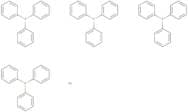
CAS 14221-02-4
:Tetrakis(trifenilfosfina)platino
Descripción:
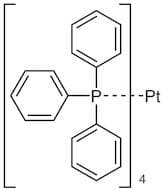
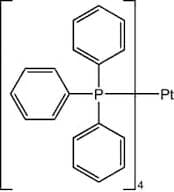
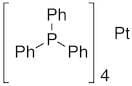
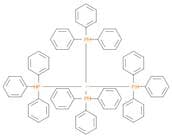
Tetrakis(trifenilfosfina)platino, con el número CAS 14221-02-4, es un compuesto de coordinación que presenta platino como el átomo central metálico coordinado a cuatro ligandos de triphenilfosfina. Este complejo se caracteriza típicamente por su geometría cuadrada plana, que es común en complejos de platino(II). La presencia de los voluminosos ligandos de triphenilfosfina imparte una significativa hindrance estérica, influyendo en la reactividad y estabilidad del compuesto. Tetrakis(trifenilfosfina)platino se utiliza a menudo en diversas aplicaciones, incluyendo catálisis, síntesis orgánica y como precursor en la preparación de otros complejos de platino. Exhibe una notable solubilidad en disolventes orgánicos, lo que lo hace adecuado para reacciones en entornos no acuosos. Además, el compuesto puede mostrar propiedades electrónicas interesantes debido a las interacciones entre el centro de platino y los ligandos de fosfina, lo que puede afectar su comportamiento en procesos catalíticos. En general, Tetrakis(trifenilfosfina)platino es un compuesto importante en la química de coordinación y la química organometálica, con diversas aplicaciones en la investigación y la industria.
Fórmula:C72H60P4Pt
InChI:InChI=1S/4C18H15P.Pt/c4*1-4-10-16(11-5-1)19(17-12-6-2-7-13-17)18-14-8-3-9-15-18;/h4*1-15H;
Clave InChI:InChIKey=SYKXNRFLNZUGAJ-UHFFFAOYSA-N
SMILES:[Pt]([P](C1=CC=CC=C1)(C2=CC=CC=C2)C3=CC=CC=C3)([P](C4=CC=CC=C4)(C5=CC=CC=C5)C6=CC=CC=C6)([P](C7=CC=CC=C7)(C8=CC=CC=C8)C9=CC=CC=C9)[P](C%10=CC=CC=C%10)(C%11=CC=CC=C%11)C%12=CC=CC=C%12
Sinónimos:- (T-4)-Tetrakis(triphenylphosphine)platinum
- Platinum tetra(triphenylphosphine)
- Platinum, tetrakis(triphenylphosphine)-
- Platinum, tetrakis(triphenylphosphine)-, (T-4)-
- Platinum-Triphenylphosphane (1:4)
- Tetrakis(triphenylphosphine)platinum
Ordenar por
Pureza (%)
0
100
|
0
|
50
|
90
|
95
|
100
Encontrado 7 productos.
Tetrakis(triphenylphosphine)platinum(0)
CAS:Fórmula:C72H60P4PtForma y color:Light yellow to Brown powder to crystalPeso molecular:1,244.25Tetrakis(triphenylphosphine)platinum(0), Pt 15.2% min
CAS:Hydrosilation and oxidationFórmula:C72H60P4PtPeso molecular:1244.25Tetrakis(triphenylphosphine)platinum(0), 98%
CAS:Tetrakis(triphenylphosphine)platinum(0), 98%
Fórmula:Pt(C6H5)3PPureza:98%Forma y color:yellow xtl.Peso molecular:1244.21Platinum, tetrakis(triphenylphosphine)-, (T-4)-
CAS:Fórmula:C72H60P4PtPureza:98%Forma y color:SolidPeso molecular:1244.2198Tetrakis(triphenylphosphine)platinum
CAS:Tetrakis(triphenylphosphine)platinum
Pureza:98%Peso molecular:1244.22g/molTetrakis(triphenylphosphine)platinum(0)
CAS:Tetrakis(triphenylphosphine)platinum(0) is a compound that belongs to the group of organometallic complexes. It is a multinuclear compound, which means it contains more than one metal atom. Tetrakis(triphenylphosphine)platinum(0) has been used as an oxidizing agent in organic chemistry and as a catalyst for chemical reactions. Tetrakis(triphenylphosphine)platinum(0) is chemically stable and insoluble in water, making it useful for reactions that require protection from water or other protic solvents. Tetrakis(triphenylphosphine)platinum(0) has been shown to react with chloride to form chloroplatinates, with ester compounds to form platinum esters, and with carbon-carbon double bonds to form platinum carbonyls.Fórmula:C72H60P4PtForma y color:PowderPeso molecular:1,244.23 g/molTetrakis(Triphenylphosphine)platinum(0)
CAS:Fórmula:C72H60P4PtPureza:95%Forma y color:Solid, PowderPeso molecular:1244.251