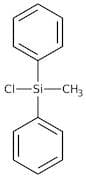
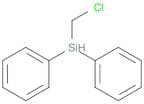
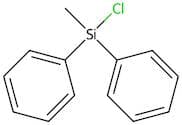
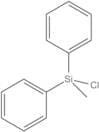
CAS 144-79-6
:Cloro(metil)difenílsilano
- 1,1′-(Chloromethylsilylene)bis[benzene]
- Benzene, 1,1'-(chloromethylsilylene)bis-
- Chloro(methyl)diphenylsilane
- Chlorodiphenylmethylsilane
- Diphenyl(methyl)chlorosilane
- Diphenyl(methyl)silyl chloride
- Methyldiphenylchlorosilane
- Methyldiphenylsilyl chloride
- NSC 93961
- Silane, chloromethyldiphenyl-
- Tsl 8066
- Ver más sinónimos
Diphenylmethylchlorosilane
CAS:Fórmula:C13H13ClSiPureza:>95.0%(GC)Forma y color:Colorless to Light yellow to Light orange clear liquidPeso molecular:232.78Chloro(methyl)diphenylsilane, 97%
CAS:Chloro(methyl)diphenylsilane is used in agrochemical, pharmaceutical and dyestuff field . This Thermo Scientific Chemicals brand product was originally part of the Alfa Aesar product portfolio. Some documentation and label information may refer to the legacy brand. The original Alfa Aesar product /Fórmula:C13H13ClSiPureza:97%Forma y color:Clear colorless, LiquidPeso molecular:232.78BENZENE, 1,1'-(CHLOROMETHYLSILYLENE)BIS-
CAS:Fórmula:C13H13ClSiPureza:97%Forma y color:LiquidPeso molecular:232.7808Chloro(methyl)diphenylsilane
CAS:Chloro(methyl)diphenylsilaneFórmula:C13H13ClSiPureza:97%Forma y color: clear.almost coulrless liquidPeso molecular:232.78g/molDIPHENYLMETHYLCHLOROSILANE
CAS:Phenyl-Containing Blocking Agent
Used as a protecting group for reactive hydrogens in alcohols, amines, thiols, and carboxylic acids. Organosilanes are hydrogen-like, can be introduced in high yield, and can be removed under selective conditions. They are stable over a wide range of reaction conditions and can be removed in the presence of other functional groups, including other protecting groups. The tolerance of silylated alcohols to chemical transformations summary is presented in Table 1 of the Silicon-Based Blocking Agents brochure.
Aromatic Silane - Conventional Surface Bonding
Aliphatic, fluorinated aliphatic or substituted aromatic hydrocarbon substituents are the hydrophobic entities which enable silanes to induce surface hydrophobicity. The organic substitution of the silane must be non-polar. The hydrophobic effect of the organic substitution can be related to the free energy of transfer of hydrocarbon molecules from an aqueous phase to a homogeneous hydrocarbon phase. A successful hydrophobic coating must eliminate or mitigate hydrogen bonding and shield polar surfaces from interaction with water by creating a non-polar interphase. Although silane and silicone derived coatings are in general the most hydrophobic, they maintain a high degree of permeability to water vapor. This allows coatings to breathe and reduce deterioration at the coating interface associated with entrapped water. Since ions are not transported through non-polar silane and silicone coatings, they offer protection to composite structures ranging from pigmented coatings to rebar reinforced concrete. A selection guide for hydrophobic silanes can be found on pages 22-31 of the Hydrophobicity, Hydrophilicity and Silane Surface Modification brochure.
Diphenylmethylchlorosilane; Methyldiphenylchlorosilane; Chloro(methyl)diphenylsilane
Viscosity: 5.3 cStΔHvap: 623.7 kJ/molSurface tension: 40.0 mN/mVapor pressure, 125 °C: 3 mmThermal conductivity: 0.112 W/m°Cα-Silylates esters, lactones; precursors to silyl enolatesC-Silylates carbamates as shown in the enantioselective example w/ a neryl carbamateStability versus other silyl ethers studiedSummary of selective deprotection conditions is provided in Table 7 through Table 20 of the Silicon-Based Blocking Agents brochureFórmula:C13H13ClSiPureza:97%Forma y color:LiquidPeso molecular:232.78