CAS 14618-59-8
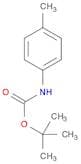
:Ácido carbámico, N-(4-metilfenil)-, éster 1,1-dimetiletilo
Descripción:
Ácido carbámico, N-(4-metilfenil)-, éster 1,1-dimetiletilo, comúnmente conocido por su número CAS 14618-59-8, es un compuesto orgánico que pertenece a la clase de los carbamatos. Esta sustancia se caracteriza por su grupo funcional éster, que se forma a partir de la reacción del ácido carbámico y un alcohol. Típicamente aparece como un líquido incoloro a amarillo pálido con un olor distintivo. El compuesto es conocido por su solubilidad moderada en disolventes orgánicos y su solubilidad limitada en agua, que es una característica común entre muchos carbamatos. Exhibe propiedades como ser un posible intermedio en la síntesis orgánica y puede tener aplicaciones en agricultura como pesticida o herbicida. Además, al igual que muchos derivados de carbamato, puede poseer actividad biológica, influyendo en su uso en varios procesos químicos. Se deben consultar los datos de seguridad, ya que los carbamatos pueden exhibir toxicidad para los humanos y la vida silvestre, lo que requiere un manejo y uso cuidadoso en entornos de laboratorio e industriales.
Fórmula:C12H17NO2
InChI:InChI=1S/C12H17NO2/c1-9-5-7-10(8-6-9)13-11(14)15-12(2,3)4/h5-8H,1-4H3,(H,13,14)
Clave InChI:InChIKey=GNUJXPOJGTXSEZ-UHFFFAOYSA-N
SMILES:N(C(OC(C)(C)C)=O)C1=CC=C(C)C=C1
Sinónimos:- tert-Butyl p-tolylcarbamate
- Carbamic acid, N-(4-methylphenyl)-, 1,1-dimethylethyl ester
- Carbamic acid, (4-methylphenyl)-, 1,1-dimethylethyl ester
- tert-Butyl p-methylphenylcarbamate
- Carbanilic acid, p-methyl-, tert-butyl ester
Ordenar por
Pureza (%)
0
100
|
0
|
50
|
90
|
95
|
100
Se han encontrado 4 productos.
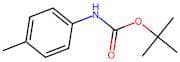
tert-Butyl N-(4-methylphenyl)carbamate
CAS:Fórmula:C12H17NO2Pureza:98%Forma y color:SolidPeso molecular:207.2689tert-butyl p-tolylcarbamate
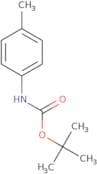
CAS:tert-butyl p-tolylcarbamateFórmula:C12H17NO2Pureza:98%Peso molecular:207.27tert-Butyl N-(4-methylphenyl)carbamate
CAS:Tert-butyl N-(4-methylphenyl)carbamate is a reusable, efficient method for the synthesis of tert-butyl carbamates from amines and carbon dioxide. This reaction is an example of a C–H bond activation that proceeds through an anion intermediate. The reaction time can be reduced by irradiation to increase the efficiency. Electrons are unpaired during this process, which is modeled with quantum mechanics software. Chloride is used as a catalyst to activate the electron and generate a reactive intermediate. Amine functionalities are added to the molecule in order to give it desired properties. The chloride group can be replaced with other anions such as bromide or iodide, which will also introduce different reactivity patterns.Fórmula:C12H17NO2Pureza:Min. 95%Peso molecular:207.27 g/mol