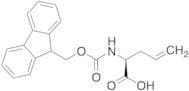
CAS 146549-21-5
:Fmoc-L-Alilglicina
Descripción:
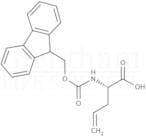
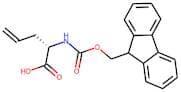
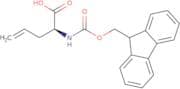
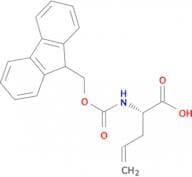
Fmoc-L-Alilglicina es un derivado sintético de aminoácidos caracterizado por la presencia de un grupo protector fluorenilmetoxicarbonilo (Fmoc) unido al grupo amino de L-alilglicina. Este compuesto es notable por su papel en la síntesis de péptidos, particularmente en la síntesis de péptidos en fase sólida (SPPS), donde el grupo Fmoc actúa como un moiety protector que puede ser eliminado selectivamente en condiciones básicas. La cadena lateral de alilo proporciona una reactividad única, permitiendo una mayor funcionalización o incorporación en péptidos. Fmoc-L-Alilglicina es típicamente un sólido blanco a blanco sucio y es soluble en disolventes orgánicos como el dimetilformamida (DMF) y el dimetilsulfóxido (DMSO), pero menos soluble en agua. Su estructura molecular incluye tanto un grupo amino como un grupo funcional ácido carboxílico, lo que lo convierte en un compuesto anfótero. El compuesto se utiliza en diversas aplicaciones bioquímicas, incluida la síntesis de bibliotecas de péptidos y el estudio de interacciones proteicas, debido a su capacidad para introducir diversidad estructural en las secuencias de péptidos.
Fórmula:C20H19NO4
InChI:InChI=1/C20H19NO4/c1-2-7-18(19(22)23)21-20(24)25-12-17-15-10-5-3-8-13(15)14-9-4-6-11-16(14)17/h2-6,8-11,17-18H,1,7,12H2,(H,21,24)(H,22,23)/t18-/m1/s1
SMILES:C=CC[C@H](C(=O)O)N=C(O)OCC1c2ccccc2c2ccccc12
Sinónimos:- Fmoc-(S)-2-Allylglycine
- (S)-N-FMOC-Allylglycine
- (S)-N-(9-Fluorenylmethoxycarbonyl)-2-amino-4-pentenoic acid
- (2S)-2-{[(9H-fluoren-9-ylmethoxy)carbonyl]amino}pent-4-enoic acid
- (2S)-2-{[(9H-fluoren-9-ylmethoxy)carbonyl]amino}pent-4-enoate
- (2R)-2-{[(9H-fluoren-9-ylmethoxy)carbonyl]amino}pent-4-enoic acid
- Fmoc-Gly(Allyl)-OH
Ordenar por
Pureza (%)
0
100
|
0
|
50
|
90
|
95
|
100
Encontrado 8 productos.
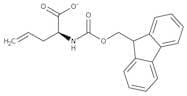
2-Allyl-N-Fmoc-L-glycine, 95%
CAS:2-Allyl-N-Fmoc-L-glycine is potentially useful for solid phase peptide synthesis techniques. 2-Allyl-N-Fmoc-L-glycine compound could be useful as an unusual amino acid analog to aid in the deconvolution of protein structure and function. Reagent in the synthesis of a Dicarba-Analog of Octreotide. ThFórmula:C20H18NO4Pureza:95%Forma y color:Powder or crystals or crystalline powder, WhitePeso molecular:336.37Fmoc-α-allyl-Gly-OH
CAS:Allylglycine-containing peptides may be cleaved selectively at the amide bond between allylglycine and the subsequent amino acid with iodine. The lateral double bond allows selective modifications of a peptide e.g. via metathesis. Replacing cysteine residues by allylglycine allows to obtain carba-analogs of disulfide-bridged peptides. Educt for obtaining Fmoc-prenylglycine.Fórmula:C20H19NO4Pureza:99.9%Forma y color:White PowderPeso molecular:337.384-Pentenoic acid, 2-[[(9H-fluoren-9-ylmethoxy)carbonyl]amino]-, (2S)-
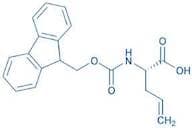
CAS:Fórmula:C20H19NO4Pureza:98%Forma y color:SolidPeso molecular:337.3692Ref: IN-DA001E3Y
1kgA consultar250gA consultar500gA consultar250mg28,00€1g34,00€5g89,00€10g139,00€25g185,00€50g332,00€100g575,00€L-2-Allylglycine, N-FMOC protected
CAS:L-2-Allylglycine, N-FMOC protectedPureza:97%Peso molecular:337.36916g/molFMoc-L-Allylglycine
CAS:FMoc-L Allylglycine is a synthetic reactive molecule that binds to the P2Y receptor. It is active in the cell maturation process and stimulates receptor activity. FMoc-L-Allylglycine has been shown to have anticancer properties, as well as an effect on human serum and bovine fetal serum. The nitrogen atoms in FMoc-L-Allylglycine are capable of forming strong bonds with buffers and imprinting agents, which can be used to study biomolecules. The disulfide bond in FMoc-L-Allylglycine can be cleaved with reductive conditions, making it a useful tool for the synthesis of peptides.Fórmula:C20H19NO4Pureza:Min. 95%Forma y color:White PowderPeso molecular:337.37 g/molFmoc-allyl-L-glycine
CAS:M06090 - Fmoc-allyl-L-glycine
Fórmula:C20H19NO4Pureza:95%Forma y color:Solid, Crystalline Powder or PowderPeso molecular:337.375Fmoc-L-allylglycine
CAS:Producto controladoApplications Fmoc-L-allylglycine is an intermediate used in the synthesis of biologically active molecules.
References Sbicca, L., et al.: Phys. Chem. Chem. Phys., 19, 18452 (2017); Namoto, K., et al.: Bioorg. Med. Chem. Lett., 28, 906 (2018)Fórmula:C20H19NO4Forma y color:NeatPeso molecular:337.37


![4-Pentenoic acid, 2-[[(9H-fluoren-9-ylmethoxy)carbonyl]amino]-, (2S)-](/_next/image/?url=https%3A%2Fstatic.cymitquimica.com%2Fproducts%2FIN%2Fthumb%2FDA001E3Y.jpg&w=3840&q=75)