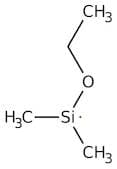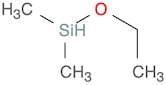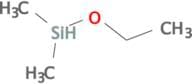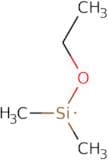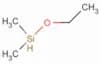
CAS 14857-34-2
:Etoxidimetilsilano
- Dimethylmonoethoxysilane
- Ethoxy(Dimethyl)Silyl
- Ethoxydimethylsilane
- Ethoxydimethylvinylsilane
- Ls 490
- Silane, ethoxydimethyl-
- Siv 9072.0
- Vinyldimethylethoxysilane
- Dimethylethoxysilane
Dimethylethoxysilane, 94%
CAS:Dimethylethoxysilane (DMES), a volatile liquid, is used by NASA to waterproof the heatprotective silica tiles and blankets on the space shuttle. DMES readily produces a variety of products in the presence of small amounts of moisture or bases. DMES readily produces a variety of products in the pres
Fórmula:C4H11OSiPureza:94%Forma y color:Clear colorless, LiquidPeso molecular:103.22DIMETHYLETHOXYSILANE
CAS:Tri-substituted Silane Reducing Agent
Organosilanes are hydrocarbon-like and possess the ability to serve as both ionic and free-radical reducing agents. These reagents and their reaction by-products are safer and more easily handled and disposed than many other reducing agents. The metallic nature of silicon and its low electronegativity relative to hydrogen lead to polarization of the Si-H bond yielding a hydridic hydrogen and a milder reducing agent compared to aluminum-, boron-, and other metal-based hydrides. A summary of some key silane reductions are presented in Table 1 of the Silicon-Based Reducing Agents brochure.
Alkyl Silane - Conventional Surface Bonding
Aliphatic, fluorinated aliphatic or substituted aromatic hydrocarbon substituents are the hydrophobic entities which enable silanes to induce surface hydrophobicity. The organic substitution of the silane must be non-polar. The hydrophobic effect of the organic substitution can be related to the free energy of transfer of hydrocarbon molecules from an aqueous phase to a homogeneous hydrocarbon phase. A successful hydrophobic coating must eliminate or mitigate hydrogen bonding and shield polar surfaces from interaction with water by creating a non-polar interphase. Although silane and silicone derived coatings are in general the most hydrophobic, they maintain a high degree of permeability to water vapor. This allows coatings to breathe and reduce deterioration at the coating interface associated with entrapped water. Since ions are not transported through non-polar silane and silicone coatings, they offer protection to composite structures ranging from pigmented coatings to rebar reinforced concrete. A selection guide for hydrophobic silanes can be found on pages 22-31 of the Hydrophobicity, Hydrophilicity and Silane Surface Modification brochure.
Dimethylethoxysilane; Ethoxydimethylsilane
Vapor pressure, 20 °C: 281 mmUndergoes hydrosilylation reactionsWaterproofing agent for space shuttle thermal tilesWill form high-boiling polymeric by-products with aqueous work-upExtensive review of silicon based reducing agents: Larson, G.; Fry, J. L. "Ionic and Organometallic-Catalyzed Organosilane Reductions", Wipf, P., Ed.; Wiley, 2007Fórmula:C4H12OSiPureza:97%Forma y color:LiquidPeso molecular:104.22Dimethylethoxysilane
CAS:S07250 - Dimethylethoxysilane
Fórmula:C4H12OSiPureza:97%Forma y color:Liquid, Clear LiquidPeso molecular:104.224Dimethylethoxysilane
CAS:Dimethylethoxysilane is a chemical compound that belongs to the group of organosilicon compounds. It is an ether of dimethyldichlorosilane and ethanol. Dimethylethoxysilane has been shown to react with metal ions, such as iron, copper, nickel, and cobalt, forming metal chelates. These metal chelates are used in catalysis and magnetic resonance imaging (MRI). The hydroxyl groups on the silicon atom have been shown to bind to reactive particles such as carbon monoxide, which may be due to the hydrogen bonding between these two atoms. Dimethylethoxysilane has a melting point of 152° Celsius and a boiling point of 330° Celsius. It is stable at room temperature but decomposes when heated or exposed to light.
Fórmula:C4H12OSiPureza:Min. 95%Forma y color:Clear LiquidPeso molecular:104.22 g/molRef: 3D-FD177802
Producto descatalogado