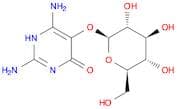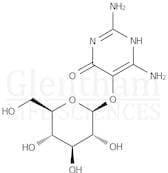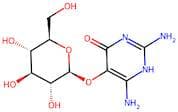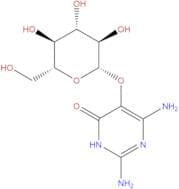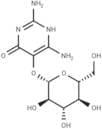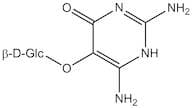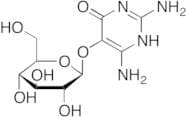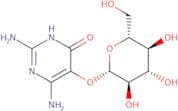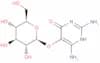
CAS 152-93-2
:Vecino
Descripción:
Vecino es un alcaloide que se encuentra de forma natural principalmente en las semillas de Vicia faba, comúnmente conocidas como habas. Se clasifica como un glucósido y es conocido por su similitud estructural con otros compuestos como conVecino. Vecino se caracteriza por su potencial para causar estrés oxidativo en ciertos individuos, particularmente aquellos con deficiencia en la enzima glucosa-6-fosfato deshidrogenasa (G6PD), lo que lleva a anemia hemolítica. El compuesto tiene una fórmula molecular que refleja su estructura compleja, que incluye múltiples grupos funcionales. Vecino es soluble en agua y presenta un sabor amargo. Se piensa que su papel en la fisiología vegetal está relacionado con los mecanismos de defensa contra herbívoros y patógenos. Además de su importancia biológica, Vecino ha sido estudiado por sus posibles efectos farmacológicos, aunque su seguridad y eficacia en aplicaciones terapéuticas requieren una investigación adicional. En general, Vecino es un compuesto importante tanto en contextos nutricionales como médicos, lo que requiere una cuidadosa consideración en las elecciones dietéticas, especialmente para individuos con condiciones de salud específicas.
Fórmula:C10H16N4O7
InChI:InChI=1S/C10H16N4O7/c11-7-6(8(19)14-10(12)13-7)21-9-5(18)4(17)3(16)2(1-15)20-9/h2-5,9,15-18H,1H2,(H5,11,12,13,14,19)/t2-,3-,4+,5-,9+/m1/s1
Clave InChI:InChIKey=KGNGTSCIQCLKEH-SYCVNHKBSA-N
SMILES:O(C1=C(N)NC(N)=NC1=O)[C@@H]2O[C@H](CO)[C@@H](O)[C@H](O)[C@H]2O
Sinónimos:- 2,6-Diamino-4-Oxo-1,4-Dihydropyrimidin-5-Yl Hexopyranoside
- 2,6-Diamino-5-(β-<span class="text-smallcaps">D</span>-glucopyranosyloxy)-4(1H)-pyrimidinone
- 2,6-diamino-4-oxo-1,4-dihydropyrimidin-5-yl beta-D-glucopyranoside
- 4(1H)-Pyrimidinone, 2,6-diamino-5-(β-<span class="text-smallcaps">D</span>-glucopyranosyloxy)-
- Divicine β-<span class="text-smallcaps">D</span>-glucopyranoside
- NSC 95092
- Vicine
- Vicioside
- 2,6-Diamino-5-(β-D-glucopyranosyloxy)-4(1H)-pyrimidinone
- Divicine β-D-glucopyranoside
- 4(1H)-Pyrimidinone, 2,6-diamino-5-(β-D-glucopyranosyloxy)-
Ordenar por
Pureza (%)
0
100
|
0
|
50
|
90
|
95
|
100
Encontrado 8 productos.
2,6-diamino-5-(β-D-glucopyranosyloxy)-(1H)-pyrimidin-4-one
CAS:Fórmula:C10H16N4O7Pureza:99%Forma y color:SolidPeso molecular:304.2566Vicine
CAS:Vicine is important natural fungicide. "High levels" of vicine or convicine or both might have shortened the birds' survival time by enhancing the neurotoxicity induced by "lower levels" of beta-cyanoalanine.Fórmula:C10H16N4O7Pureza:95%~99%Peso molecular:304.259Vicine
CAS:Vicine, an alkaloid found in fava beans, is toxic in individuals and may cause haemolytic anaemia.Fórmula:C10H16N4O7Pureza:99.82% - >99.99%Forma y color:SolidPeso molecular:304.26Vicine
CAS:Natural alkaloidFórmula:C10H16N4O7Pureza:≥ 95.0 % (HPLC)Forma y color:PowderPeso molecular:304.26Vicine
CAS:Applications Vicine is a pyrimidine glycosides, a precursor of the aglycons divicine and isouramil which is main factors of favism. It is found in faba/fava bean. Also, it is derived from Ethyl Glyoxylate (E918550), which is used as a reagent in the synthesis of a new class of cinnamyl-triazole compounds which can be used as selective inhibitors of human aromatase (cytochrome P 450 19A1)
References Rizzello, C. G., et al.: Sci. Rep., 6, 32452 (2016); Pulkkinen, M., et al.: Food Chem., 212, 10-19 (2016); McNulty, J., et al.: Bioorg. Med. Chem. Lett., 24, 4586 (2014)Fórmula:C10H16N4O7Forma y color:White To Light BeigePeso molecular:304.26Vicine
CAS:Vicine is a plant toxin that inhibits the activity of the enzyme hydroxylase, which is essential for the synthesis of the amino acid tyrosine. Vicine also inhibits proteins involved in the metabolism of carbohydrates, fatty acids, and proteins. Vicine is found in plants such as beans, peas, lentils, and soybeans. It has been shown to inhibit glomerular filtration rate and may be used to treat metabolic disorders such as hyperglycemia or fatty acid oxidation disorder.Fórmula:C10H16N4O7Pureza:Min. 95%Peso molecular:304.26 g/mol