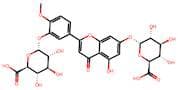
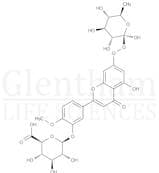
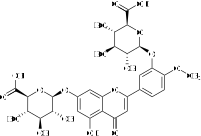
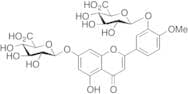
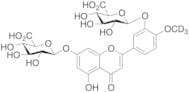
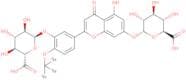
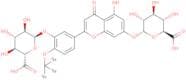
![5-[7-(β-D-Glucopyranuronosyloxy)-5-hydroxy-4-oxo-4H-1-benzopyran-2-yl]-2-methoxyphenyl β-D-glucopy…](/_next/image/?url=https%3A%2Fstatic.cymitquimica.com%2Fcas-image%2Fthumb-webp%2F324556-5-7-b-d-glucopyranuronosyloxy-5-hydroxy-4-oxo-4h-1-benzopyran-2-yl-2-methoxyphenyl-b-d-glucopyranosiduronic-acid.webp&w=3840&q=75)
CAS 152503-51-0
:ácido 5-[7-(β-D-glucopiranuronosiloxi)-5-hidroxi-4-oxo-4H-1-benzopiran-2-il]-2-metoxifenil β-D-glucopiranosidurónico
Descripción:
La sustancia química conocida como "ácido 5-[7-(β-D-glucopiranuronosiloxi)-5-hidroxi-4-oxo-4H-1-benzopiran-2-il]-2-metoxifenil β-D-glucopiranosidurónico" con número CAS 152503-51-0 es un compuesto orgánico complejo caracterizado por su estructura polifenólica, que incluye un moiety de benzopirano y múltiples unidades de azúcar. Este compuesto presenta un grupo glucopiranuronosilo, lo que indica que tiene enlaces glucosídicos que contribuyen a su solubilidad y actividad biológica. La presencia de grupos hidroxilo y metoxi sugiere potencial para enlaces de hidrógeno y reactividad, lo que puede influir en sus propiedades farmacológicas. Tales compuestos a menudo se estudian por sus efectos antioxidantes, antiinflamatorios y terapéuticos potenciales en varios sistemas biológicos. La estructura intrincada también implica que puede interactuar con varios objetivos biológicos, lo que lo hace de interés en la química medicinal y la investigación de productos naturales. En general, esta sustancia ejemplifica la complejidad y diversidad de los compuestos fenólicos glicosilados que se encuentran en la naturaleza.
Fórmula:C28H28O18
InChI:InChI=1S/C28H28O18/c1-41-12-3-2-8(4-14(12)44-28-22(36)18(32)20(34)24(46-28)26(39)40)13-7-11(30)16-10(29)5-9(6-15(16)43-13)42-27-21(35)17(31)19(33)23(45-27)25(37)38/h2-7,17-24,27-29,31-36H,1H3,(H,37,38)(H,39,40)/t17-,18-,19-,20-,21+,22+,23-,24-,27+,28+/m0/s1
Clave InChI:InChIKey=JBZAJCHQSCNMOJ-MUZNOBILSA-N
SMILES:O=C1C=2C(OC(=C1)C3=CC(O[C@@H]4O[C@H](C(O)=O)[C@@H](O)[C@H](O)[C@H]4O)=C(OC)C=C3)=CC(O[C@@H]5O[C@H](C(O)=O)[C@@H](O)[C@H](O)[C@H]5O)=CC2O
Sinónimos:- β-D-Glucopyranosiduronic acid, 5-[7-(β-D-glucopyranuronosyloxy)-5-hydroxy-4-oxo-4H-1-benzopyran-2-yl]-2-methoxyphenyl
- 5-[7-(β-D-Glucopyranuronosyloxy)-5-hydroxy-4-oxo-4H-1-benzopyran-2-yl]-2-methoxyphenyl β-D-glucopyranosiduronic acid
Ordenar por
Pureza (%)
0
100
|
0
|
50
|
90
|
95
|
100
Encontrado 8 productos.
Diosmetin 7,3'-di-O-β-D-glucuronide
CAS:Diosmetin 7,3'-di-O-β-D-glucuronidePeso molecular:652.51g/molDiosmetin 3’,7-Diglucuronide (>85%)
CAS:Producto controladoStability Hygroscopic
Applications Diosmetin 3’,7-Diglucuronide is a metabolite of Diosmetin (D485000) which is a flavonoid often administered in the treatment of chronic venous insufficiency, hemorrhoids, and related affections.
References Silverstro, L., et al.: Anal. Bioanal. Chem., 405, 8295 (2013); Boutin, J., et al.; Drug Metab. Dispos., 21, 1157 (1993)Fórmula:C28H28O18Pureza:>85%Forma y color:NeatPeso molecular:652.51Diosmetin 3',7-Diglucuronide-d3
CAS:Producto controladoApplications Diosmetin 3’,7-Diglucuronide-d3 is labelled Diosmetin 3’,7-Diglucuronide (D485040), a metabolite of Diosmetin (D485000) which is a flavonoid often administered in the treatment of chronic venous insufficiency, hemorrhoids, and related affections.
References Silverstro, L., et al.: Anal. Bioanal. Chem., 405, 8295 (2013); Boutin, J., et al.; Drug Metab. Dispos., 21, 1157 (1993)Fórmula:C28H25D3O18Forma y color:NeatPeso molecular:655.53Diosmetin-d3-3,7-O-di-Glucuronide
CAS:Producto controladoDiosmetin-d3-3,7-O-di-Glucuronide is a white to off-white powder that is soluble in water. It is a synthetic compound that can be used as a sugar or carbohydrate modification. It has been shown to be useful for the synthesis of complex carbohydrates and polysaccharides. This product can also be used in click chemistry, methylation, and fluoroination.Fórmula:C28H25D3O18Pureza:Min. 95%Peso molecular:655.53 g/molDiosmetin-3',7-diglucuronide
CAS:Producto controladoDiosmetin-3',7-diglucuronide is a synthetic compound that can be used as a methyl donor in the synthesis of oligosaccharides and polysaccharides. It has been modified with fluorination to increase its stability and efficiency. This product is highly pure, with an excellent quality.Fórmula:C28H28O18Pureza:Min. 95 Area-%Forma y color:PowderPeso molecular:652.51 g/mol