CAS 15291-75-5
:Ginkgólido A
Descripción:
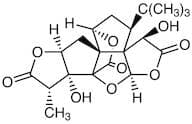
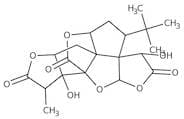
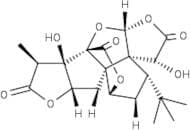
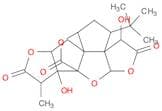
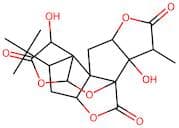
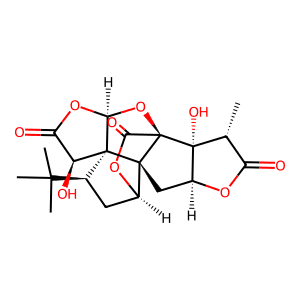
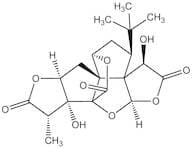
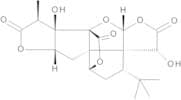
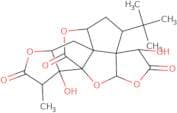
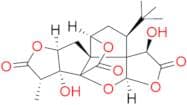
Ginkgólido A es un compuesto natural derivado de las hojas del árbol Ginkgo biloba, conocido por sus posibles beneficios para la salud y propiedades medicinales. Pertenece a una clase de compuestos llamados terpenoides, específicamente un tipo de lactona diterpénica. Ginkgólido A se caracteriza por su estructura bicíclica única, que contribuye a su actividad biológica. Exhibe varios efectos farmacológicos, incluyendo propiedades neuroprotectoras, antiinflamatorias y antioxidantes, lo que lo hace de interés en el estudio de enfermedades neurodegenerativas y mejora cognitiva. Además, se ha investigado Ginkgólido A por su capacidad para inhibir el factor activador de plaquetas (PAF), que juega un papel en la inflamación y la trombosis. El compuesto se encuentra típicamente en suplementos herbales y extractos derivados de Ginkgo biloba, y su perfil de seguridad ha sido evaluado en varios estudios. Sin embargo, al igual que muchos productos herbales, puede interactuar con otros medicamentos, por lo que se aconseja precaución cuando se utiliza junto con anticoagulantes o medicamentos antiplaquetarios. En general, Ginkgólido A representa un área significativa de investigación en fitoquímica y farmacología.
Fórmula:C20H24O9
InChI:InChI=1S/C20H24O9/c1-7-12(22)26-10-6-17-9-5-8(16(2,3)4)18(17)11(21)13(23)28-15(18)29-20(17,14(24)27-9)19(7,10)25/h7-11,15,21,25H,5-6H2,1-4H3/t7-,8+,9-,10+,11+,15+,17-,18?,19-,20?/m1/s1
Clave InChI:InChIKey=FPUXKXIZEIDQKW-IKIFPUOBSA-N
SMILES:O[C@@]12C34[C@]5(C6([C@](O3)(OC(=O)[C@@H]6O)[H])[C@H](C(C)(C)C)C[C@]5(OC4=O)[H])C[C@@]1(OC(=O)[C@H]2C)[H]
Sinónimos:- (1R,3S,3aS,4R,6aR,7aR,7bR,8S,10aS,11aS)-3-(1,1-Dimethylethyl)hexahydro-4,7b-dihydroxy-8-methyl-9H-1,7a-(epoxymethano)-1H,6aH-cyclopenta[c]furo[2,3-b]furo[3′,2′:3,4]cyclopenta[1,2-d]furan-5,9,12(4H)-trione
- (1R,3aR,4bR,5S,7aS,9R,11S)-11-tert-butyl-1,4b-dihydroxy-5-methyltetrahydro-4bH,9H-9,4a-(epoxymethano)cyclopenta[c]furo[2,3-b]furo[3',2':3,4]cyclopenta[1,2-d]furan-2,6,13(1H,5H)-trione
- (3aR,4aR,4bR,5S,7aS,9R,11S)-11-tert-butyl-1,4b-dihydroxy-5-methyltetrahydro-4bH,9H-9,4a-(epoxymethano)cyclopenta[c]furo[2,3-b]furo[3',2':3,4]cyclopenta[1,2-d]furan-2,6,13(1H,5H)-trione
- 9H-1,7a-(Epoxymethano)-1H,6aH-cyclopenta(c)furo(2,3-b)furo(3',2':3,4)cyclopenta(1,2-d)furan-5,9,12(4H)-trione, 3-(1,1-dimethylethyl)hexahydro-4,7b-dihydroxy-8-methyl-, (1R,3S,3aS,4R,6aR,7aR,7bR,8S,10aS,11aS)-
- 9H-1,7a-(Epoxymethano)-1H,6aH-cyclopenta(c)furo(2,3-b)furo(3',2':3,4)cyclopenta(1,2-d)furan-5,9,12(4H)-trione, 3-(1,1-dimethylethyl)hexahydro-4,7b-dihydroxy-8-methyl-, (1R-(1alpha,3beta,3aS*,4beta,6aalpha,7aalpha,7balpha,8alpha,10aalpha,11 aS*))-
- 9H-1,7a-(Epoxymethano)-1H,6aH-cyclopenta(c)furo(2,3-b)furo(3',2':3,4)cyclopenta(1,2-d)furan-5,9,12(4H)-trione, 3-tert-butylhexahydro-4,7b-dihydroxy-8-methyl-
- 9H-1,7a-(Epoxymethano)-1H,6aH-cyclopenta[c]furo[2,3-b]furo[3′,2′:3,4]cyclopenta[1,2-d]furan-5,9,12(4H)-trione, 3-(1,1-dimethylethyl)hexahydro-4,7b-dihydroxy-8-methyl-, (1R,3S,3aS,4R,6aR,7aR,7bR,8S,10aS,11aS)-
- 9H-1,7a-(Epoxymethano)-1H,6aH-cyclopenta[c]furo[2,3-b]furo[3′,2′:3,4]cyclopenta[1,2-d]furan-5,9,12(4H)-trione, 3-(1,1-dimethylethyl)hexahydro-4,7b-dihydroxy-8-methyl-, [1R-(1α,3β,3aS*,4β,6aα,7aα,7bα,8α,10aα,11aS*)]-
- 9H-1,7a-(Epoxymethano)-1H,6aH-cyclopenta[c]furo[2,3-b]furo[3′,2′:3,4]cyclopenta[1,2-d]furan-5,9,12(4H)-trione, 3-tert-butylhexahydro-4,7b-dihydroxy-8-methyl-
- Bilobalide A
- Bn 52020
- [1R-(1α,3β,3aS*,4β,6aα,7aα,7bα,8α,10aα,11aS*)]-3-(1,1-Dimethylethyl)hexahydro-4,7b-dihydroxy-8-methyl-9H-1,7a-(epoxymethano)-1H,6aH-cyclopenta[c]furo[2,3-b]furo[3′,2′:3,4]cyclopenta[1,2-d]furan-5,9,12(4H)-trione
- Ver más sinónimos
Ordenar por
Pureza (%)
0
100
|
0
|
50
|
90
|
95
|
100
Encontrado 15 productos.
Ginkgolide A
CAS:Fórmula:C20H24O9Pureza:>98.0%(HPLC)(qNMR)Forma y color:White to Light yellow powder to crystalPeso molecular:408.40Ginkgolide A
CAS:Ginkgolide A analytical standard provided with w/w absolute assay, to be used for quantitative titration.Fórmula:C20H24O9Pureza:(HPLC) ≥98%Forma y color:PowderPeso molecular:408.41Ginkgolide A
CAS:Ginkgolide A is a platelet-activating factor antagonist, it can inhibit the neurotoxicity of prions or amyloid-beta1-42, may be relevant treatments for prion or Alzheimer's diseases.Ginkgolide A has neuroprotective, and anxiolytic-like effects, it is widely used for the treatment of cardiovascular diseases and diabetic vascular complications, which might be achieved through regulating the STAT3-mediated pathway.Fórmula:C20H24O9Pureza:95%~99%Peso molecular:408.403Ginkgolide A
CAS:Fórmula:C20H24O9Pureza:(HPLC) ≥ 98.0%Forma y color:Off-white powderPeso molecular:408.41Ginkgolide A
CAS:Ginkgolide A (BN-52020), from Ginkgo biloba leaves, is an active PAF antagonist with potential in treating inflammation and immune disorders.Fórmula:C20H24O9Pureza:98.76% - 99.81%Forma y color:White PowderPeso molecular:408.40Ginkgolide a
CAS:LactoneFórmula:C20H24O9Pureza:≥ 95.0 % (HPLC)Forma y color:PowderPeso molecular:408.41Ginkgolide A
CAS:Producto controladoApplications Family of bioactive terpenes treating cardiovascular and cerebrovascular diseases. Specific platelet activating factor (PAF) antagonists.
References Korth, R., et al.: Eur. J. Pharmacol., 152, 101 (1988), Braquet, P., et al.: Med. Res. Rev., 11, 295 (1991), van Beek, T.A., et al.: Bioorg. Med. Chem., 13, 5001 (2005)Fórmula:C20H24O9Forma y color:NeatPeso molecular:408.4Ginkgolide A
CAS:Ginkgolide A is a terpenoid lactone, which is a diterpene known for its presence in the leaves of the Ginkgo biloba tree. As a bioactive compound, it is naturally sourced from this ancient plant, which has been utilized in traditional medicine for centuries. Ginkgolide A acts primarily as an antagonist of platelet-activating factor (PAF), thereby influencing a range of physiological processes. Its modulatory effects on neurotransmission and vascular function arise from its ability to inhibit PAF binding to its receptor, reducing platelet aggregation and improving microcirculatory flow.Fórmula:C20H24O9Pureza:Min. 95%Forma y color:White PowderPeso molecular:408.4 g/mol