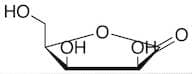
CAS 15384-34-6
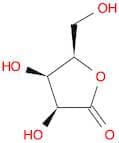
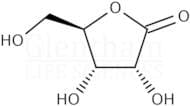
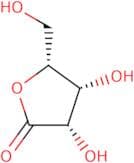
:(3R,5R)-3,4-dihidroxi-5-(hidroximetil)tetrahidrofurano-2-ona
Descripción:
La sustancia química conocida como (3R,5R)-3,4-dihidroxi-5-(hidroximetil)tetrahidrofurano-2-ona, con el número CAS 15384-34-6, es un derivado de azúcar cíclico caracterizado por su estructura de anillo de tetrahidrofurano. Este compuesto presenta múltiples grupos hidroxilo, que contribuyen a su naturaleza hidrofílica y potencial de formación de enlaces de hidrógeno, influyendo en su solubilidad en agua y otros disolventes polares. La presencia de estereocentros en las posiciones 3 y 5 otorga quiralidad, lo que conduce a una actividad óptica específica. Este compuesto se estudia a menudo por su actividad biológica, particularmente en relación con su papel en las vías metabólicas o como un posible precursor en la química orgánica sintética. Sus características estructurales sugieren que puede participar en varias reacciones químicas, incluyendo oxidación y esterificación, lo que lo hace de interés tanto en la investigación farmacéutica como bioquímica. En general, sus características estructurales únicas y grupos funcionales lo posicionan como un compuesto valioso en el estudio de la química de carbohidratos y campos relacionados.
Fórmula:C5H8O5
InChI:InChI=1/C5H8O5/c6-1-2-3(7)4(8)5(9)10-2/h2-4,6-8H,1H2/t2-,3?,4-/m1/s1
SMILES:C([C@@H]1C([C@H](C(=O)O1)O)O)O
Ordenar por
Pureza (%)
0
100
|
0
|
50
|
90
|
95
|
100
Encontrado 7 productos.
D-Lyxono-1,4-lactone
CAS:D-Lyxono-1,4-lactone is a 4-deoxy-l-fucose derivative that is a potent inhibitor of bacterial growth. It is a highly effective antibiotic with a broad spectrum of activity against Gram-positive and Gram-negative bacteria. D-Lyxono-1,4-lactone has been shown to be active against multivorans, including Escherichia coli and Salmonella enterica serovar Typhimurium. This compound was found to be more active than antibiotics such as penicillin and streptomycin. The structure of D-Lyxono-1,4-lactone includes two hydroxamic acid groups that are connected by an acetal linkage to form the benzylidene acetal moiety. The optical enantiomers of this molecule have been characterized using high resolution NMR spectroscopy and magnetic resonance spectroscopy techniques.BR> Dosis: 250Fórmula:C5H8O5Pureza:Min. 95.0 Area-%Peso molecular:148.11 g/molRef: 3D-W-201380
-Unit-ggA consultar5gA consultar10gA consultar25gA consultar50gA consultar2500mgA consultarD-Lyxono-1,4-lactone
CAS:D-Lyxono-1,4-lactone is an inhibitor of the enzyme fucosidase. It competitively inhibits the enzyme, but does not inhibit other hydroxamic acids such as enantiomers of D-lyxono-1,4-lactone. D-Lyxono-1,4-lactone has been used to treat HIV and AIDS because it prevents viral replication by blocking the synthesis of glycoproteins in the virus's envelope. It also has inhibitory effects on tumor cells that are not dependent on fucosidase activity. Magnetic resonance spectroscopy (NMR) studies have shown that d-lyxono-1,4-lactone binds to human liver cells and blocks the binding site for cytotoxic molecules in these cells. The molecular modelling study has demonstrated that d-lyxono 1,4 lactone binds to a specific site on human HLA class II molecule and reduces itsFórmula:C5H8O5Pureza:(%) Min. 97%Forma y color:PowderPeso molecular:148.11 g/mol(3S,4R,5R)-3,4-Dihydroxy-5-(hydroxymethyl)dihydrofuran-2(3H)-one
CAS:Fórmula:C5H8O5Pureza:95%Peso molecular:148.114D-Lyxono-1,4-lactone
CAS:Producto controladoApplications D-Lyxono-1,4-lactone is used for synthesis of 1,4-dideoxy-1,4-imino-L-arabinitol, a glucosidase inhibitor with in vitro antiviral activity.
References Mitrakou, A., et al.: Diab. Med., 15, 657 (1998), Scott, L., et al.: Drugs, 59, 521 (2000), Vasella, A., et al.: Curr. Opin. Chem. Biol., 6, 619 (2002), Kato, A., et al.: J. Med. Chem., 48, 2036 (2005),Fórmula:C5H8O5Forma y color:NeatPeso molecular:148.11