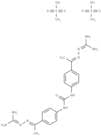
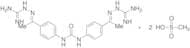
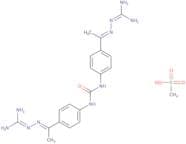
![1,3-bis(4-{(1E)-1-[(diaminomethylidene)hydrazinylidene]ethyl}phenyl)urea methanesulfonate (1:2)](/_next/image/?url=https%3A%2Fstatic.cymitquimica.com%2Fcas-image%2Fthumb-webp%2F383308-13-bis-4-1e-1-diaminomethylidene-hydrazinylidene-ethyl-phenyl-urea-methanesulfonate-1-2.webp&w=3840&q=75)
CAS 15427-93-7
:1,3-bis(4-{(1E)-1-[(diaminometilideno)hidrazinilideno]etil}fenil)urea metanosulfonato (1:2)
Descripción:
1,3-bis(4-{(1E)-1-[(diaminometilideno)hidrazinilideno]etil}fenil)urea metanosulfonato (1:2), con número CAS 15427-93-7, es un compuesto orgánico complejo caracterizado por sus características estructurales únicas, que incluyen múltiples grupos funcionales que contribuyen a su reactividad y solubilidad. Esta sustancia contiene grupos de urea y metanosulfonato, que mejoran sus aplicaciones potenciales en diversos campos, incluidos los productos farmacéuticos y agroquímicos. La presencia de derivados de hidrazina sugiere una posible actividad biológica, posiblemente como precursor de transformaciones químicas adicionales o como un ingrediente farmacéutico activo. La solubilidad del compuesto en disolventes polares se debe probablemente al grupo metanosulfonato, que puede facilitar interacciones con sistemas biológicos. Además, la presencia de múltiples anillos aromáticos puede contribuir a su estabilidad y potencial para interacciones de apilamiento π-π. En general, la intrincada estructura y diversidad funcional de este compuesto lo convierten en un tema de interés para la investigación en química medicinal y ciencia de materiales.
Fórmula:C21H32N10O7S2
InChI:InChI=1/C19H24N10O.2CH4O3S/c1-11(26-28-17(20)21)13-3-7-15(8-4-13)24-19(30)25-16-9-5-14(6-10-16)12(2)27-29-18(22)23;2*1-5(2,3)4/h3-10H,1-2H3,(H4,20,21,28)(H4,22,23,29)(H2,24,25,30);2*1H3,(H,2,3,4)/b26-11+,27-12+;;
Ordenar por
Pureza (%)
0
100
|
0
|
50
|
90
|
95
|
100
Encontrado 3 productos.
NSC 109555
CAS:NSC 109555 is a selective, reversible, ATP-competitive Chk2 inhibitor (IC50 = 0.2 μM) that displays no effect on a range of other kinases including Chk1 (IC50Fórmula:C21H32N10O7S2Forma y color:SolidPeso molecular:600.67NSC 109555
CAS:Producto controladoApplications NSC 109555 is an inhibitor of checkpoint kinase 2 (Chk2), a serine/threonine kinase involved in the ATM-Chk2 checkpoint pathway. Drugs that target Chk2 in combination with DNA-damaging agents can be beneficial in cancer therapy. Studies in mice, rats, rabbits, dogs, and monkeys have shown that NSC 109555 displays toxic effects. A singe injection of the drug at a concentration of 12.5-25 mg/kg caused acute paralysis leading to apnea and death.
References Lountos, G. et al.: Protein Sci., 18, 92 (2009); Mihich, E. et al.: Canc. Res., 29, 1056 (1969)Fórmula:C19H24N10O·2C7H8O3SForma y color:NeatPeso molecular:752.864NSC109555
CAS:NSC109555 is a small molecule that is chemically synthesized. It has been shown to inhibit the uptake of sodium citrate by mitochondria, which inhibits cellular energy production. NSC109555 also has anti-cancer properties and may be used as a diagnostic agent for cancer. It is activated when it binds to DNA as a template and prevents the formation of dna strands, which prevents the replication of cells. NSC109555 can also cross cell membranes and enter into cells, where it prevents repair mechanisms such as DNA repair from occurring. The chemical structure of this drug is not yet known, but its mechanism of action may involve the response pathway in cancer cells that regulates cell cycle progression, gene expression, and apoptosis.Fórmula:C19H24N10O·2CH3SO3HPureza:Min. 95%Peso molecular:600.67 g/mol