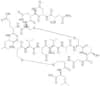
CAS 154525-25-4
:uroguanilina humana
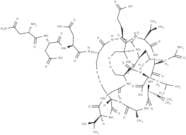
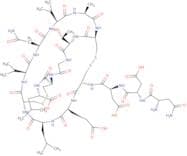
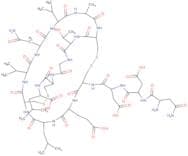
- ASN-ASP-ASP-CYS-GLU-LEU-CYS-VAL-ASN-VAL-ALA-CYS-THR-GLY-CYS-LEU
- Uroguanylin Topoisomer A (human)
- asn-asp-asp-cys-glu-leu-cys-val-asn-val-ala-cys-thr-gly-cys-leu [disulfide bridges: 4-12, 7-15]
- Uroguanylin >=90% (HPLC)
- UROGUANYLIN
- H-ASN-ASP-ASP-CYS-GLU-LEU-CYS-VAL-ASN-VAL-ALA-CYS-THR-GLY-CYS-LEU-OH
- UGN (HUMAN)
- L-Leucine, L-asparaginyl-L-α-aspartyl-L-α-aspartyl-L-cysteinyl-L-α-glutamyl-L-leucyl-L-cysteinyl-L-valyl-L-asparaginyl-L-valyl-L-alanyl-L-cysteinyl-L-threonylglycyl-L-cysteinyl-, cyclic (4→12),(7→15)-bis(disulfide)
- ASN-ASP-ASP-CYS-GLU-LEU-CYS-VAL-ASN-VAL-ALA-CYS-THR- GLY-CYS-LEU(DISULFIDE BRIDGE: CYS4-CYS12, CYS7-CYS15)
- UGN (huMan)
- UROGUANYLIN (HUMAN)
- Uroguanylin (huMan)
- Ver más sinónimos
Uroguanylin Topoisomer A (human)
CAS:Uroguanylin belongs to the guanylin family of cyclic guanosine monophosphate (cGMP) regulating peptides. This family of peptides shows homology to the heat stable enterotoxins produced by strains of Escherichia coli and other enteric bacteria that cause a secretory form of diarrhea. Along with the isolation of uroguanylin from urine and the subsequent demonstration of its natriuretic activity by direct effects on the kidney, uroguanylin has been suggested to play a role in the physiological maintenance of sodium balance in vivo. Uroguanylin activation of the guanylate cyclase-C/cyclic guanosine monophosphate pathway elicited analgesic effects in animal models of colonic hypersensitivity, unraveling a novel pathway to treat abdominal pain (Silos-Santiago et al. (2013)).Fórmula:C64H102N18O26S4Pureza:92.7%Forma y color:White PowderPeso molecular:1667.88Uroguanylin (human)
CAS:Uroguanylin (human) serves as a natural ligand for the Guanylyl Cyclase C (GCC) receptor in metastatic colorectal cancer tumors and exhibits anti-tumor effectsFórmula:C64H102N18O26S4Pureza:98%Forma y color:SolidPeso molecular:1667.86Uroguanylin (Human)
CAS:Uroguanylin (Human) product containing the disulfide bonds: Cys4-Cys12 and Cys7-Cys15 and avaialable in the trifluoroacetate salt form. Uroguanylin is a peptide hormone that is involved in the regulation of fluid and electrolyte balance in the body. It is produced in the intestinal tract, specifically in the lining of the small intestine and colon.
Uroguanylin belongs to a family of peptides that includes guanylin and the heat-stable enterotoxins (STs).These peptides all share a similar structure and function, as they bind to and activate the guanylate cyclase-C (GC-C) receptor in intestinal cells.
Activation of GC-C by uroguanylin leads to an increase in cyclic GMP (cGMP) levels, which in turn activates a variety of downstream signaling pathways. This leads to an increase in chloride and bicarbonate secretion in the intestine, as well as an increase in intestinal fluid secretion. Uroguanylin also stimulates sodium and water reabsorption in the kidneys, leading to an increase in urine output.
Uroguanylin has been studied for its potential therapeutic applications, particularly in the treatment of gastrointestinal disorders. For example, synthetic analogs of uroguanylin are being developed as potential treatments for constipation and other disorders of intestinal motility. Additionally, uroguanylin has been shown to have anti-inflammatory properties and may be useful in the treatment of inflammatory bowel disease.Fórmula:C64H102N18O26S4Pureza:Min. 95%Peso molecular:1,667.89 g/molUroguanylin Topoisomer A (human) trifluoroacetate salt
CAS:Trifluoroacetate salt
Fórmula:C64H102N18O26S4Pureza:Min. 95%Peso molecular:1,667.86 g/molUroguanylin Isomer A (Human)
CAS:Uroguanylin is a peptide that is released by cells in the intestine. It binds to the guanylate cyclase receptor, which stimulates the production of cyclic GMP (cGMP). This leads to an increase in intestinal water and electrolyte secretion. Uroguanylin Isomer A (Human) is a high-purity peptide that can be used as a research tool for studying ligand-receptor interactions and as an inhibitor of ion channels.
Fórmula:C64H102N18O26S4Pureza:Min. 95%Peso molecular:1,667.9 g/mol