


CAS 155760-02-4
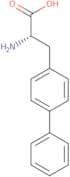
:H-4-Fenil-Phe-OH
Descripción:
H-4-Fenil-Phe-OH, también conocido como un derivado de la fenilalanina, es un compuesto químico caracterizado por su estructura, que incluye un grupo fenilo unido al aminoácido fenilalanina. Este compuesto se utiliza típicamente en investigación bioquímica y puede servir como un bloque de construcción en la síntesis de péptidos o como un modelo para estudiar interacciones proteicas. Sus propiedades incluyen ser soluble en disolventes polares, lo que facilita su uso en varios ensayos biológicos. La presencia del grupo hidroxilo (-OH) sugiere un potencial para la formación de enlaces de hidrógeno, influyendo en su reactividad e interacciones con otras moléculas. Además, el grupo fenilo contribuye a sus características hidrofóbicas, lo que puede afectar su comportamiento en sistemas biológicos. Como derivado de la fenilalanina, también puede desempeñar un papel en las vías metabólicas y podría ser de interés en estudios relacionados con la síntesis de neurotransmisores o los impactos dietéticos en la salud. En general, H-4-Fenil-Phe-OH es significativo tanto en contextos de química sintética como biológica.
Fórmula:C18H20N2O4
InChI:InChI=1/C18H20N2O4/c19-15(17(21)22)9-11-1-5-13(6-2-11)14-7-3-12(4-8-14)10-16(20)18(23)24/h1-8,15-16H,9-10,19-20H2,(H,21,22)(H,23,24)/t15-,16-/m0/s1
SMILES:c1cc(ccc1C[C@@H](C(=O)O)N)c1ccc(cc1)C[C@@H](C(=O)O)N
Sinónimos:- H-Bip-OH
- L--4,4-Biphenylalanine
- (2S)-2-amino-3-biphenyl-4-ylpropanoic acid (non-preferred name)
- (2R)-2-ammonio-3-biphenyl-4-ylpropanoate
- (2S,2'S)-3,3'-biphenyl-4,4'-diylbis(2-aminopropanoic acid) (non-preferred name)
- L-4,4'-Biphenylphenylalanine
- (S)-2-Amino-3-(biphenyl-4-yl)propanoic acid
Ordenar por
Pureza (%)
0
100
|
0
|
50
|
90
|
95
|
100
Encontrado 4 productos.
[1,1'-Biphenyl]-4-propanoic acid, α-amino-, (αS)-
CAS:Fórmula:C15H15NO2Pureza:98%Forma y color:SolidPeso molecular:241.2851H-p-Phenyl-L-phenylalanine
CAS:H-p-Phenyl-L-phenylalanine (HPPPA) is a proteolytic agent that has been shown to have antimicrobial activity. It has the ability to inhibit bacterial growth by hydrolysing proteins and peptides, which are essential for bacterial cell division. HPPPA also exhibits hemolytic activity, which may be due to its cationic nature and inhibition of the synthesis of collagen in human erythrocytes. The pharmacokinetic properties of HPPPA have been studied in mice, where it was found that this drug is primarily excreted by the kidney. HPPPA has also been shown to be an inhibitor of glp-1r agonists, metal hydroxides, and tumor cells in animal models. It is believed that HPPPA's ability to bind receptors may contribute to its anti-tumor effects.Fórmula:C15H15NO2Pureza:Min. 95%Forma y color:White/Off-White SolidPeso molecular:241.29 g/mol(S)-3-([1,1′-Biphenyl]-4-yl)-2-aminopropanoic acid
CAS:Fórmula:C15H15NO2Pureza:98%Forma y color:SolidPeso molecular:241.29
![[1,1'-Biphenyl]-4-propanoic acid, α-amino-, (αS)-](/_next/image/?url=https%3A%2Fstatic.cymitquimica.com%2Fproducts%2FIN%2Fthumb%2FDA001O64.jpg&w=3840&q=75)



![(S)-3-([1,1′-Biphenyl]-4-yl)-2-aminopropanoic acid](/_next/image/?url=https%3A%2Fstatic.cymitquimica.com%2Fproducts%2F10%2Fthumb%2FF211753.jpg&w=3840&q=75)
