CAS 157606-25-2
:CECROPINA A (1-7)-MELITINA A (2-9) AMIDA
Descripción:
CECROPINA A (1-7)-MELITINA A (2-9) AMIDA, con número CAS 157606-25-2, es un péptido sintético que combina elementos de dos péptidos antimicrobianos diferentes: cecropina A y melitina A. La cecropina A es conocida por su actividad antimicrobiana de amplio espectro, particularmente contra bacterias y hongos, mientras que la melitina, derivada del veneno de abeja, exhibe potentes propiedades hemolíticas y antimicrobianas. La hibridación de estos péptidos tiene como objetivo mejorar su eficacia y estabilidad antimicrobiana. Este compuesto típicamente exhibe características anfipáticas, lo que le permite interactuar con membranas lipídicas, provocando la disrupción de membranas en patógenos objetivo. Su estructura a menudo incluye una región cargada positivamente que facilita la unión a membranas bacterianas cargadas negativamente. La modificación de amida en el extremo terminal puede mejorar su estabilidad y biodisponibilidad. Debido a sus posibles aplicaciones en el desarrollo de nuevos agentes antimicrobianos, CECROPINA A (1-7)-MELITINA A (2-9) AMIDA es de interés en la investigación farmacéutica y biotecnológica, particularmente en el contexto de combatir infecciones resistentes a antibióticos.
Fórmula:C89H152N22O15
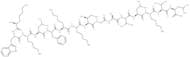
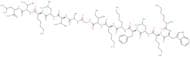
Sinónimos:- Lys-Trp-Lys-Leu-Phe-Lys-Lys-Ile-Gly-Ala-Val-Leu-Lys-Val-Leu-Nh2
- H-Lys-Trp-Lys-Leu-Phe-Lys-Lys-Ile-Gly-Ala-Val-Leu-Lys-Val-Leu-Nh2
- Cecropin A (1-8)-Melittin A (3-9) Amide
- Cecropin A-Melittin Hybrid Peptide
- Ca(1-7)M(2-9)Nh2
- Cecropin A-melittin hybrid peptide [CA(1-7)M(2-9)NH2]
- Oct-CA(1-7)M(2-9)
- Cecropin A (1-7)-Melittin A (2-9) amide , Cecropin A (1-8)-Melittin A (3-9) amide
- Cecropin A (1-7)-Melittin A (2-9) aMide
- Cecropin A (1-7)-Melittin A (2-9) amide/Cecropin A (1-8)-Melittin A (3-9) amide, CAMEL0, CM15, Cecropin A-melittin hybrid peptide [CA(1-7)M(2-9)NH2]
- CAMEL0, Cecropin A (1-8)-Melittin A (3-9) aMide, CM15
- L-Leucinamide,L-lysyl-L-tryptophyl-L-lysyl-L-leucyl-L-phenylalanyl-L-lysyl-L-lysyl-L-isoleucylglycyl-L-alanyl-L-valyl-L-leucyl-L-lysyl-L-valyl-
- CECROPIN A (1-7)-MELITTIN A (2-9) AMIDE
- Ver más sinónimos
Ordenar por
Pureza (%)
0
100
|
0
|
50
|
90
|
95
|
100
Encontrado 3 productos.
Cecropin A (1-7)-Melittin A (2-9) amide
CAS:Cecropin A (1-7)-Melittin A (2-9) amide, also referred to as CAMEL0, is a synthetic hybrid peptide that is composed of portions of the naturally occurring antibiotic peptide cecropin A and melittin. CAMEL0 shows a better antimicrobial activity than the native molecules, but lacks the hemolytic properties of melittin. Studies revealed that the range of its antimicrobial activity is not only restricted to aerobic microorganisms but also included several gram-negative and gram-positive anaerobic microorganisms. Through its ascertained broad spectrum of antibiotic activity, this hybrid peptide may also represent an effective substitute for ciprofloxacin in the treatment of anthrax infections.Fórmula:C89H152N22O15Pureza:98.3%Forma y color:WhitePeso molecular:1770.33Cecropin A (1-7)-Melittin A (2-9)
CAS:Cecropin A-Melittin peptide combats Gram+ & Gram- bacteria, has antimalarial effects, no hemolysis like bee venom.Fórmula:C89H152N22O15Forma y color:SolidPeso molecular:1770.3Cecropin A (1-7)-Melittin A (2-9) amide trifluoroacetate salt
CAS:Cecropin A (1-7)-Melittin A (2-9) amide trifluoroacetate salt is a cecropin-melittin hybrid peptide that has been immobilized on cellulose nanofibers for use as an antimicrobial. It has been shown to have strong antimicrobial activity against bacillus subtilis, and the immobilization process ensures that the peptide is not released from the surface of the material. The process of coating with nanopaper and then applying the peptides provides a stable surface with high antimicrobial activity. The synthetic peptides are synthesized by solid phase synthesis using Fmoc chemistry and purified by preparative HPLC.Fórmula:C89H152N22O15Pureza:Min. 95%Forma y color:PowderPeso molecular:1,770.3 g/mol