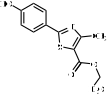
CAS 161797-99-5
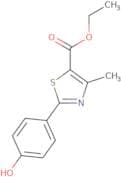
:Etilo 2-(4-hidroxifenil)-4-metil-5-tiazolcarboxilato
Descripción:
Etilo 2-(4-hidroxifenil)-4-metil-5-tiazolcarboxilato, con el número CAS 161797-99-5, es un compuesto orgánico caracterizado por sus grupos funcionales de tiazol y fenólico. Este compuesto típicamente aparece como una sustancia sólida o cristalina y es conocido por sus posibles aplicaciones en farmacéuticos y agroquímicos debido a su actividad biológica. La presencia del grupo éster etílico contribuye a su solubilidad en disolventes orgánicos, mientras que el grupo hidroxilo en el anillo fenílico puede mejorar su reactividad y capacidad para formar enlaces de hidrógeno. El anillo de tiazol es conocido por su papel en varios procesos biológicos, lo que hace que este compuesto sea de interés en la química medicinal. Su estructura molecular sugiere interacciones potenciales con objetivos biológicos, lo que podría llevar a varios efectos terapéuticos. Además, la estabilidad y reactividad del compuesto pueden verse influenciadas por factores ambientales como el pH y la temperatura, que son consideraciones importantes en su aplicación y manejo. En general, este compuesto ejemplifica la complejidad y utilidad de los compuestos heterocíclicos en la investigación y desarrollo químico.
Fórmula:C13H13NO3S
InChI:InChI=1S/C13H13NO3S/c1-3-17-13(16)11-8(2)14-12(18-11)9-4-6-10(15)7-5-9/h4-7,15H,3H2,1-2H3
Clave InChI:InChIKey=LOCYSKNNFCGDTR-UHFFFAOYSA-N
SMILES:C(OCC)(=O)C=1SC(=NC1C)C2=CC=C(O)C=C2
Sinónimos:- 2-(4-Hydroxyphenyl)-4-Methylthiazole-5-Carboxylate
- 2-(4-Hydroxyphenyl)-4-methylthiazole-5-carboxylic acid ethyl ester
- 2-(4-Hydroxyphenyl)-4-methylthiazole-5-carboxytic acid ethyl ester
- 5-Thiazolecarboxylic acid, 2-(4-hydroxyphenyl)-4-methyl-, ethyl ester
- Ethyl 2-(4-HydroxyPhenyl)-4-Methyl Thiazole-5-Carboxylate
- Ethyl 2-(4-hydroxyphenyl)-4-methyl-1,3-thiazole-5-carboxylate
- Ethyl-2-(4-Hydroxyphenyl)-4-Methyl-5-Thiazolecarboxylate
- Ethyl2-(4-hydroxy phenyl)-4-methylthiazole-5-carboxylate
- Febuxostat N-2
Ordenar por
Pureza (%)
0
100
|
0
|
50
|
90
|
95
|
100
Encontrado 7 productos.
5-Thiazolecarboxylic acid, 2-(4-hydroxyphenyl)-4-methyl-, ethyl ester
CAS:Fórmula:C13H13NO3SPureza:96%Forma y color:SolidPeso molecular:263.3122Febuxostat Impurity 39
CAS:Fórmula:C13H13NO3SForma y color:White To Off-White SolidPeso molecular:263.31Ethyl 2-(4-Hydroxyphenyl)-4-Methylthiazole-5-Carboxylate
CAS:Ethyl 2-(4-Hydroxyphenyl)-4-Methylthiazole-5-CarboxylatePureza:98%Peso molecular:263.31g/molEthyl 2-(4-Hydroxyphenyl)-4-methylthiazole-5-carboxylate
CAS:Applications Ethyl 2-(4-Hydroxyphenyl)-4-methylthiazole-5-carboxylate is used in the synthesis of the major metabolites of Febuxostat (F229000), a xanthine oxidase/xanthine dehydrogenase inhibitor. Used for treatment of hyperuricemia and chronic gout. 40-120 mg/day febuxostat was proven effective in lowering serum urate levels when administered to manage hyperuricemia in patients with gout.
References Li, X., et. al.: Lett. Org. Chem., 12, 217 (2015); Vallu, V., et. al.: Anal. Chem. Indian J., 14, 339 (2014); Osada, Y., et al.: Eur. J. Pharmacol., 241, 183 (1993); Okamoto, K., et al.: J. Biol. Chem., 278, 1848 (2003); Mayer, M.D., et al.: Am. J. Therap., 12, 22 (2005); Tomlinson, B., et al.: Curr. Opin. Invest. Drugs, 6, 1168 (2005)Fórmula:C13H13NO3SForma y color:NeatPeso molecular:263.312-(4-Hydroxyphenyl)-4-methyl-thiazole-5-carboxylic acid ethyl ester
CAS:Fórmula:C13H13NO3SPureza:96%Forma y color:SolidPeso molecular:263.31Ethyl 2-(4-hydroxyphenyl)-4-methylthiazole-5-carboxylate
CAS:Ethyl 2-(4-hydroxyphenyl)-4-methylthiazole-5-carboxylate is an anticancer agent that belongs to the class of formamidines. It is synthesized by refluxing ethyl 4-hydroxyphenylacetic acid with hexamethylenetetramine and acetic acid in ethanol. After purification, it is converted to its active form by reacting with hydrochloric acid. Ethyl 2-(4-hydroxyphenyl)-4-methylthiazole-5-carboxylate prevents the growth of cancer cells in culture by preventing DNA synthesis, which prevents RNA and protein synthesis. This agent has also been found to suppress paclitaxel production in cultured human breast cancer cells.Fórmula:C13H13NO3SPureza:Min. 95%Peso molecular:263.31 g/mol