CAS 16298-03-6
:Ácido 2-pirazincarboxílico, 3-amino-, éster metílico
Descripción:
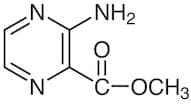
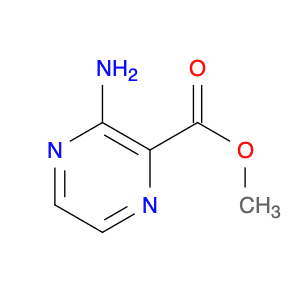
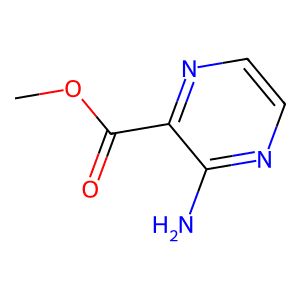
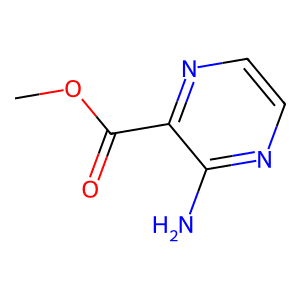
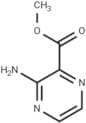
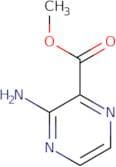
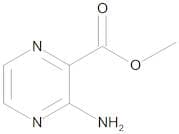
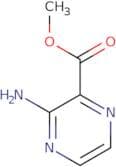
Ácido 2-pirazincarboxílico, 3-amino-, éster metílico, con el número CAS 16298-03-6, es un compuesto orgánico caracterizado por su estructura de anillo de pirazina, que es un heterociclo aromático de seis miembros que contiene dos átomos de nitrógeno. Este compuesto presenta un grupo funcional ácido carboxílico y un grupo amino, lo que contribuye a su potencial como un bloque de construcción versátil en la síntesis orgánica. El éster metílico indica que el ácido carboxílico está esterificado con metanol, lo que mejora su solubilidad en disolventes orgánicos y lo hace más adecuado para diversas reacciones químicas. La presencia de funcionalidades tanto amino como ácido carboxílico sugiere que puede participar en enlaces de hidrógeno, influyendo en su reactividad e interacción con otras moléculas. Este compuesto puede ser de interés en la investigación y desarrollo farmacéutico debido a su potencial actividad biológica, ya que los derivados de la pirazina a menudo se exploran por sus propiedades medicinales. En general, Ácido 2-pirazincarboxílico, 3-amino-, éster metílico es un compuesto con implicaciones significativas en la química sintética y el descubrimiento de fármacos.
Fórmula:C6H7N3O2
InChI:InChI=1S/C6H7N3O2/c1-11-6(10)4-5(7)9-3-2-8-4/h2-3H,1H3,(H2,7,9)
Clave InChI:InChIKey=INCSQLZZXBPATR-UHFFFAOYSA-N
SMILES:C(OC)(=O)C=1C(N)=NC=CN1
Sinónimos:- 2-Amino-3-(methoxycarbonyl)pyrazine
- 2-Pyrazinecarboxylic acid, 3-amino-, methyl ester
- 3-Amino-2-pyrazinecarboxylic Acid Methyl Ester
- Methyl 2-aminopyrazine-3-carboxylate
- Methyl 3-Aminopyrazine-2-Carboxylate
- Methyl 3-amino-2-pyrazinecarboxylate
- Methyl 3-aminopyrazine-2-carboxylic ester
- Methyl 3-aminopyrazinecarboxylate
- NSC 123649
- Pyrazinecarboxylic acid, 3-amino-, methyl ester
- Pyrazinoic acid, 3-amino-, methyl ester
Ordenar por
Pureza (%)
0
100
|
0
|
50
|
90
|
95
|
100
Encontrado 11 productos.
Methyl 3-Aminopyrazine-2-carboxylate
CAS:Fórmula:C6H7N3O2Pureza:>98.0%(GC)(T)Forma y color:Light yellow to Amber to Dark green powder to crystalPeso molecular:153.142-Pyrazinecarboxylic acid, 3-amino-, methyl ester
CAS:Fórmula:C6H7N3O2Pureza:97%Forma y color:SolidPeso molecular:153.1387Methyl 3-aminopyrazine-2-carboxylate
CAS:Methyl 3-aminopyrazine-2-carboxylatePureza:≥98%Peso molecular:153.14g/molMethyl 3-aminopyrazine-2-carboxylate
CAS:Methyl 3-aminopyrazine-2-carboxylateFórmula:C6H7N3O2Pureza:97%Forma y color: dark brown. fluffy crystalline powderPeso molecular:153.14g/molMethyl 3-aminopyrazine-2-carboxylate
CAS:Methyl 3-aminopyrazine-2-carboxylate: a pyrazine with methoxycarbonyl (2) and amino (3); an ester and aromatic amine, used in synthesis.Fórmula:C6H7N3O2Pureza:99.34%Forma y color:Yellow Crystalline PowderPeso molecular:153.143-Amino-2-pyrazinecarboxylic acid methyl ester
CAS:3-Amino-2-pyrazinecarboxylic acid methyl ester (3APCME) is a potent anti-mycobacterial agent that inhibits the growth of Mycobacterium tuberculosis by inhibiting the synthesis of amines, which are necessary for its survival. 3APCME has also been shown to have an inhibitory effect on other bacteria that require amines for their survival, such as Escherichia coli. This agent binds to the receptor and inhibits the enzyme pyrazinase in the reaction of phenoxy with dimethylformamide. The molecular modeling studies show that 3APCME is able to bind to a hydrophobic region on the enzyme's surface and form a covalent bond through nucleophilic attack. The asymmetric synthesis results in the production of one enantiomer of 3APCME and allows for greater efficacy against mycobacteria than other agents.Fórmula:C6H7N3O2Pureza:Min. 95%Forma y color:PowderPeso molecular:153.14 g/mol3-Amino-pyrazine-2-carboxylic acid methyl ester
CAS:Fórmula:C6H7N3O2Pureza:97%Forma y color:SolidPeso molecular:153.1413-Amino-2-pyrazinecarboxylic Acid Methyl Ester
CAS:Producto controladoFórmula:C6H7N3O2Forma y color:NeatPeso molecular:153.14Methyl 3-aminopyrazine-2-carboxylate
CAS:Methyl 3-aminopyrazine-2-carboxylate (MAPC) is a versatile building block that can be used as a reaction component, reagent, or useful scaffold in organic synthesis. MAPC is a high quality chemical that has been shown to be useful for the preparation of complex compounds with fine chemical and pharmaceutical properties. It is a versatile intermediate in the preparation of speciality chemicals, research chemicals, and other organic compounds. MAPC is also a useful building block for the synthesis of pharmaceuticals and other organic compounds. CAS# 16298-03-6Fórmula:C6H7N3O2Pureza:Min. 95.0 Area-%Peso molecular:153.14 g/molRef: 3D-Q-103337
-Unit-kgkgA consultar1kgA consultar100gA consultar250gA consultar500gA consultar2500gA consultar