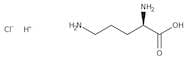
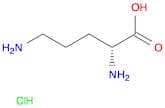
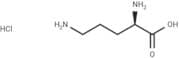
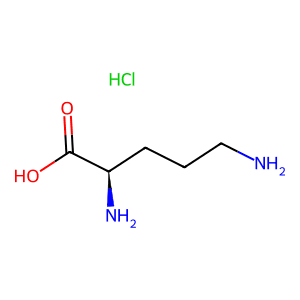
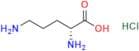
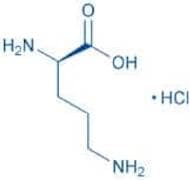
CAS 16682-12-5
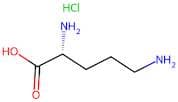
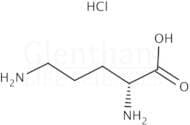
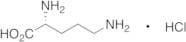
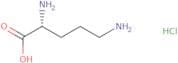
:D-Ornitina, clorhidrato (1:1)
Descripción:
El clorhidrato de D-ornitina es un compuesto cristalino que sirve como una forma salina del aminoácido D-ornitina, que es un aminoácido no proteico involucrado en el ciclo de la urea. Esta sustancia es típicamente blanca a blanco sucio en apariencia y es soluble en agua, lo que la hace adecuada para diversas aplicaciones bioquímicas. La D-ornitina juega un papel crucial en la síntesis de poliaminas, que son importantes para el crecimiento y la diferenciación celular. La forma de clorhidrato mejora su estabilidad y solubilidad, facilitando su uso en entornos de laboratorio y clínicos. A menudo se utiliza en investigaciones relacionadas con el metabolismo, la función celular y como un posible suplemento en la nutrición deportiva. Además, se estudia la D-ornitina por sus posibles efectos terapéuticos, incluyendo su papel en la cicatrización de heridas y sus implicaciones en ciertos trastornos metabólicos. Al igual que con cualquier sustancia química, se deben observar las precauciones adecuadas de manejo y seguridad, particularmente en entornos de laboratorio.
Fórmula:C5H12N2O2·ClH
InChI:InChI=1S/C5H12N2O2.ClH/c6-3-1-2-4(7)5(8)9;/h4H,1-3,6-7H2,(H,8,9);1H/t4-;/m1./s1
Clave InChI:InChIKey=GGTYBZJRPHEQDG-PGMHMLKASA-N
SMILES:[C@H](C(O)=O)(CCCN)N.Cl
Sinónimos:- (2R)-2,5-Diaminopentanoic acid hydrochloride
- (2R)-2,5-diammoniopentanoate
- (R)-Ornithine hydrochloride
- <span class="text-smallcaps">D</span>-Ornithine, hydrochloride (1:1)
- <span class="text-smallcaps">D</span>-Ornithine, monohydrochloride
- D-(-)-Ornithine hydrochloride
- D-Omithine HCl
- D-Orn.HCL
- D-Ornithine HCL
- D-Ornithine Monohydrochloride
- D-ornithine hydrochloride (1:1)
- H-D-Orn-OH・HCl
- Ornithine, monohydrochloride, <span class="text-smallcaps">D</span>-
- R-2,5-Diaminopentanoic Acidhydrochloride
- Ornithine, monohydrochloride, D-
- D-ORTHININE MONOHYDROCHLORIDE
- (R)-2,5-DIAMINOPENTANOIC ACID MONOHYDROCHLORIDE
- H-D-Orn-OH·HCI
- D-ORNITHINE HCI
- D-Ornitrine
- (r)-(-)-2,5-diaminopentanoic acid hydrochloride
- D(-)-2,5-DIAMINOPENTANOIC ACID HYDROCHLORIDE
- H-D-ORN HCL
- (R)-(-)-2,5-DiaminopentanoicacidHCl~H-D-Orn-OH.HCl
- D-ORNITHINE-OH HCL
- H-D-ORN-OH HCL
- D-(-)-2,5-diaminopentanoic acid
- Ver más sinónimos
Ordenar por
Pureza (%)
0
100
|
0
|
50
|
90
|
95
|
100
Encontrado 12 productos.
D-Ornithine hydrochloride, 98+%
CAS:This Thermo Scientific Chemicals brand product was originally part of the Alfa Aesar product portfolio. Some documentation and label information may refer to the legacy brand. The original Alfa Aesar product / item code or SKU reference has not changed as a part of the brand transition to Thermo SciFórmula:C5H13ClN2O2Pureza:98+%Forma y color:White to pale cream, Crystals or powder or crystalline powderPeso molecular:168.62D-Ornithine hydrochloride
CAS:D-Ornithine hydrochloride (D-Ornithine HCl) is used as pharmaceutical intermediates.Fórmula:C5H13ClN2O2Pureza:98% - 99.78%Forma y color:White PowderPeso molecular:168.62D-Ornithine monohydrochloride
CAS:Fórmula:C5H12N2O2·HClPureza:≥ 98.0%Forma y color:White to off-white powderPeso molecular:168.62D-Ornithine Hydrochloride
CAS:Applications The D-enatiomer and putative metabolite of the non-essential amino acid L-Orthinine. Stress response studies show intracerebroventricular D-Ornithine Hydrochloride weakly attenuated stress response in neonatal chick under acute stressful condition.
References Kurauchi, I. et al.: J. Animal Vet. Adv., 8, 2580 (2009);Fórmula:C5H12N2O2·ClHForma y color:Off White SolidPeso molecular:168.6219D-Ornithine hydrochloride
CAS:D-Ornithine hydrochloride is a synthetic amino acid that is used as a precursor for the synthesis of polyamines in the body. It is also used as an additive in food and animal feed. This amino acid has been shown to inhibit gramicidin production by inhibiting the enzyme acylase. D-Ornithine hydrochloride has also been shown to stimulate the production of ornithine by increasing ATP levels and activating enzymes such as pyruvate kinase, glutamic pyruvate transaminase, and phosphoenolpyruvate carboxykinase. In addition, it has been shown to have chemoenzymatic properties that allow for its use in reactions with fatty acids as substrates. The reaction yield increases with higher substrate concentrations, which can be achieved using immobilized cells or by adding cyclic peptides such as ornithine to the reaction mixture.Fórmula:C5H12N2O2•HClPureza:Min. 95%Forma y color:PowderPeso molecular:168.62 g/molH-D-Orn.HCl
CAS:M03134 - H-D-Orn.HCl
Fórmula:C5H13ClN2O2Pureza:98%Forma y color:SolidPeso molecular:168.62H-D-Orn-OH · HCl
CAS:Bachem ID: 4031134.
Fórmula:C5H12N2O2·HClPureza:> 99%Forma y color:WhitePeso molecular:168.62