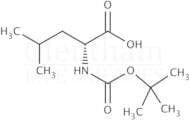
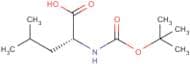
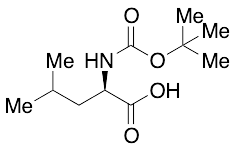
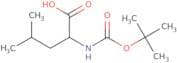
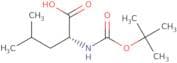
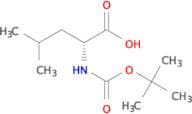
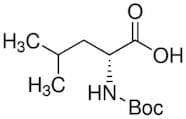
CAS 16937-99-8
:tert-Butiloxicarbonil-D-leucina
- (2R)-2-[[(tert-Butoxy)carbonyl]amino]-4-methylpentanoic acid
- (2R)-4-Methyl-2-[(2-methylpropan-2-yl)oxycarbonylamino]pentanoic acid
- (R)-2-(tert-Butoxycarbonylamino)-4-methylpentanoic acid
- (R)-2-[[tert-Butoxycarbonyl)amino]-4-methylpentanoicacid
- (R)-N-(t-Butoxycarbonyl)leucine
- <span class="text-smallcaps">D</span>-Boc leucine
- <span class="text-smallcaps">D</span>-Leucine, N-[(1,1-dimethylethoxy)carbonyl]-
- Boc-D-Leu-OH hydrate
- Boc-D-Leu-OH.H2O
- Boc-D-Leu-Oh
- Boc-D-Leucine
- L-Leucine-5,5,5-D3, N-T-Boc Deriv.H20
- Leucine, N-carboxy-, N-tert-butyl ester, <span class="text-smallcaps">D</span>-
- N-(Tert-Butoxycarbonyl)-D-Leucine
- N-(tert-Butoxycarbonyl)-<span class="text-smallcaps">D</span>-leucine
- N-(tert-butoxycarbonyl)-D-leucine hydrate
- N-Alpha-T-Boc-D-Leucine
- N-Boc-<span class="text-smallcaps">D</span>-leucine
- N-Boc-D-Leu-OH monohydrate
- N-T-Boc-D-Leucine
- N-Tert-Butoxycarbonyl-D-Leucine 1-Hydrate
- N-[(1,1-Dimethylethoxy)carbonyl]-<span class="text-smallcaps">D</span>-leucine
- tert-Butoxycarbonyl-<span class="text-smallcaps">D</span>-leucine
- Leucine, N-carboxy-, N-tert-butyl ester, D-
- N-[(1,1-Dimethylethoxy)carbonyl]-D-leucine
- D-Leucine, N-[(1,1-dimethylethoxy)carbonyl]-
- Ver más sinónimos
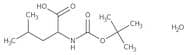
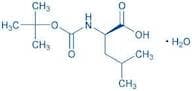
N-(tert-Butoxycarbonyl)-D-leucine Monohydrate
CAS:Fórmula:C11H21NO4·H2OPureza:>98.0%(T)Forma y color:White to Almost white powder to crystalPeso molecular:249.31N-Boc-D-leucine hydrate, 98+%
CAS:This Thermo Scientific Chemicals brand product was originally part of the Alfa Aesar product portfolio. Some documentation and label information may refer to the legacy brand. The original Alfa Aesar product / item code or SKU reference has not changed as a part of the brand transition to Thermo SciFórmula:C11H23NO5Pureza:98+%Forma y color:Crystals or powder or crystalline powder, WhitePeso molecular:249.31Boc-D-Leu-OH · H₂O
CAS:Bachem ID: 4002976.
Fórmula:C11H21NO4·H2OPureza:> 99%Forma y color:WhitePeso molecular:249.31D-Leucine, N-[(1,1-dimethylethoxy)carbonyl]-
CAS:Fórmula:C11H23NO5Pureza:98%Forma y color:SolidPeso molecular:249.3040Ref: IN-DA00IKJ0
5kgA consultar10kgA consultar5g20,00€10g24,00€25g37,00€100g84,00€500g228,00€1kg301,00€N-Boc-D-leucine
CAS:Producto controladoApplications N-Boc-D-leucine is an N-Boc-protected form of D-Leucine (L330150). D-Leucine is an unnatural isomer of L-Leucine (L330110) that acts as an auto-inhibitor of lactic streptococci in culture. D-Leucine causes analgesia in humans and also exhibits inhibitory activity in bacterial cell cultures.
References Chuan, Y., et al.: Chin. J. Anim. Vet. Sci., 4, 003 (1985); Fox, S., et al.: J. Biol. Chem., 155, 465 (1944); Gillillad, S. & Speck, M.: J. Dairy Sci., 51, 1573 (1968); Schoenheimer, R., et al.: J. Biol. Chem., 130, 703 (1939); Seltzer, S., et al.: Pain, 11, 141 (1981)Fórmula:C11H21NO4Forma y color:NeatPeso molecular:231.29Boc-D-Leu-OH • H2O
CAS:Boc-D-Leu-OH • H2O is an intramolecular hydrogen. It has a helical structure and forms hydrogen bonds with other molecules. Boc-D-Leu-OH • H2O is a cyclic peptide with a hydrophobic side chain and a hydrophilic head group. The peptide has been shown to have antimicrobial activity in the biliary and intestinal tract, as well as chronic pain relief properties. Boc-D-Leu-OH • H2O was found to be effective in animal studies for neuropathic pain, which may be due to its amide structure. A silico analysis revealed that the drug substance had a high binding affinity for the mu opioid receptor and could potentially be used to treat chronic pain caused by inflammation.
Fórmula:C11H21NO4•H2OPureza:Min. 95%Peso molecular:249.31 g/molBoc-D-Leu-OH
CAS:Boc-D-Leu-OH is a cyclic peptide that has been shown to have antibacterial activity. It is a monomer with a hydroxy group and a cavity. Boc-D-Leu-OH was found to be able to transport hydrophobic compounds across membranes, which may be due to its hydrophobic nature. Boc-D-Leu-OH also induces apoptosis in cells, which can lead to cancer. This compound has been optimized by structural modifications and residue substitutions, which have led to improved properties such as enhanced stability and increased antimicrobial activity.Fórmula:C11H21NO4Pureza:Min. 95%Forma y color:PowderPeso molecular:231.29 g/molBoc-D-Leu-OH
CAS:M03296 - Boc-D-Leu-OH
Fórmula:C11H21NO4Pureza:95%Forma y color:Solid, CrystallinePeso molecular:231.292BOC-D-Leucine extrapure, 98%
CAS:Fórmula:C11H21NO4Pureza:min. 98%Forma y color:White, Crystalline powderPeso molecular:231.30
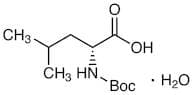



![D-Leucine, N-[(1,1-dimethylethoxy)carbonyl]-](/_next/image/?url=https%3A%2Fstatic.cymitquimica.com%2Fproducts%2FIN%2Fthumb%2FDA00IKJ0.jpg&w=3840&q=75)