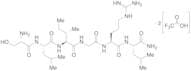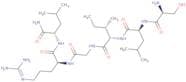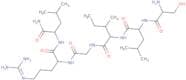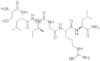
CAS 171436-38-7
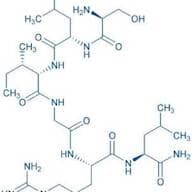
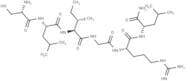
:H-SER-LEU-ILE-GLY-ARG-LEU-NH2
- Ser-Leu-Ile-Gly-Arg-Leu-Amide
- Sligrlamide
- Sligrl-Nh2
- Thrombin Receptor-Like 1 (1-6) Amide (Mouse, Rat)
- Proteinase Activated Receptor 2 (1-6) Amide (Mouse, Rat)
- Proline/Betaine Transporter Fragment Amide
- Par-2 (1-6) Amide (Mouse, Rat)
- Par2-Ap
PAR-2 (1-6) amide (mouse, rat)
CAS:SLIGRL-amide, protease-activated receptor-2 (PAR2) selective agonist. The reverted PAR2 peptide can be used as inactive control.Fórmula:C29H56N10O7Pureza:99.4%Forma y color:WhitePeso molecular:656.83SLIGRL-NH2
CAS:SLIGRL-NH2 (Protease-Activated Receptor-2 Activating Peptide) is a PAR-2 agonist that induces non-histaminergic pruritus.Fórmula:C29H56N10O7Pureza:98.29%Forma y color:SolidPeso molecular:656.82PAR-2 (1-6) amide (mouse, rat)
CAS:Custom research peptide; min purity 95%. For different specs please use the Peptide Quote ToolFórmula:C29H56N10O7Peso molecular:656.83 g/molSL-NH2 Trifluoroacetic Acid Salt (1:2)
CAS:Producto controladoApplications SL-NH2 Trifluoroacetic Acid Salt (1:2), is a PAR2 acute agonist which causes hyperglasia, or an increase to the sensitivity to pain.
References Huang, Z. et al.; Brain Res., 1425, 20 (2011);Fórmula:C29H56N10O7•2(C2HF3O2)Forma y color:NeatPeso molecular:656.82211402PAR-2 (1-6) amide (mouse, rat) trifluoroacetate salt
CAS:PAR-2 agonist is a synthetic peptide that activates PAR-2. It binds to PAR-2 receptors, which are present in the mesenteric vasculature and in various other tissues. Activation of PAR-2 leads to an increase in intracellular calcium concentration, activation of protein kinase C, cytosolic calcium ion release, phosphorylation of myosin light chain, muscle cell proliferation, transcription and translation initiation, and increased production of vasoactive intestinal peptide. This drug also has anti-inflammatory effects and stimulates epidermal growth factor (EGF) and thrombin receptor expression as well as growth factor production.Fórmula:C29H56N10O7Pureza:Min. 95%Peso molecular:656.82 g/molPAR-2 (1-6) (mouse, rat)
CAS:Custom research peptide; min purity 95%. For different specs please use the Peptide Quote Tool
Fórmula:C29H56N10O7Peso molecular:656.83 g/molH-Ser-Leu-Ile-Gly-Arg-Leu-NH2
CAS:H-Ser-Leu-Ile-Gly-Arg-Leu-NH2 is a cyclase inhibitor that binds to the neurokinin 1 receptor, leading to an inhibition of the release of inflammatory substances in the bowel. HSLIGRL can also inhibit epidermal growth factor (EGF), which suppresses inflammation and cell proliferation. HSLIGRL also inhibits inflammatory bowel disease by decreasing the production of prostaglandins, which are chemical messengers involved in pain and inflammation. HSLIGRL has been shown to be effective against low potency benzalkonium chloride, which is often used as a preservative in pharmaceuticals. This compound has been shown to reduce inflammation by inhibiting proinflammatory cytokines such as TNFα and IL1β.
Fórmula:C29H56N10O7Pureza:Min. 95%Peso molecular:656.83 g/mol