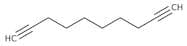
CAS 1720-38-3
:1,9-Decadiino
- Deca-1,9-Diyne
- Decadiyne
- 1,9-Decadiyne
1,9-Decadiyne
CAS:Fórmula:C10H14Pureza:>98.0%(GC)Forma y color:Colorless to Light yellow clear liquidPeso molecular:134.221,9-Decadiyne, 97%
CAS:One-step synthesis of carbametacyclophane 3 from 1,9-decadiyne and diethyl acetylenedicarboxylate is described. The use of 1,9-decadiyne as a nucleophile led only to the monoalkynylation product, a selectivity that would be difficult to achieve with a catalytic in situ metalation process. 1,9-decadiFórmula:C10H14Pureza:97%Forma y color:Liquid, Clear colorless to yellowPeso molecular:134.221,9-Decadiyne
CAS:1,9-Decadiyne is a monolayer that has been synthesized from the coupling of two phenylacetylene molecules. This molecule has a molecular weight of 204. The interpunctella and pteleifolia species are the only known natural sources of 1,9-decadiyne. These species were bioassayed for antifungal activity against a number of fungi, including Aspergillus niger and Candida albicans. The optical properties of 1,9-decadiyne have been characterized using UV-visible spectroscopy and found to be similar to those of eugenol. Molecular modeling studies have shown that 1,9-decadiyne copolymerizes with polystyrene in an alternating fashion. Pharmacokinetic properties have been studied in rats and show that it is absorbed through the skin and metabolized by esterases in the liver. Gel permeation chromatography results show that there is a large amount
Fórmula:C10H14Pureza:Min. 95%Peso molecular:134.22 g/mol