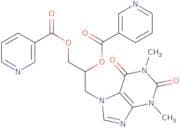
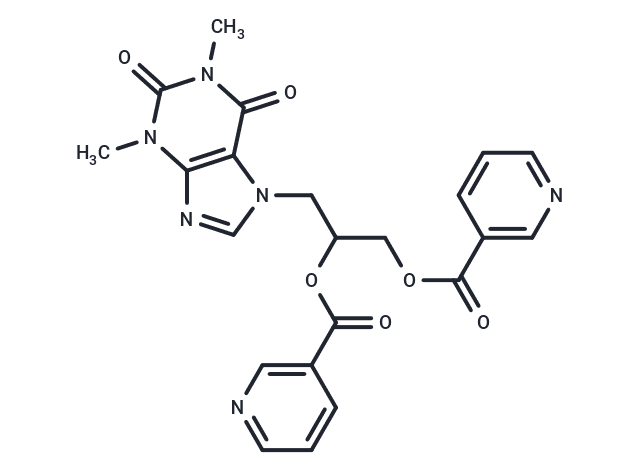
![1,1′-[1-[(1,2,3,6-Tetrahydro-1,3-dimethyl-2,6-dioxo-7H-purin-7-yl)methyl]-1,2-ethanediyl] di-3-pyr…](/_next/image/?url=https%3A%2Fstatic.cymitquimica.com%2Fcas-image%2Fthumb-webp%2F479126-11-1-1236-tetrahydro-13-dimethyl-26-dioxo-7h-purin-7-yl-methyl-12-ethanediyl-di-3-pyridinecarboxylate.webp&w=3840&q=75)
CAS 17692-30-7
:1,1′-[1-[(1,2,3,6-Tetrahidro-1,3-dimetil-2,6-dioxo-7H-purin-7-il)metil]-1,2-etano diil] di-3-piridinacarboxilato
Descripción:
1,1′-[1-[(1,2,3,6-Tetrahidro-1,3-dimetil-2,6-dioxo-7H-purin-7-il)metil]-1,2-etano diil] di-3-piridinacarboxilato, con número CAS 17692-30-7, es un compuesto orgánico complejo caracterizado por sus características estructurales únicas, que incluyen un derivado de purina y moieties de piridina carboxilato. Esta sustancia exhibe propiedades típicas de los análogos de purina, como la posible actividad biológica, que puede incluir interacciones con estructuras de ácidos nucleicos o enzimas. La presencia de múltiples grupos funcionales, incluidos grupos carboxilato y metilo, sugiere que puede participar en varias reacciones químicas, incluidas la esterificación y sustituciones nucleofílicas. Su solubilidad y estabilidad pueden variar dependiendo del disolvente y las condiciones ambientales, lo cual es crucial para su aplicación en investigación bioquímica o desarrollo farmacéutico. Además, la estructura molecular del compuesto puede conferir propiedades farmacológicas específicas, lo que lo hace de interés en la química medicinal. En general, este compuesto representa un ejemplo significativo de la interacción entre la química orgánica y la actividad biológica, lo que justifica una mayor investigación sobre sus posibles usos.
Fórmula:C22H20N6O6
InChI:InChI=1S/C22H20N6O6/c1-26-18-17(19(29)27(2)22(26)32)28(13-25-18)11-16(34-21(31)15-6-4-8-24-10-15)12-33-20(30)14-5-3-7-23-9-14/h3-10,13,16H,11-12H2,1-2H3
Clave InChI:InChIKey=ZMXGPGZXYJCCHZ-UHFFFAOYSA-N
SMILES:C(C(OC(=O)C=1C=CC=NC1)COC(=O)C=2C=CC=NC2)N3C4=C(N=C3)N(C)C(=O)N(C)C4=O
Sinónimos:- (Dinicotinoyloxy-2,3-propyl)-7 theophylline
- (Dinicotinoyloxy-2,3-propyl)-7 theophylline [French]
- 1,1′-[1-[(1,2,3,6-Tetrahydro-1,3-dimethyl-2,6-dioxo-7H-purin-7-yl)methyl]-1,2-ethanediyl] di-3-pyridinecarboxylate
- 3-(1,3-dimethyl-2,6-dioxo-1,2,3,6-tetrahydro-7H-purin-7-yl)propane-1,2-diyl dipyridine-3-carboxylate
- 3-(7-Theophyllinyl)propylen dinicotinat
- 3-Pyridinecarboxylic acid, 1,1′-[1-[(1,2,3,6-tetrahydro-1,3-dimethyl-2,6-dioxo-7H-purin-7-yl)methyl]-1,2-ethanediyl] ester
- 3-Pyridinecarboxylic acid, 1-((1,2,3,6-tetrahydro-1,3-dimethyl-2,6-dioxo-7H-purin-7-yl)methyl)-1,2-ethanediyl ester
- 7-(2,3-Dihydroxypropyl)theophylline bis(nicotinate ester)
- 7-(2,3-Dinicotinoyloxypropyl)theophyllin
- A 17 Hf
- Corverum
- Diniprofilina
- Diniprofilina [INN-Spanish]
- Diniprofylline [INN:DCF]
- Diniprofyllinum
- Diniprofyllinum [INN-Latin]
- Nicotinic acid, diester with 7-(2,3-dihydroxypropyl)theophylline
- Nicotinic acid, diester with 7-(2,3-dihydroxypropyl)theophylline (8CI)
- Theophylline, 7-(2,3-dihydroxypropyl)-, dinicotinate (ester)
- Ver más sinónimos
Ordenar por
Pureza (%)
0
100
|
0
|
50
|
90
|
95
|
100
Encontrado 2 productos.
Diniprofylline
CAS:Producto controladoDiniprofylline is a drug that binds to adrenergic receptors and increases the levels of cAMP. It is used cosmetically to reduce the viscosity of oils and fatty acids, as well as in implanting because it can be reconstituted with distilled water. Diniprofylline has been shown to have positive effects on the heart by increasing heart rate, coronary blood flow, and myocardial contractility. It also reduces the chances of developing radiation-induced heart disease by suppressing radiation-induced constriction of coronary arteries. Diniprofylline has been shown to decrease inflammation by inhibiting the H2 receptor.Fórmula:C22H20N6O6Pureza:Min. 95%Peso molecular:464.43 g/molDiniprofylline
CAS:Diniprofylline, a phosphodiesterase inhibitor, has been used as a peripheral nervous system agent, a bronchodilator agent, and an anti-asthamtic agent.Fórmula:C22H20N6O6Forma y color:SolidPeso molecular:464.43