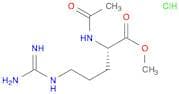
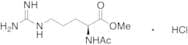
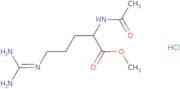
CAS 1784-05-0
:L-Arginina, N2-acetil-, éster metílico, clorhidrato (1:1)
Descripción:
L-Arginina, N2-acetil-, éster metílico, clorhidrato (1:1) es un derivado del aminoácido L-arginina, que desempeña un papel crucial en varios procesos fisiológicos, incluida la síntesis de proteínas y la producción de óxido nítrico. Este compuesto presenta un grupo acetilo y una modificación de éster metílico, lo que mejora su solubilidad y biodisponibilidad. Como sal de clorhidrato, es típicamente más estable y más fácil de manejar en entornos de laboratorio y farmacéuticos. La presencia del grupo éster metílico puede influir en su farmacocinética, permitiendo potencialmente una mejor absorción y transporte a través de las membranas celulares. Los derivados de L-arginina a menudo se estudian por sus posibles aplicaciones terapéuticas, incluida la salud cardiovascular, la función inmunológica y la cicatrización de heridas. Además, este compuesto puede exhibir diferentes actividades biológicas en comparación con su aminoácido padre, lo que lo hace de interés en la investigación relacionada con las vías metabólicas y el desarrollo de fármacos. Al igual que con cualquier sustancia química, el manejo adecuado y las precauciones de seguridad son esenciales, dado sus posibles efectos biológicos e interacciones.
Fórmula:C9H19ClN4O3
InChI:InChI=1/C9H18N4O3.ClH/c1-6(14)13-7(8(15)16-2)4-3-5-12-9(10)11;/h7H,3-5H2,1-2H3,(H,13,14)(H4,10,11,12);1H
Clave InChI:InChIKey=FIUSXBMWQFBXLZ-FJXQXJEOSA-N
SMILES:[C@H](CCCNC(=N)N)(C(OC)=O)NC(C)=O.Cl
Sinónimos:- <span class="text-smallcaps">L</span>-Arginine, N<sup>2</sup>-acetyl-, methyl ester, hydrochloride (1:1)
- <span class="text-smallcaps">L</span>-Arginine, N<sup>2</sup>-acetyl-, methyl ester, monohydrochloride
- Ac-Arg-Ome hydrochloride
- Ac-Arginine-Ome Hcl
- Acetyl-L-Arg Methyl Ester Hcl
- Acetyl-L-Arginine Methyl Ester Hydrochloride
- Acetyl-L-Arginine Methyl Ester Monohydrochloride
- Arginine, N<sup>2</sup>-acetyl-, methyl ester, monohydrochloride, <span class="text-smallcaps">L</span>-
- N-Acetyl-L-Arginine Methyl Ester Hydrochloride
- N-Alpha-Acetyl-Arginine Methyl Ester Hydrochloride
- L-Arginine, N2-acetyl-, methyl ester, monohydrochloride
- Arginine, N2-acetyl-, methyl ester, monohydrochloride, L-
- L-Arginine, N2-acetyl-, methyl ester, hydrochloride (1:1)
- 2-acetamido-5-(diaminomethylideneamino)pentanoic acid methyl ester hydrochloride
- Ac-Arg-OMe
- Nα-Acetyl-L-arginine methyl ester hydrochloride
- Ac-L-Arg-OMe·HCl
- Nα-Acetyl-L-arginine methyl ester hydrochloride≥ 95% (HPLC)
- AC-ARG-OME HCL
- Methyl-N2-Acetylargininate Hydrochloride
- (S)-Methyl 2-acetaMido-5-guanidinopentanoate hydrochloride
- Ver más sinónimos
Ordenar por
Pureza (%)
0
100
|
0
|
50
|
90
|
95
|
100
Encontrado 6 productos.
Ac-Arg-OMe · HCl
CAS:Substrate for pancreatic and intestinal kallikreins from different species. It is also hydrolyzed by trypsin.Fórmula:C9H18N4O3·HClPureza:> 99%Forma y color:White PowderPeso molecular:266.73(S)-Methyl 2-acetamido-5-guanidinopentanoate hydrochloride
CAS:Fórmula:C9H19ClN4O3Pureza:95.0%Peso molecular:266.73N-alpha-Acetyl-L-arginine methyl ester hydrochloride
CAS:N-alpha-Acetyl-L-arginine methyl ester hydrochloride is an enzyme that catalyzes the conversion of arginine to citrulline. It is a part of a group of enzymes called kallikreins. Kinetic constants for this enzyme have been determined in both porcine and human pancreatic preparations. The efficiency of this enzyme has been found to be increased in the presence of L-phenylalanine, and it was found that the C-terminal subsite is responsible for this effect.Fórmula:C9H18N4O3·HClPureza:Min. 95%Forma y color:White PowderPeso molecular:266.73 g/molN-Acetyl-L-arginine Methyl Ester Hydrochloride
CAS:Producto controladoApplications N-Acetyl-L-arginine Methyl Ester is used in the synthetic route to biologically important L-arginine peptides.
References Levison, P.R., et al.: Synthetic Communic., 13, 167 (1983),Fórmula:C9H18N4O3·ClHForma y color:NeatPeso molecular:266.725Ac-Arg-OMe • HCl
CAS:Ac-Arg-OMe • HCl is a labile peptide that has been shown to be homologous to the human Arg-Gly-Asp (RGD) sequence. Ac-Arg-OMe • HCl is activated by trypsin and trypsin-like proteases, but inactivated by hemolytic activity and conformation. Ac-Arg-OMe • HCl is an enzyme substrate for peptidases such as trypsin and trypsin like proteases. It has been shown to be a molecule that interacts with various proteins, including hemoglobin.
Fórmula:C9H18N4O3•HCIPureza:Min. 95%Peso molecular:266.72 g/mol