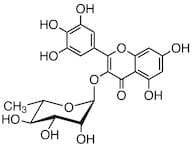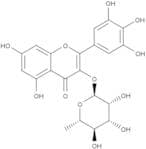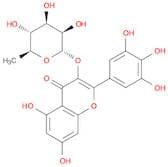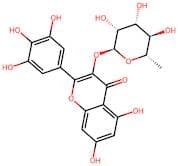
CAS 17912-87-7
:Miricitrina
Descripción:
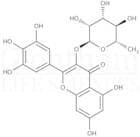
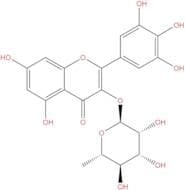
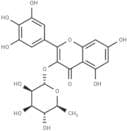
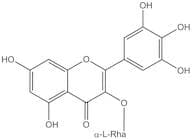
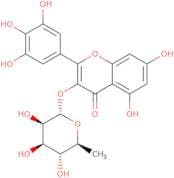
Miricitrina, con el número CAS 17912-87-7, es un glucósido flavonoide que se encuentra principalmente en varias plantas, particularmente en las especies de Myrica. Se caracteriza por su estructura, que consiste en un aglicona de miricetina unida a una porción de azúcar rhamnosa. Miricitrina exhibe varias actividades biológicas, incluyendo propiedades antioxidantes, antiinflamatorias y potencialmente antimicrobianas, lo que lo hace de interés en la investigación farmacológica. El compuesto es típicamente soluble en disolventes polares, reflejando su naturaleza glucosídica, y a menudo se estudia por sus beneficios para la salud, particularmente en la medicina tradicional. Además, se ha investigado el papel de Miricitrina en la protección de las células contra el estrés oxidativo y su potencial para modular diversas vías bioquímicas. Su presencia en fuentes dietéticas sugiere que puede contribuir a los beneficios para la salud asociados con las dietas basadas en plantas. En general, Miricitrina representa un compuesto significativo en el campo de los productos naturales y la fitoquímica, con investigaciones en curso sobre sus aplicaciones terapéuticas.
Fórmula:C21H20O12
InChI:InChI=1/C21H20O12/c1-6-14(26)17(29)18(30)21(31-6)33-20-16(28)13-9(23)4-8(22)5-12(13)32-19(20)7-2-10(24)15(27)11(25)3-7/h2-6,14,17-18,21-27,29-30H,1H3
Clave InChI:InChIKey=DCYOADKBABEMIQ-OWMUPTOHSA-N
SMILES:O(C1=C(OC=2C(C1=O)=C(O)C=C(O)C2)C3=CC(O)=C(O)C(O)=C3)[C@H]4[C@H](O)[C@H](O)[C@@H](O)[C@H](C)O4
Sinónimos:- 17912-87-7
- 3,3′,4′,5,5′,7-Hexahydroxyflavone, 3-rhamnoside
- 3-O-Rhamnosylmyricetin
- 3-[(6-Deoxy-α-<span class="text-smallcaps">L</span>-mannopyranosyl)oxy]-5,7-dihydroxy-2-(3,4,5-trihydroxyphenyl)-4H-1-benzopyran-4-one
- 4H-1-Benzopyran-4-one, 3-[(6-deoxy-α-<span class="text-smallcaps">L</span>-mannopyranosyl)oxy]-5,7-dihydroxy-2-(3,4,5-trihydroxyphenyl)-
- 4H-1-benzopyran-4-one, 3-[(6-deoxy-alpha-L-mannopyranosyl)oxy]-5,7-dihydroxy-2-(3,4,5-trihydroxyphenyl)-
- 5,7-Dihydroxy-3-{[(2S,3R,4R,5R,6S)-3,4,5-trihydroxy-6-methyltetrahydro-2H-pyran-2-yl]oxy}-2-(3,4,5-trihydroxyphenyl)-4H-chromen-4-on
- 5,7-Dihydroxy-3-{[(2S,3R,4R,5R,6S)-3,4,5-trihydroxy-6-methyltetrahydro-2H-pyran-2-yl]oxy}-2-(3,4,5-trihydroxyphenyl)-4H-chromen-4-one
- 5,7-Dihydroxy-4-oxo-2-(3,4,5-trihydroxyphenyl)-4H-chromen-3-yl 6-deoxy-a-L-mannopyranoside
- 5,7-Dihydroxy-4-oxo-2-(3,4,5-trihydroxyphenyl)-4H-chromen-3-yl 6-deoxy-alpha-L-mannopyranoside
- 5,7-dihydroxy-4-oxo-2-(3,4,5-trihydroxyphenyl)-4H-chromen-3-yl 6-deoxyhexopyranoside
- 6-Désoxy-alpha-L-mannopyranoside de 5,7-dihydroxy-4-oxo-2-(3,4,5-trihydroxyphényl)-4H-chromén-3-yle
- Myricetin 3-O-rhamnopyranoside
- Myricetin 3-O-rhamnoside
- Myricetin 3-O-α-<span class="text-smallcaps">L</span>-rhamnopyranoside
- Myricetin 3-O-α-<span class="text-smallcaps">L</span>-rhamnoside
- Myricetin 3-O-α-<span class="text-smallcaps">L</span>-rhamnpyronoside
- Myricetin 3-O-α-rhamnopyranoside
- Myricetin 3-rhamnoside
- Myricetin-3-O-α-rhamnoside
- Myricetin-3-O-β-rhamnopyranoside
- Myricitrin
- Myricitrine
- Myricitroside
- NSC 19803
- 4H-1-Benzopyran-4-one, 3-[(6-deoxy-α-L-mannopyranosyl)oxy]-5,7-dihydroxy-2-(3,4,5-trihydroxyphenyl)-
- 3-[(6-Deoxy-α-L-mannopyranosyl)oxy]-5,7-dihydroxy-2-(3,4,5-trihydroxyphenyl)-4H-1-benzopyran-4-one
- MYRICITRIN WITH HPLC
- MIRICITRIN
- 3-[(6-Deoxy-alpha-L-Mannopyranosyloxy)]-5,7-dihydroxy-2-(3,4,5-trihydroxyphenyl)-4H-chroMen-4-one
- CANNABISCITRIN
- 3,3′,4′,5,5′,7-Hexahydroxyflavone 3-O-rhamnoside
- Myricetin 3-O-α-L-rhamnopyranoside
- mannopyranosyl)oxy]-5,7-dihydroxy-2-(3,4,5-trihydroxyphenyl)-
- MYRICITRIN HPLC 98+%
- YRICITRIN
- Myricitrin(Myricitrine)
- MYRICITRIN(MYRICETIN-3-O-RHAMNOSIDE)(SH)
- 5,7-dihydroxy-3-((2s,3r,4r,5r,6s)-3,4,5-trihydroxy-6-methyl-tetrahydro-pyran-2-yloxy)-2-(3,4,5-trihydroxy-phenyl)-1-benzopyran-4-one
- 3-[(6-deoxy-alpha-L-mannopyranosyl)oxy]-5,7-dihydroxy-2-(3,4,5-trihydroxyphenyl)-4H-benzopyran-4-one
- Myricitrin, froM Myrica rubra
- Myricetin 3-α-L-rhamnopyranoside
- MYRICETIN-3-O-RHAVINOSIDE
- 5,7-Dihydroxy-3-((2S,3R,4R,5R,6S)-3,4,5-trihydroxy-6-methyl-tetrahydro-pyran-2-yloxy)-2-(3,4,5-trihydroxy-phenyl)-1-benzopyran-4-one
- 3',4',5,5',7-Pentahydroxy-3-(α-L-rhamnopyranosyloxy)flavone
- 4H-1-Benzopyran-4-one,3-[(6-deoxy-α-L-
- 3-[(6-deoxy-α-L-mannopyranosyl)oxy]-5,7-dihydroxy-2-(3,4,5-trihydroxyphenyl)-4H-benzopyran-4-one
- Myricetrin
- Ver más sinónimos
Ordenar por
Pureza (%)
0
100
|
0
|
50
|
90
|
95
|
100
Encontrado 10 productos.
Myricitrin
CAS:Fórmula:C21H20O12Pureza:>98.0%(HPLC)Forma y color:Light yellow to Yellow to Orange powder to crystalPeso molecular:464.38Myricitrin
CAS:Myricitrin analytical standard provided with w/w absolute assay, to be used for quantitative titration.Fórmula:C21H20O12Pureza:(HPLC) ≥99%Forma y color:PowderPeso molecular:464.38Myricitrin
CAS:Fórmula:C21H20O12Pureza:(HPLC) ≥ 98.0%Forma y color:White to light yellow powderPeso molecular:464.38Myricetrin
CAS:Myricitrin exhibits hepatoprotective, anti-inflammatory,antioxidant, anti-allergic, antinociception, anxiolytic-like, and antipsychotic-like effects. Myricitrin can be used as a drug candidate for the treatment of cardiovascular diseases, by effectively protecting cells from ox-LDL-induced endothelial cell apoptosis and reducing atherosclerotic plaque formation. Myricitrin is also a nitric oxide (NO) and protein kinase C (PKC) inhibitor that has central nervous system activity.Fórmula:C21H20O12Pureza:95%~99%Peso molecular:464.379Myricitrin
CAS:Myricitrin (Myricitrine), a flavonoid compound isolated from the root bark of Myrica cerifera, exerts antinociceptive effects.Fórmula:C21H20O12Pureza:99.72%Forma y color:Light Yellow To Off-White Crystalline PowderPeso molecular:464.38Myricitrin
CAS:Natural glycosideFórmula:C21H20O12Pureza:≥ 95.0 % (HPLC)Forma y color:PowderPeso molecular:464.38Myricitrin
CAS:Myricitrin is a natural compound that is found in the bark of the Myrica tree. It has been shown to have antioxidant effects and pro-apoptotic activities. Myricitrin has been shown to induce apoptosis in HL-60 cells through activation of the caspase-3 pathway, which includes cleavage of poly (ADP-ribose) polymerase and activation of caspases. In addition, myricitrin induces apoptosis by binding to DNA and inhibiting transcription. The physiological effects of myricetin are similar to those of myricitrin due to their structural similarity. However, there is no data available on the anti-inflammatory properties or hypoglycemic effect of myricetin.Fórmula:C21H20O12Pureza:Min. 95%Forma y color:White PowderPeso molecular:464.38 g/mol