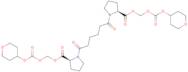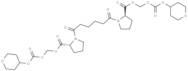
CAS 1819986-22-5
:Fórmula:C30H44N2O14
InChI:InChI=1S/C30H44N2O14/c33-25(31-13-3-5-23(31)27(35)41-19-43-29(37)45-21-9-15-39-16-10-21)7-1-2-8-26(34)32-14-4-6-24(32)28(36)42-20-44-30(38)46-22-11-17-40-18-12-22/h21-24H,1-20H2/t23-,24-/m1/s1
Clave InChI:KSKLDMGKWDUQCT-DNQXCXABSA-N
SMILES:C1C[C@@H](N(C1)C(=O)CCCCC(=O)N2CCC[C@@H]2C(=O)OCOC(=O)OC3CCOCC3)C(=O)OCOC(=O)OC4CCOCC4
Filtrar por
Porcentaje de pureza
0
100
|
0
|
50
|
90
|
95
|
100
Se han encontrado 5 productos.
- Precio más bajo
- Precio más alto
- Pureza más baja
- Pureza más alta
- Entrega estimada más rápida
amyloid P-IN-1
CAS:Bis(((((tetrahydro-2H-pyran-4-yl)oxy)carbonyl)oxy)methyl) adipoyl(R)-di-D-prolinateFórmula:C30H44N2O14Pureza:98+%Peso molecular:656.68amyloid P-IN-1
CAS:Amyloid P-IN-1 is a ligand that binds to the amyloid peptide and inhibits the formation of amyloids. Amyloid P-IN-1 has been shown to be an orally active molecule in humans, with a low oral bioavailability due to its physicochemical properties. The affinity for amyloid P-IN-1 to bind to the amyloid peptide is high and it has been shown to inhibit the growth of amyloids in vitro and in vivo. Amyloid P-IN-1 also has pharmacological effects on ligands, such as binding to receptors on cells, which may account for its potential use as a therapeutic agent.
Fórmula:C30H44N2O14Pureza:Min. 95%Peso molecular:656.68 g/molamyloid P-IN-1
CAS:amyloid P-IN-1 can be used in studies about diseases with depletion of serum amyloid P components such as Alzheimer's disease, amyloidosis, osteoarthritis, andFórmula:C30H44N2O14Pureza:99.76%Forma y color:SolidPeso molecular:656.68