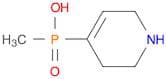
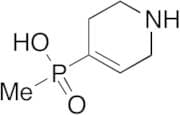
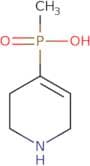
CAS 182485-36-5
:Ácido P-metil-P-(1,2,3,6-tetrahidro-4-piridinil)fosfínico
Descripción:
Ácido P-metil-P-(1,2,3,6-tetrahidro-4-piridinil)fosfínico, identificado por su número CAS 182485-36-5, es un compuesto químico que presenta un grupo funcional de ácido fosfínico. Esta sustancia se caracteriza por la presencia de un grupo metilo y un moiety de tetrahidro-piridina, que contribuye a sus propiedades químicas únicas. El grupo de ácido fosfínico generalmente exhibe acidez moderada y puede participar en varias reacciones químicas, incluyendo sustituciones nucleofílicas y coordinación con iones metálicos. La estructura de tetrahidro-piridina puede influir en la actividad biológica del compuesto, afectando potencialmente sus interacciones con sistemas biológicos. Este compuesto es de interés en la química medicinal y puede tener aplicaciones en el desarrollo de fármacos o como herramienta bioquímica. Su solubilidad, estabilidad y reactividad pueden variar según las condiciones ambientales como el pH y la temperatura. Al igual que con muchos ácidos fosfínicos, se deben observar precauciones de seguridad al manipular este compuesto, ya que puede exhibir toxicidad o peligros ambientales.
Fórmula:C6H12NO2P
InChI:InChI=1S/C6H12NO2P/c1-10(8,9)6-2-4-7-5-3-6/h2,7H,3-5H2,1H3,(H,8,9)
Clave InChI:InChIKey=MFUKVPOVVKKLRQ-UHFFFAOYSA-N
SMILES:P(C)(=O)(O)C=1CCNCC1
Sinónimos:- (1,2,5,6-Tetrahydropyridin-4-Yl)Methylphosphinic Acid Hydrate
- P-Methyl-P-(1,2,3,6-tetrahydro-4-pyridinyl)phosphinic acid
- Phosphinic acid, P-methyl-P-(1,2,3,6-tetrahydro-4-pyridinyl)-
- Phosphinic acid, methyl(1,2,3,6-tetrahydro-4-pyridinyl)-
- Tpmpa
- Tpmpa Hydrate
Ordenar por
Pureza (%)
0
100
|
0
|
50
|
90
|
95
|
100
Encontrado 4 productos.
Phosphinic acid, P-methyl-P-(1,2,3,6-tetrahydro-4-pyridinyl)-
CAS:Fórmula:C6H12NO2PPureza:98%Forma y color:SolidPeso molecular:161.1387TPMPA
CAS:TPMPA is a gamma-aminobutyric acid (GABA) receptor antagonist that binds to the GABA receptor and blocks its activity. It also has been shown to have synergistic effects with other GABAergic agents, including benzodiazepines, barbiturates, and neurosteroids. TPMPA is able to inhibit the production of pro-apoptotic proteins by binding to the GABAA receptor in cells. The binding site of TPMPA on the GABAA receptor is located at the α1 subunit and it can bind competitively with agonist molecules. TPMPA can be used as a pharmacological agent for treatment of neurological disorders such as epilepsy and Alzheimer's disease because it inhibits glutamate release from neurons and prevents calcium from entering cells.Fórmula:C6H12NO2PPureza:Min. 95%Peso molecular:161.14 g/mol