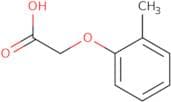
CAS 1878-49-5
:Ácido (2-metilfenoxi)acético
Descripción:
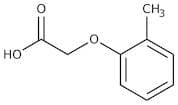
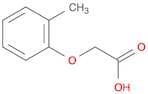
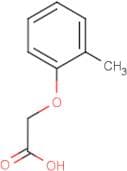
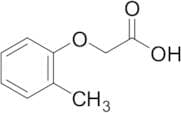
Ácido (2-metilfenoxi)acético, con el número CAS 1878-49-5, es un compuesto orgánico caracterizado por su estructura aromática y grupos funcionales. Presenta un grupo fenoxilo, que es un anillo de fenilo unido a un átomo de oxígeno, y un grupo ácido acético, que contribuye a sus propiedades ácidas. Este compuesto es típicamente un líquido o sólido incoloro a amarillo pálido, dependiendo de su pureza y forma. Es soluble en disolventes orgánicos y exhibe solubilidad moderada en agua. La presencia del grupo metilo en el anillo fenoxilo influye en su reactividad química y actividad biológica, lo que lo hace de interés en diversas aplicaciones, incluyendo como herbicida y en la síntesis de otros compuestos químicos. Su estructura molecular permite interacciones con sistemas biológicos, lo que puede llevar a efectos herbicidas específicos. Los datos de seguridad indican que debe manejarse con cuidado, ya que puede presentar riesgos si se ingiere o si entra en contacto con la piel. En general, Ácido (2-metilfenoxi)acético es un compuesto versátil con una relevancia significativa tanto en la química industrial como en la agrícola.
Fórmula:C9H10O3
InChI:InChI=1/C9H10O3/c1-7-4-2-3-5-8(7)12-6-9(10)11/h2-5H,6H2,1H3,(H,10,11)/p-1
Clave InChI:InChIKey=QJVXBRUGKLCUMY-UHFFFAOYSA-N
SMILES:O(CC(O)=O)C1=C(C)C=CC=C1
Sinónimos:- (2-Methylphenoxy)Acetate
- (o-Methylphenoxy)acetic acid
- (o-Tolyloxy)-acetic acid
- 2-(2-Methylphenoxy)acetic acid
- 2-(o-Tolyloxy)acetic acid
- 2-Methylphenoxyacetic acid
- 2-Methylphenyloxyacetic acid
- 2-[(2-Methylphenyl)oxy]acetic acid
- Acetic acid, (2-methylphenoxy)-
- Acetic acid, (o-tolyloxy)-
- Acetic acid, 2-(2-methylphenoxy)-
- NSC 5293
- o-Cresolglycolic acid
- o-Cresoxyacetic acid
- o-Cresyloxyacetic acid
- o-Tolyloxyacetic acid
- (2-Methylphenoxy)acetic acid
- 2-Methylphenoxyacetic acid, 98+%
- Acide o-methylphenoxyacetique
- AKOS BBB/207
- IFLAB-BB F1924-0028
- AKOS BBS-00007680
- acideo-methylphenoxyacetique
- (2-methylphenoxy)aceticacid(asimpurity)
- (o-tolyloxy)aceticacid
- ortho-Tolyloxyacetic acid
- 2-(Tolyloxy)-acetic acid
- (2-methylphenoxy)acetic
- (o-tolyloxy)-aceticaci
- AKOS B013804
- Ver más sinónimos
Ordenar por
Pureza (%)
0
100
|
0
|
50
|
90
|
95
|
100
Encontrado 6 productos.
2-Methylphenoxyacetic acid, 98%
CAS:This Thermo Scientific Chemicals brand product was originally part of the Alfa Aesar product portfolio. Some documentation and label information may refer to the legacy brand. The original Alfa Aesar product / item code or SKU reference has not changed as a part of the brand transition to Thermo SciFórmula:C9H10O3Pureza:98%Forma y color:Crystals or powder or crystalline powder, White to pale creamPeso molecular:166.18Acetic acid, 2-(2-methylphenoxy)-
CAS:Fórmula:C9H10O3Pureza:97%Forma y color:SolidPeso molecular:166.1739o-Cresolglycolic Acid
CAS:Producto controladoApplications (2-methylphenoxy)acetic acid (cas# 1878-49-5) is a useful research chemical.
Fórmula:C9H10O3Forma y color:NeatPeso molecular:166.172-Methylphenoxyacetic acid
CAS:2-Methylphenoxyacetic acid is a small-molecule drug that acts as an inhibitor of the protein kinase C (PKC) enzyme. It binds to the active site of PKC and prevents it from phosphorylating other proteins, which ultimately leads to cell death. The PKC enzyme is a potential drug target for cancer and cardiovascular disease because it plays a role in both pathologies. 2-Methylphenoxyacetic acid has been shown to inhibit PKC in vitro and in vivo, with the latter being demonstrated using mathematical modeling and molecular dynamics simulations. 2-Methylphenoxyacetic acid also inhibits annexin II, which is believed to be involved in signal transduction pathways that lead to tumor growth. 2-Methylphenoxyacetic acid has been shown to bind to the hydroxyl group of phospholipids and form hydrogen bonds with amino acids that are important for protein–protein interactions or intermolecular hydrogen bonds.Fórmula:C9H10O3Pureza:Min. 95%Forma y color:White PowderPeso molecular:166.17 g/mol