CAS 18956-15-5
:Chalcona de pinostrobin
Descripción:
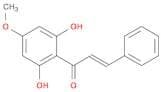
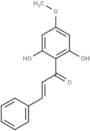
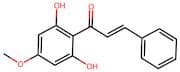
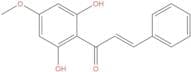
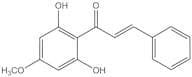
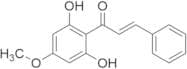
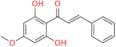
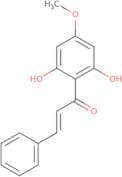
Chalcona de pinostrobin es un compuesto flavonoide que se encuentra de forma natural y pertenece a la clase de los chalconos. Se caracteriza por su apariencia cristalina amarilla y se deriva principalmente de diversas fuentes vegetales, particularmente del género *Alpinia*. Este compuesto exhibe una variedad de actividades biológicas, incluyendo propiedades antioxidantes, antiinflamatorias y antimicrobianas, lo que lo hace de interés tanto en la investigación farmacológica como en la nutracéutica. Chalcona de pinostrobin es conocido por su capacidad para modular diversas vías de señalización, lo que puede contribuir a sus posibles efectos terapéuticos. Además, se ha estudiado por su papel en la prevención y tratamiento del cáncer debido a su capacidad para inducir apoptosis en células cancerosas. La estructura del compuesto presenta un esqueleto de chalcono, que consiste en dos anillos aromáticos conectados por un sistema carbonílico α,β-insaturado de tres carbonos, lo que contribuye a su reactividad y actividad biológica. En general, Chalcona de pinostrobin representa un área prometedora de estudio en la química de productos naturales y aplicaciones medicinales.
Fórmula:C16H14O4
InChI:InChI=1S/C16H14O4/c1-20-12-9-14(18)16(15(19)10-12)13(17)8-7-11-5-3-2-4-6-11/h2-10,18-19H,1H3/b8-7+
Clave InChI:InChIKey=CUGDOWNTXKLQMD-BQYQJAHWSA-N
SMILES:C(/C=C/C1=CC=CC=C1)(=O)C2=C(O)C=C(OC)C=C2O
Sinónimos:- (2E)-1-(2,6-Dihydroxy-4-methoxyphenyl)-3-phenyl-2-propen-1-one
- (2E)-1-(2,6-dihydroxy-4-methoxyphenyl)-3-phenylprop-2-en-1-one
- (E)-1-(2,6-Dihydroxy-4-Methoxy-Phenyl)-3-Phenyl-Propenone
- (E)-1-(2,6-Dihydroxy-4-methoxy-phenyl)-3-phenyl-
- (E)-1-(2,6-Dihydroxy-4-methoxyphenyl)-3-phenyl-2-propen-1-one
- 2-Propen-1-one, 1-(2,6-dihydroxy-4-methoxyphenyl)-3-phenyl-, (2E)-
- 2-Propen-1-one, 1-(2,6-dihydroxy-4-methoxyphenyl)-3-phenyl-, (E)-
- 2-Propen-1-one,1-(2,6-dihy
- 2′,6′-Dihydroxy-4′-methoxychalcone
- Chalcone, 2′,6′-dihydroxy-4′-methoxy-
- Dihydroxy-4'-Methoxychalcone, 2',6'-
- Ver más sinónimos
Ordenar por
Pureza (%)
0
100
|
0
|
50
|
90
|
95
|
100
Encontrado 10 productos.
2-Propen-1-one, 1-(2,6-dihydroxy-4-methoxyphenyl)-3-phenyl-, (2E)-
CAS:Fórmula:C16H14O4Pureza:99%Forma y color:SolidPeso molecular:270.2800Pinostrobin chalcone
CAS:Pinostrobin chalcone from Mucuna pruriens shows anticancer effects; IC50: 20.42 μg/mL in MDA-MB-231, 22.51 μg/mL in HT-29.Fórmula:C16H14O4Pureza:98.65%Forma y color:SolidPeso molecular:270.28Ref: TM-TN2083
1mg88,00€5mg216,00€10mg321,00€25mg530,00€50mg772,00€100mg1.063,00€200mg1.431,00€1mL*10mM (DMSO)200,00€2',6'-dihydroxy 4'-methoxychalcone
CAS:Ketone with other oxygen functionsFórmula:C16H14O4Pureza:≥ 90.0 % (HPLC)Forma y color:PowderPeso molecular:270.29Iso-cardamonin
CAS:cIsocardamonin is a versatile building block that can be used as a precursor to a variety of complex compounds. It is commercially available and has been shown to be useful in the synthesis of various research chemicals, including reagents and speciality chemicals. cIsocardamonin is an intermediate in the synthesis of other compounds, such as indole-3-carboxylic acid, which can be used as a useful scaffold in drug design. The compound also has properties that make it suitable for use as a reagent or catalyst. cIsocardamonin is soluble in organic solvents and has a melting point of about 190°C.Fórmula:C16H14O4Pureza:Min. 95%Peso molecular:270.28 g/molPinostrobin chalcone
CAS:Pinostrobin chalcone is a bioactive chalcone compound, which is a naturally occurring flavonoid derivative found in various plant sources, notably in the leaves of Magnolia and other species. Its mode of action involves interacting with several cellular pathways, including antioxidative mechanisms and enzyme inhibition. Pinostrobin chalcone exhibits a broad range of biological activities, such as anti-inflammatory, antioxidant, and potential anticancer properties. These effects are attributed to its ability to modulate signaling pathways and protect cells from oxidative stress, making it valuable for scientific research.
Fórmula:C16H14O4Pureza:Min. 95%Forma y color:Yellow To Orange Or Brown SolidPeso molecular:270.28 g/molRef: 3D-FP158556
Producto descatalogado