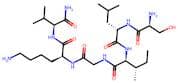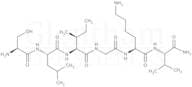
CAS 190383-13-2
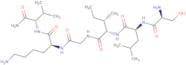
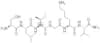
:H-Ser-Leu-Ile-Gly-Lys-Val-NH2
Descripción:
La sustancia química identificada como H-Ser-Leu-Ile-Gly-Lys-Val-NH2, con el número CAS 190383-13-2, es un péptido compuesto por una secuencia de aminoácidos. Este péptido presenta un grupo amida en el extremo C-terminal, lo que mejora su estabilidad y bioactividad en comparación con su contraparte de ácido carboxílico. La secuencia incluye serina (Ser), leucina (Leu), isoleucina (Ile), glicina (Gly), lisina (Lys) y valina (Val), que contribuyen a sus propiedades únicas y funciones biológicas potenciales. Péptidos como este pueden exhibir diversas características, como solubilidad en agua, afinidades de unión específicas a receptores y roles potenciales en vías de señalización o como agentes terapéuticos. La presencia de lisina, un aminoácido cargado positivamente, puede influir en la interacción del péptido con moléculas biológicas cargadas negativamente. En general, la estructura y composición de H-Ser-Leu-Ile-Gly-Lys-Val-NH2 sugieren que puede tener aplicaciones en bioquímica y farmacología, particularmente en el desarrollo de fármacos basados en péptidos o como herramientas de investigación en el estudio de interacciones proteicas.
Fórmula:C28H54N8O7
Sinónimos:- Protease-Activated Receptor-2 Agonist, Amide
- Proteinase Activated Receptor 2 (1-6) Amide (Human)
- Proteinase Activated Receptor 2 Agonist Peptide Sligkv Amide, Human
- Ser-Leu-Ile-Gly-Lys-Val-Amide
- Ser-Leu-Ile-Gly-Lys-Val-Nh2
- Sligkvamide
- Sligkv-Nh2
- Par-2 Agonist Peptide (Sligkv) Amide, Human
Ordenar por
Pureza (%)
0
100
|
0
|
50
|
90
|
95
|
100
Encontrado 6 productos.
Protease-Activated Receptor-2, amide
CAS:Protease-Activated Receptor-2, amidePureza:≥98%Peso molecular:614.78g/molProtease-Activated Receptor-2, amide
CAS:Protease-Activated Receptor-2, amide (SLIGKV-NH2) is an agonist of PAR2 (IC50 : 10.4 M)Fórmula:C28H54N8O7Pureza:>99.99%Forma y color:SolidPeso molecular:614.78H-Ser-Leu-Ile-Gly-Lys-Val-NH2
CAS:H-Ser-Leu-Ile-Gly-Lys-Val-NH2 is a synthetic peptide that is a cyclase inhibitor. It binds to the receptor for neurokinin 1, which has been shown to inhibit lacrimal gland function in rats. The compound also inhibits the synthesis of epidermal growth factor and has been shown to have anti-inflammatory effects in mouse models. H-Ser-Leu-Ile-Gly-Lys-Val-NH2 has also been shown to inhibit protease activity in rat prostate cells and can be used as a chemical inhibitor for proteases.Fórmula:C25H54N8O7Pureza:Min. 95%Peso molecular:614.79 g/molPAR-2 (1-6) amide (human) trifluoroacetate salt
CAS:PAR-2 (1-6) amide (human) trifluoroacetate salt H-Ser-Leu-Ile-Gly-Lys-Val-NH2 trifluoroacetate salt is a protease inhibitor that inhibits the activity of PAR2, a protein receptor. PAR2 is implicated in cancer and inflammation. It has been shown to inhibit growth factor signaling, as well as activate toll-like receptor 4 and other inflammatory pathways. PAR2 inhibition has also been studied in vivo and found to be effective in treating wild type mice with melanoma cells. In vitro studies have shown that PAR2 inhibition by PAR 2 (1-6) amide (human) trifluoroacetate salt H-Ser-Leu-Ile-Gly-Lys-Val NH2 trifluoroacetate salt blocks the production of tumour necrosis factor alpha and interleukin 6.Fórmula:C28H54N8O7Pureza:Min. 95%Peso molecular:614.78 g/molPAR-2 (1-6) amide (human)
CAS:SLIGKV-amide, which corresponds to the tethered ligand sequence of human PAR-2 (protease activated receptor 2), can be used to investigate receptor functions.Fórmula:C28H54N8O7Pureza:> 98%Forma y color:White LyophilisatePeso molecular:614.79