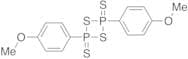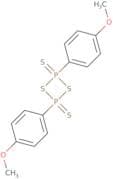
CAS 19172-47-5
:Reactivo de Lawesson
Descripción:
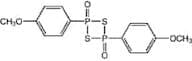
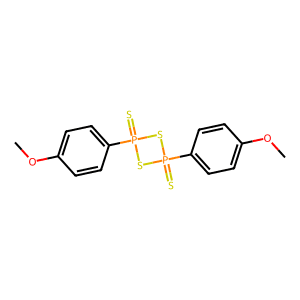
Reactivo de Lawesson, con el número CAS 19172-47-5, es un compuesto químico que se utiliza principalmente como tiocetona y como reactivo en la síntesis orgánica. Se caracteriza por su capacidad para convertir compuestos carbonílicos en tiones, que son análogos de azufre de las cetonas. El reactivo es típicamente un sólido de color amarillo a marrón y es conocido por su estabilidad en condiciones ambientales. Reactivo de Lawesson se utiliza a menudo en la síntesis de varios compuestos que contienen azufre, incluidos tioésteres y tiocetonas, lo que lo hace valioso en la química medicinal y la ciencia de materiales. Su reactividad se atribuye a la presencia de fósforo y azufre en su estructura, lo que facilita el ataque nucleofílico a los grupos carbonílicos electrofílicos. Además, es importante manejar Reactivo de Lawesson con cuidado debido a su potencial toxicidad y la necesidad de medidas de seguridad adecuadas durante su uso. En general, Reactivo de Lawesson es una herramienta versátil en la química orgánica sintética, particularmente para la funcionalización de compuestos carbonílicos.
Fórmula:C14H14O2P2S4
InChI:InChI=1S/C14H14O2P2S4/c1-15-11-3-7-13(8-4-11)17(19)21-18(20,22-17)14-9-5-12(16-2)6-10-14/h3-10H,1-2H3
Clave InChI:InChIKey=CFHGBZLNZZVTAY-UHFFFAOYSA-N
SMILES:S=P1(SP(=S)(S1)C2=CC=C(OC)C=C2)C3=CC=C(OC)C=C3
Sinónimos:- 1,3,2,4-Dithiadiphosphetane, 2,4-bis(4-methoxyphenyl)-, 2,4-disulfide
- 19172-47-5
- 2,4-(4-Methoxyphenyl)-1,3,2,4-dithiadiphosphetane-2,4-disulfide
- 2,4-Bis(4-Methoxyphenyl)-1,3,2,4-Dithiadiphosphetane-2,4-Disulfide
- 2,4-Bis(4-Methoxyphenyl)-1,3-Dithia-2,4-Diphosphetane-2,4-Disulfide
- 2,4-Bis(4-methoxyphenyl)-2,4-dithioxo-1,3,2,4-dithiadiphosphetane
- 2,4-Bis(p-methoxyphenyl)-1,3,2,4-dithiadiphosphetane 2,4-disulfide
- 2,4-Di(p-methoxyphenyl)-1,3-dithiadiphosphetane disulfide
- 242-855-4
- Lawesson reagent
- NSC 150550
- Phosphonotrithioic acid, (p-methoxyphenyl)-, bimol. cyclic anhydrosulfide
- Reagents, Lawesson's
- p-Anisyldithiophosphonic anhydride
- p-Methoxyphenylthionophosphine sulfide dimer
- Ver más sinónimos
Ordenar por
Pureza (%)
0
100
|
0
|
50
|
90
|
95
|
100
Se han encontrado 8 productos.
Lawesson's Reagent [Sulfurating Reagent]
CAS:Fórmula:C14H14O2P2S4Pureza:>93.0%(T)Forma y color:White to Light yellow to Green powder to crystalPeso molecular:404.45Lawesson's Reagent, 97%
CAS:Lawesson's reagent is a thiation agent used to convert carbonyl compounds into thiocarbonyls. It is also used to thionate enones, esters, lactones, amides, lactams and quinones. Further, it is used to prepare thiols from alcohols. It is associated with silver perchlorate and utilized as and oxophiliFórmula:C14H14O2P2S4Pureza:97%Forma y color:White to pale cream or pale yellow, Crystals or powder or crystalline powderPeso molecular:404.452,4-Bis(4-methoxyphenyl)-2,4-dithioxo-1,3,2,4-dithiadiphosphetane
CAS:2,4-Bis(4-methoxyphenyl)-2,4-dithioxo-1,3,2,4-dithiadiphosphetanePureza:95%Peso molecular:404.47g/molLawesson's reagent
CAS:Lawesson's reagent is a thiation agent. It is incompatible with strong oxidizing agents.Fórmula:C14H14O2P2S4Pureza:98%Forma y color:Light Yellow To Beige PowderPeso molecular:404.47Lawesson reagent
CAS:Fórmula:C14H14O2P2S4Pureza:(Titration) ≥ 96.0%Forma y color:Off-white to light-yellow or pale beige-brown powderPeso molecular:404.47Lawesson’s Reagent
CAS:Producto controladoApplications Lawesson’s Reagent is used primarily in the conversion of carbonyls to thiocarbonyls. It is also used in the synthesis of β-D-ribonucleosides.
Not a dangerous good if item is equal to or less than 1g/ml and there is less than 100g/ml in the package
References Shimomura, N. et al.: Bull. Chem. Jpn., 67, 3100 (1994); Wang, F. et al.: Sens. Actu. Chem., 161, 948 (2012);Fórmula:C14H14O2P2S4Forma y color:NeatPeso molecular:404.467Lawesson's reagent
CAS:Lawesson's reagent is a solution of copper(II) acetate, ammonium chloride and hydrochloric acid. It is used in organic chemistry as an oxidizing agent for the conversion of amines to nitro compounds. Lawesson's reagent is also used in vitro as an antifungal agent. The mechanism of action is not fully understood, but it appears to act by producing reactive oxygen species that cause oxidative damage to fungal cell membranes. In addition, Lawesson's reagent has anti-inflammatory properties and can be used as a pharmaceutical preparation.Fórmula:C14H14O2P2S4Pureza:(%) Min. 98%Forma y color:Off-White PowderPeso molecular:404.47 g/mol
![Lawesson's Reagent [Sulfurating Reagent]](/_next/image/?url=https%3A%2Fstatic.cymitquimica.com%2Fproducts%2F3B%2Fthumb%2FB1133.jpg&w=3840&q=75)