CAS 1918-82-7
:2-Viniltiofeno
Descripción:
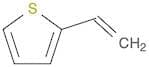
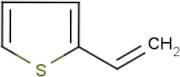
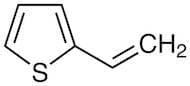
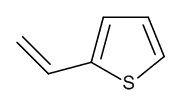
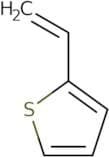
2-Viniltiofeno es un compuesto orgánico caracterizado por su grupo vinilo unido a un anillo de tiofeno, que es un heterociclo aromático de cinco miembros que contiene azufre. Su fórmula molecular es C₈H₈S, y presenta un doble enlace entre los átomos de carbono en el grupo vinilo, lo que contribuye a su reactividad. Este compuesto es típicamente un líquido incoloro a amarillo pálido con un olor característico. Es soluble en disolventes orgánicos como el etanol y el éter, pero tiene una solubilidad limitada en agua. 2-Viniltiofeno es conocido por su papel como monómero en la síntesis de polímeros conductores y puede sufrir reacciones de polimerización, lo que lo hace valioso en la ciencia de materiales y la electrónica orgánica. Además, exhibe propiedades típicas de los derivados de tiofeno, incluyendo estabilidad bajo diversas condiciones y la capacidad de participar en reacciones de sustitución aromática electrofílica. Se deben tomar precauciones de seguridad al manipular este compuesto, ya que puede ser irritante y presenta riesgos para la salud al estar expuesto.
Fórmula:C6H6S
InChI:InChI=1S/C6H6S/c1-2-6-4-3-5-7-6/h2-5H,1H2
Clave InChI:InChIKey=ORNUPNRNNSVZTC-UHFFFAOYSA-N
SMILES:C(=C)C1=CC=CS1
Sinónimos:- 2-Ethenylthiophene
- Thien-2-ylethene
- 2-Vinylthiophene
- Thiophene, 2-vinyl-
- Thiophene, 2-ethenyl-
Ordenar por
Pureza (%)
0
100
|
0
|
50
|
90
|
95
|
100
Encontrado 7 productos.
2-Vinylthiophene
CAS:2-VinylthiopheneFórmula:C6H6SPureza:97% (stabilized with BHT)Forma y color: clear. faint brown liquidPeso molecular:110.18g/mol2-Vinylthiophene
CAS:Fórmula:C6H6SPureza:>98.0%(GC)Forma y color:Colorless to Light yellow clear liquidPeso molecular:110.172-Vinylthiophene (Stabilized with BHT)
CAS:Producto controladoStability Light Sensitive
Applications 2-VINYLTHIOPHENE (cas# 1918-82-7) is a useful research chemical.Fórmula:C6H6SForma y color:NeatPeso molecular:110.172-Vinylthiophene
CAS:2-Vinylthiophene is a reactive, low energy electron donor that reacts with sodium carbonate in the presence of UV light to produce poly(2-vinylthiophene) (PVT). The UV absorption spectrum and uv/vis spectra of PVT are unique, showing only one peak in the visible region. The cationic polymerization reaction is initiated by the photolysis of 2-vinylthiophene with triethylamine. This reaction produces a soluble polymer that can be collected and purified by precipitation with acetone. The insoluble polymer product is obtained by reacting 2-vinylthiophene with sodium carbonate in the absence of UV light. The use of this synthetic substrate allows for the production of polymers that are stable to air and moisture, resistant to oxidation, and soluble in organic solvents.Fórmula:C6H6SPureza:Min. 95%Peso molecular:110.18 g/mol