CAS 1929-29-9
:Ácido 3-(4-metoxifenil)propiónico
Descripción:
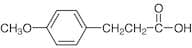
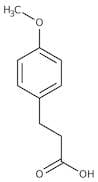
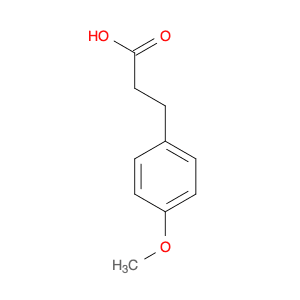
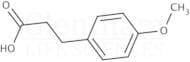
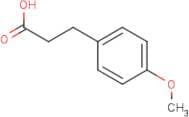
Ácido 3-(4-metoxifenil)propiónico, con el número CAS 1929-29-9, es un compuesto orgánico caracterizado por su estructura de ácido propiónico sustituido con un grupo 4-metoxifenilo. Este compuesto típicamente aparece como un sólido cristalino blanco a blanco sucio. Es soluble en disolventes orgánicos como etanol y metanol, pero tiene una solubilidad limitada en agua. La presencia del grupo metoxi mejora su lipofilia, lo que puede influir en su actividad biológica e interacciones. El compuesto exhibe propiedades ácidas debido al grupo funcional ácido carboxílico, lo que le permite participar en varias reacciones químicas, incluyendo esterificación y amidación. También puede exhibir actividades farmacológicas potenciales, lo que lo hace de interés en la química medicinal. Además, sus características estructurales sugieren que podría participar en enlaces de hidrógeno e interacciones de apilamiento π-π, que son relevantes en sistemas biológicos. En general, Ácido 3-(4-metoxifenil)propiónico es un compuesto versátil con aplicaciones en investigación y posibles usos terapéuticos.
Fórmula:C10H12O3
InChI:InChI=1S/C10H12O3/c1-13-9-5-2-8(3-6-9)4-7-10(11)12/h2-3,5-6H,4,7H2,1H3,(H,11,12)
Clave InChI:InChIKey=FIUFLISGGHNPSM-UHFFFAOYSA-N
SMILES:C(CC(O)=O)C1=CC=C(OC)C=C1
Sinónimos:- 3-(2-Methoxyphenyl)Propanoic Acid
- 3-(4-Methoxyphenyl)Propanoate
- 3-(4-Methoxyphenyl)Propanoic Acid
- 3-(p-Methoxyphenyl)propanoic acid
- 3-(p-Methoxyphenyl)propionic acid
- 3-[4-(Methyloxy)phenyl]propanoic acid
- 4-Methoxybenzenepropanoic acid
- 4-Methoxyhydrocinnamic acid
- 4-Methoxyphenylpropiinic Acid
- Benzenepropanoic acid, 4-methoxy-
- Hydrocinnamic acid, p-methoxy-
- NSC 33134
- NSC 51509
- p-Methoxybenzenepropionic acid
- p-Methoxyhydrocinnamic acid
- Ver más sinónimos
Ordenar por
Pureza (%)
0
100
|
0
|
50
|
90
|
95
|
100
Encontrado 8 productos.
3-(4-Methoxyphenyl)propionic Acid
CAS:Fórmula:C10H12O3Pureza:>98.0%(GC)(T)Forma y color:White to Light yellow to Light orange powder to crystalPeso molecular:180.203-(4-Methoxyphenyl)propionic acid, 98%
CAS:This Thermo Scientific Chemicals brand product was originally part of the Alfa Aesar product portfolio. Some documentation and label information may refer to the legacy brand. The original Alfa Aesar product / item code or SKU reference has not changed as a part of the brand transition to Thermo SciFórmula:C10H12O3Pureza:98%Forma y color:White to cream to brown, Crystalline powder or powderPeso molecular:180.20Benzenepropanoic acid, 4-methoxy-
CAS:Fórmula:C10H12O3Pureza:97%Forma y color:SolidPeso molecular:180.20053-(4-Methoxyphenyl)propanoic acid
CAS:3-(4-Methoxyphenyl)propanoic acidPureza:98%Peso molecular:180.20g/mol3-(4-Methoxyphenyl)propanoic acid
CAS:3-(4-Methoxyphenyl)propanoic acid is a useful organic compound for research related to life sciences.Fórmula:C10H12O3Forma y color:SolidPeso molecular:180.2033-(4-Methoxyphenyl)propionic acid
CAS:3-(4-Methoxyphenyl)propionic acid is a nutrient solution that can be used to inhibit microbial growth by binding to the active site of enzymes such as carbonyl group, formation rate, acidic ph, chlorogenic acids, cinnamic acid derivatives. 3-(4-Methoxyphenyl)propionic acid has been shown to react with hydrogen bond and diltiazem hydrochloride in surface methodology experiments. This compound has also been shown to have activity against cavity microorganisms, including Streptococcus mutans and Lactobacillus acidophilus.
Fórmula:C10H12O3Pureza:Min. 95%Forma y color:PowderPeso molecular:180.2 g/mol3-(4-Methoxyphenyl)propionic acid
CAS:Fórmula:C10H12O3Pureza:97%Forma y color:SolidPeso molecular:180.203