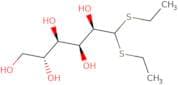
CAS 1941-52-2
:D-Glucosa, dietil ditioacetal
Descripción:
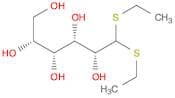
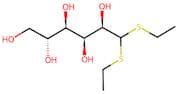
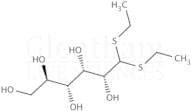
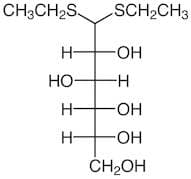
D-Glucosa, dietil ditioacetal es un compuesto químico caracterizado por su estructura, que incluye un moiety de glucosa modificado con grupos ditiocetales de dietilo. Esta modificación mejora su estabilidad y solubilidad en disolventes orgánicos, haciéndolo útil en diversas aplicaciones químicas, particularmente en síntesis orgánica y química de carbohidratos. La presencia de grupos ditiocetales permite la protección del grupo funcional aldehído de la glucosa, facilitando transformaciones químicas adicionales sin el riesgo de oxidación. Este compuesto típicamente aparece como un líquido incoloro a amarillo pálido y tiene una volatilidad relativamente baja. Su reactividad está influenciada por los grupos ditiocetales, que pueden sufrir escisión bajo condiciones específicas, liberando la estructura original de glucosa. D-Glucosa, dietil ditioacetal se utiliza a menudo en la síntesis de glicosidos y otros derivados, sirviendo como un intermediario versátil en la preparación de compuestos más complejos a base de carbohidratos. Al igual que muchos compuestos organosulfurados, debe manejarse con cuidado debido a su potencial toxicidad y reactividad.
Fórmula:C10H22O5S2
InChI:InChI=1S/C10H22O5S2/c1-3-16-10(17-4-2)9(15)8(14)7(13)6(12)5-11/h6-15H,3-5H2,1-2H3/t6-,7-,8+,9-/m1/s1
Clave InChI:InChIKey=BTOYCPDACQXQRS-LURQLKTLSA-N
SMILES:C([C@@H]([C@H]([C@@H]([C@@H](CO)O)O)O)O)(SCC)SCC
Sinónimos:- (2R,3R,4R,5R)-6,6-bis(ethylsulfanyl)hexane-1,2,3,4,5-pentol (non-preferred name)
- (2R,3R,4R,5S)-6,6-bis(ethylsulfanyl)hexane-1,2,3,4,5-pentol (non-preferred name)
- (2R,3R,4S,5R)-6,6-bis(ethylsulfanyl)hexane-1,2,3,4,5-pentol (non-preferred name)
- (2R,3R,4S,5S)-6,6-bis(ethylsulfanyl)hexane-1,2,3,4,5-pentol (non-preferred name)
- 6,6-Bis(Ethylsulfanyl)Hexane-1,2,3,4,5-Pentol (Non-Preferred Name)
- <span class="text-smallcaps">D</span>-Glucose, diethyl dithioacetal
- <span class="text-smallcaps">D</span>-Glucose, diethyl mercaptal
- Glucose diethyl mercaptal
- NSC 19773
- NSC 8521
- D-glucose diethyl mercaptal
- D-(-)-Glucose diethyl mercaptal
- D-Glucose, diethyl mercaptal
- Ver más sinónimos
Ordenar por
Pureza (%)
0
100
|
0
|
50
|
90
|
95
|
100
Encontrado 6 productos.
D-Glucose Diethyl Mercaptal
CAS:Fórmula:C10H22O5S2Pureza:98%Forma y color:SolidPeso molecular:286.4087(2R,3R,4S,5R)-6,6-Bis(Ethylthio)Hexane-1,2,3,4,5-Pentaol
CAS:(2R,3R,4S,5R)-6,6-Bis(Ethylthio)Hexane-1,2,3,4,5-PentaolPureza:>98.0%Peso molecular:286.41g/molD-Glucose Diethyl Mercaptal
CAS:Fórmula:C10H22O5S2Pureza:>98.0%(GC)Forma y color:White to Light yellow powder to crystalPeso molecular:286.40D-Glucose diethyl mercaptal
CAS:D-Glucose diethyl mercaptal is a homogeneous catalyst that can be used to acetylate galactitol to produce D-arabinose. It acts as an efficient and selective catalyst for the reaction of nitrous acid with hydrochloric acid, which produces acetyl chloride. Acetyl chloride is a reactive compound that can be used in the synthesis of many other compounds. D-Glucose diethyl mercaptal has been used in chromatographic methods to separate d-arabinose from L-arabinose. The ring-opening polymerization of D-glucopyranose by mercaptals leads to the formation of polyols, which are useful materials for the production of plastics and rubber products. Chloride ions are required for this reaction, while hydrogen chloride is produced as a byproduct.Fórmula:C10H22O5S2Pureza:Min. 95%Peso molecular:286.41 g/mol