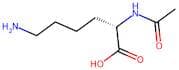
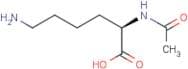
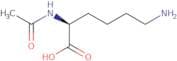
CAS 1946-82-3
:N-acetil-L-lisina
Descripción:
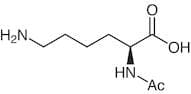
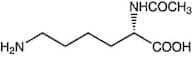
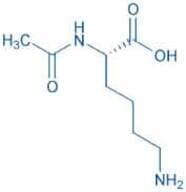
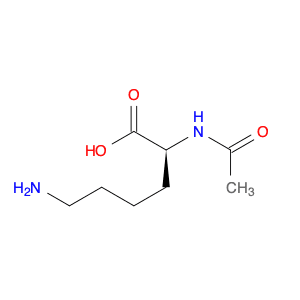
N-acetil-L-lisina es un derivado del aminoácido L-lisina, caracterizado por la adición de un grupo acetilo al grupo amino de la lisina. Esta modificación mejora su solubilidad en agua y altera su actividad biológica. La fórmula molecular de N-acetil-L-lisina es C₆H₁₄N₂O₂, y tiene un peso molecular que refleja su composición de carbono, hidrógeno, nitrógeno y oxígeno. Este compuesto se utiliza a menudo en investigaciones bioquímicas y tiene aplicaciones potenciales en nutrición y farmacéutica, particularmente en estudios relacionados con la síntesis de proteínas y el metabolismo. Se sabe que N-acetil-L-lisina juega un papel en varios procesos fisiológicos, incluyendo actuar como precursor para la síntesis de proteínas acetiladas. Se considera generalmente seguro para su uso en suplementos dietéticos y aplicaciones de investigación. Al igual que con muchos derivados de aminoácidos, es importante manejar N-acetil-L-lisina con cuidado, siguiendo los protocolos de seguridad apropiados para garantizar un uso adecuado en entornos de laboratorio.
Fórmula:C8H16N2O3
InChI:InChI=1S/C8H16N2O3/c1-6(11)10-7(8(12)13)4-2-3-5-9/h7H,2-5,9H2,1H3,(H,10,11)(H,12,13)/t7-/m0/s1
Clave InChI:InChIKey=VEYYWZRYIYDQJM-ZETCQYMHSA-N
SMILES:[C@@H](CCCCN)(NC(C)=O)C(O)=O
Sinónimos:- (2S)-2-Acetamido-6-aminohexanoic acid
- (2S)-6-Amino-2-acetamidohexanoic acid
- 6-Amino-<span class="text-smallcaps">L</span>-2-acetamidohexanoic acid
- <span class="text-smallcaps">L</span>-Lysine, N<sup>2</sup>-acetyl-
- Ac-Lys-Oh
- Lysine, N<sup>2</sup>-acetyl-, <span class="text-smallcaps">L</span>-
- N(alpha)-Acetyllysine
- N-Acetyl-<span class="text-smallcaps">L</span>-lysine
- N-acetyl-L-lysine
- N-alpha-Acetyl-L-lysine
- N<sup>2</sup>-Acetyl-<span class="text-smallcaps">L</span>-lysine
- N<sup>2</sup>-Acetyllysine
- N<sup>α</sup>-Acetyl-<span class="text-smallcaps">L</span>-lysine
- N<sup>α</sup>-Acetyllysine
- N~2~-acetyl-L-lysine
- Nα-Acetyl-L-lysine
- Lysine, N2-acetyl-, L-
- Nα-Acetyllysine
- N2-Acetyl-L-lysine
- Ver más sinónimos
Ordenar por
Pureza (%)
0
100
|
0
|
50
|
90
|
95
|
100
Encontrado 12 productos.
Nα-Acetyl-L-lysine
CAS:Fórmula:C8H16N2O3Pureza:>97.0%(T)(HPLC)Forma y color:White to Almost white powder to crystalinePeso molecular:188.23N(α)-Acetyl-L-lysine, 99%
CAS:N-Acetyl-L-lysine is a biologically available N-terminal capped form of the proteinogenic amino acid L-lysine. N-Acetyl-L-lysine is a substrate used to study and characterize lysyl oxidize(s). This Thermo Scientific Chemicals brand product was originally part of the Alfa Aesar product portfolio. SoFórmula:C8H16N2O3Pureza:99%Peso molecular:188.2Ac-Lys-OH
CAS:Bachem ID: 4000486.
Fórmula:C8H16N2O3Pureza:≥99%Forma y color:White PowderPeso molecular:188.23Acetyl-L-lysine
CAS:Acetyl-L-lysine: N-acetylated amino acid, normally found in trace urine amounts, elevated in aminoacylase I deficiency.Fórmula:C8H16N2O3Pureza:99.40% - 99.83%Forma y color:SolidPeso molecular:188.22Nalpha-Acetyl-L-Lysine
CAS:Applications Nα-Acetyl-L-Lysine is an antibacterial lysine analogue that targets lysine riboswitches. Nα-Acetyl-L-Lysine is used in the metabolomic characterization of ovarian epithelial carcinomas which allows for better therapeutic management of patients. The presence of Nα-Acetyl-L-Lysine and other N-acetylated amino acids in the urine can be used to detect aminoacylase I deficiency.
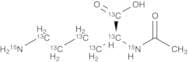
References Gerlo, E. et al.: Anal. Chim. Acta, 571, 191 (2006); Ben Sellem, D. et al.: J. Oncol., 174019, 9 (2011); Blount, K.F. et al.: Nat. Chem. Biol., 3, 44 (2007);Fórmula:C8H16N2O3Forma y color:NeatPeso molecular:188.22Nα-Acetyl-L-Lysine-13C6,15N2
CAS:Producto controladoFórmula:C6C2H1615N2O3Forma y color:NeatPeso molecular:196.167N-α-Acetyl-L-lysine
CAS:N-alpha-Acetyl-L-lysine is a reactive chemical that is used as an analytical method to measure the amount of aminotransferase activity in tissue samples. It reacts with the enzyme and produces a characteristic color change that can be quantified. This compound has been shown to cause lung damage in rats after inhalation and has been studied as a model system for bronchiolitis obliterans, which is caused by exposure to sulfur dioxide gas. N-alpha-Acetyl-L-lysine also binds to monoclonal antibody, which may lead to inhibition of protein synthesis. Titration calorimetry experiments have revealed a reaction mechanism for this compound involving the formation of a hydroxyl group from acetaldehyde via an intermediate hydroxide ion.Fórmula:C8H16N2O3Pureza:Min. 95%Peso molecular:188.22 g/mol